Traditional Music · UNESCO Heritage
Xi'an Drum Music
A Thousand-Year Symphony of the Tang Dynasty
A Thousand-Year Symphony of the Tang Dynasty
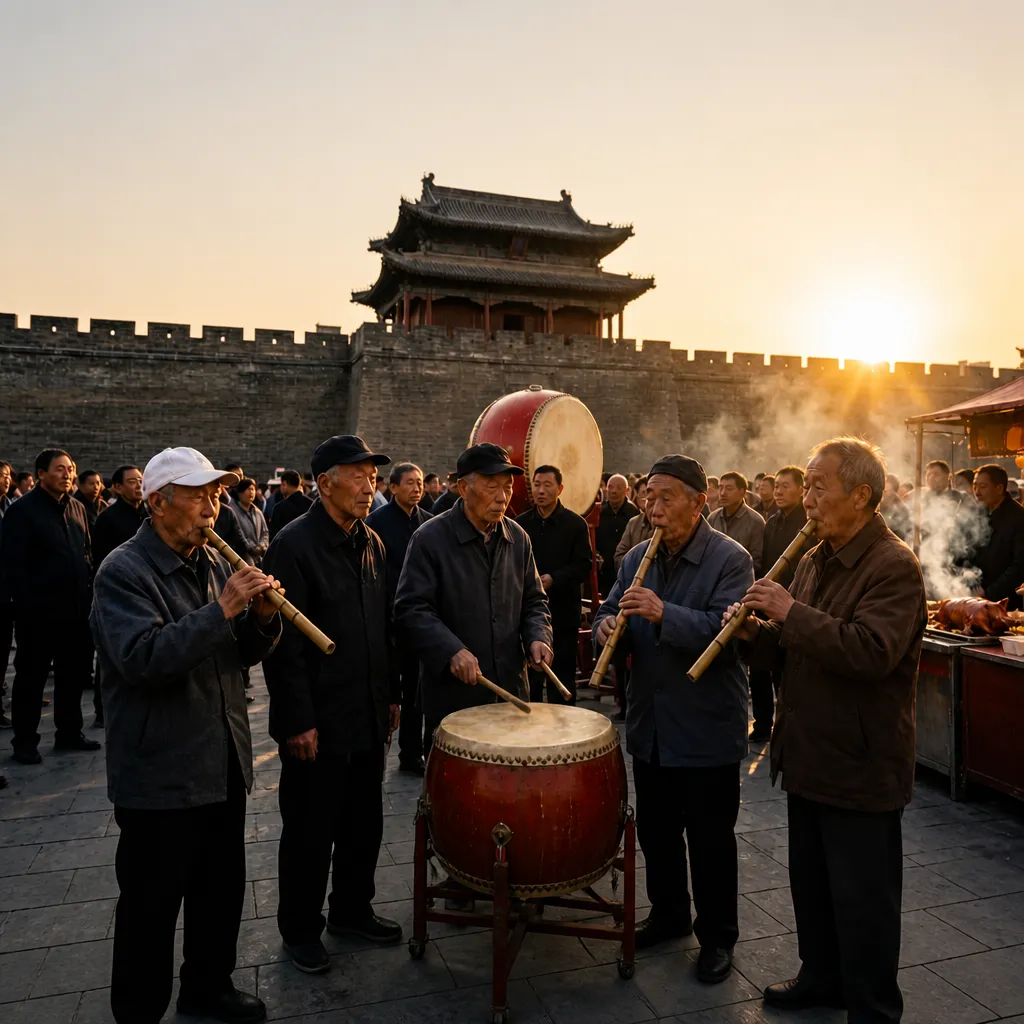
In a narrow alley in Xi'an, not far from the City God Temple, the sound of heavy drumming and a sharp, clear flute spill from an ordinary-looking courtyard. An old man carrying groceries stops in his tracks. A young man on an e-scooter brakes and turns his head. The music sounds ancient — as if it has traveled a long distance through time to arrive here.
This music is called Xi'an Drum Music (西安鼓乐). It is over 1,300 years old, born in the Tang Dynasty imperial palace as court banquet music. When the dynasty fell, court musicians scattered across the country, carrying this music with them. They passed it down through generations — father to son, master to disciple — keeping the Tang Dynasty's soundtrack alive in the narrow alleys of Xi'an.
In 2009, UNESCO inscribed Xi'an Drum Music on the Representative List of the Intangible Cultural Heritage of Humanity. Today, you can still hear it live in Xi'an, performed exactly as it was played for emperors more than a millennium ago.
When the Tang Dynasty ruled, its emperors governed from the Daming Palace — the largest palace complex on Earth at the time, four and a half times the size of the Forbidden City in Beijing. Inside its walls, a music bureau called the "Pear Garden" (梨园) trained thousands of court musicians and dancers. Emperor Xuanzong himself — a poet, calligrapher, and composer — personally taught and composed for the Pear Garden.
Tang court music was grand, complex, and deeply ceremonial. It combined influences from across Asia — Indian melodies, Central Asian rhythms, Persian instruments — reflecting the cosmopolitan nature of Tang Chang'an, the world's largest and most international city. Xi'an Drum Music is the only surviving form of this court music repertoire.
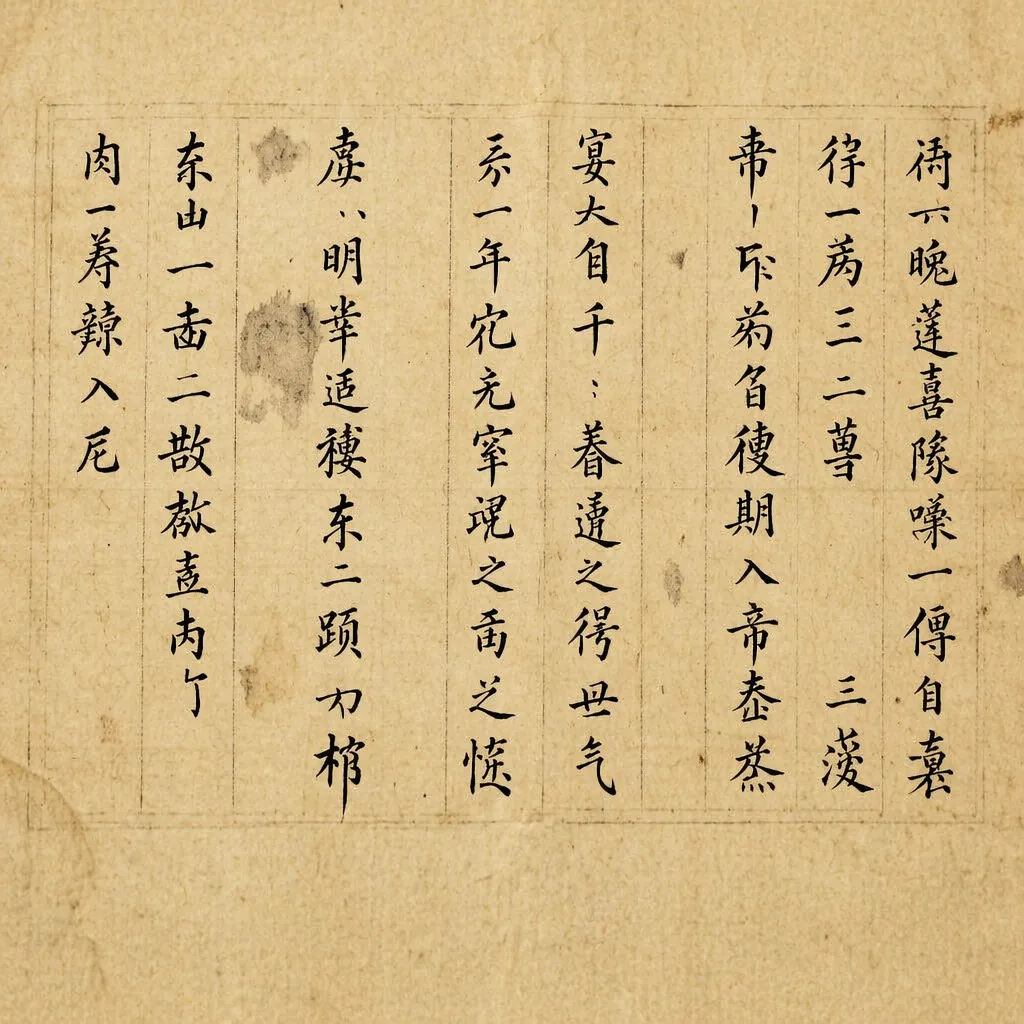
The notation system used by Xi'an Drum Music — handed down through generations, unreadable to most modern musicians
What makes Xi'an Drum Music extraordinary is its notation system — a script that looks more like Chinese characters than musical notes. This is "gongche notation" (工尺谱), a traditional Chinese musical writing system that uses characters to represent pitches. Senior musicians must teach younger players to read these scores by rote, passing down not just the notes but the specific way each note should bend and breathe — knowledge that can only be transmitted in person, ear to ear.
The drums themselves are also special. Xi'an Drum Music uses "seat drums" (坐鼓) and "standing drums" (立鼓), each with a distinct timbre. The seat drum, placed horizontally in front of the seated musician, produces a deep, resonant sound; the standing drum, tall and narrow, gives a sharper, more penetrating beat. Together with gongs, cymbals, flutes, and sheng (mouth organs), they create a layered sonic tapestry that fills a courtyard and spills into the alleys beyond.
Xi'an Drum Music is not a museum piece. It is still performed regularly — and you can hear it.
The most authentic place is the Drum Music Performance Hall at the City God Temple (城隍庙) in central Xi'an. On most weekends, the elderly musicians of the City God Temple Drum Music Society take their seats, adjust their robes, and begin to play. The audience sits on wooden benches in a centuries-old hall. No amplifiers, no stage lights — just the raw sound of gongs, drums, and flutes filling the ancient space.
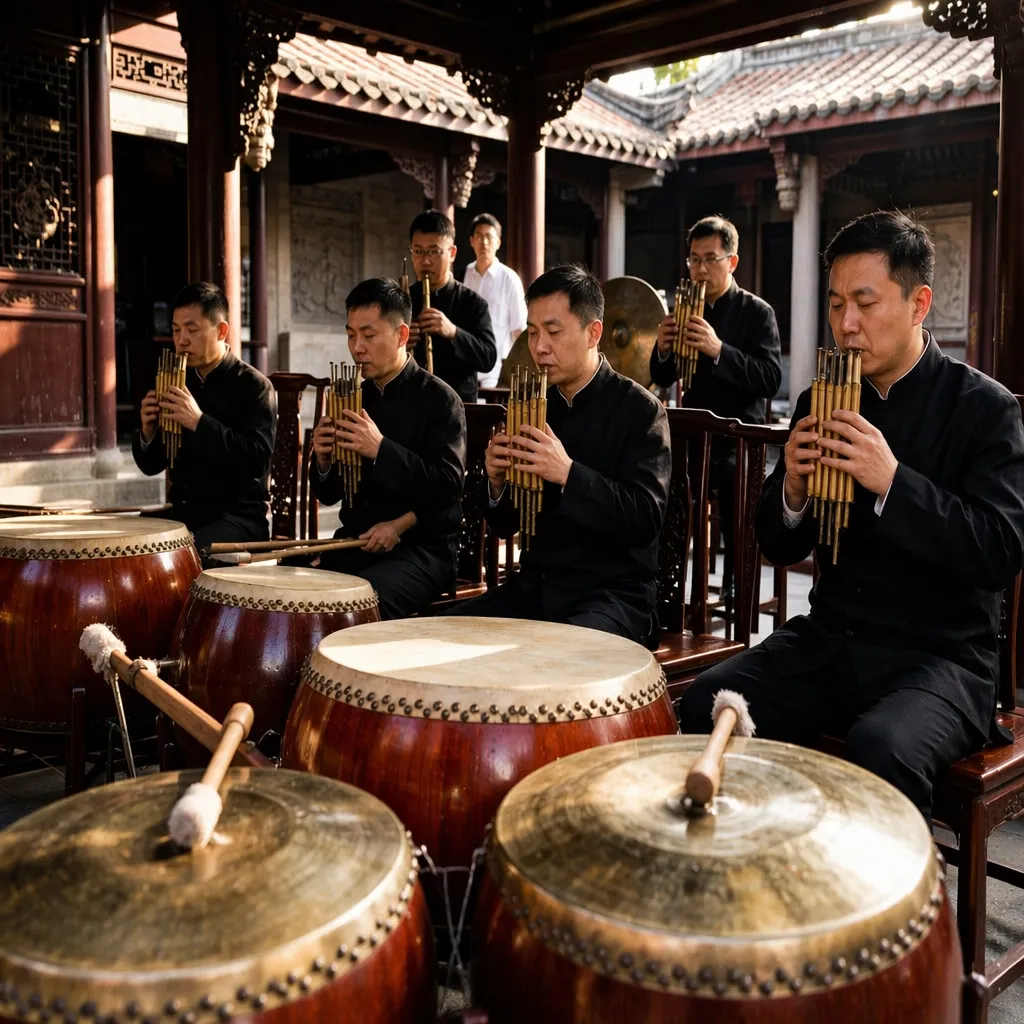
The audience sits on wooden benches in a centuries-old hall — no amplifiers, no stage lights, just the music
Another venue is the Xi'an Drum Music Museum in the Daming Palace National Heritage Park. Here, in addition to performances, you can see ancient scores, traditional instruments, and learn about the music's history. The museum is built on the site of the Tang Dynasty palace, where the first court musicians once played.
For the full experience, visit the Zhengyuan Temple (荐福寺) in Xi'an, where a drum music society has performed continuously since the Ming Dynasty. The temple's small performance hall holds about 80 people. When the drumming starts, the ancient beams of the hall vibrate, and you feel the sound in your chest — the same vibration that Tang Dynasty audiences felt thirteen centuries ago.
• City God Temple Drum Music: Weekend performances. Temple entrance is free, performances ~50-100 RMB. Address: West Street, Beilin District, Xi'an.
• Daming Palace Museum: Xi'an Drum Music performances on select days. Museum ticket: 60 RMB. Address: 585 Ziqiang North Road, Xi'an.
• Best time to visit: Spring and autumn for comfortable weather. Combine with a visit to the Xi'an City Wall and Shaanxi History Museum.
• Travel: Take Xi'an Metro Line 2 to Zhonglou Station for City God Temple; Line 4 to Daming Palace Station for the museum.
When you listen to Xi'an Drum Music — when the first drumbeat rolls and the flute enters like a voice climbing an ancient stairway — you are hearing exactly what Tang Dynasty emperors heard. The same notes. The same rhythms. The same vibration in your chest. In a country where so much has changed in thirteen centuries, the fact that this music still exists, still played by elderly musicians in a back-alley courtyard in Xi'an, is itself a kind of miracle.
The French sinologist Jacques Pimpaneau once wrote: "To listen to Xi'an Drum Music is to hear the echo of the Tang Dynasty — the golden age of Chinese civilization, whose poetry and music defined what it meant to be cultured."
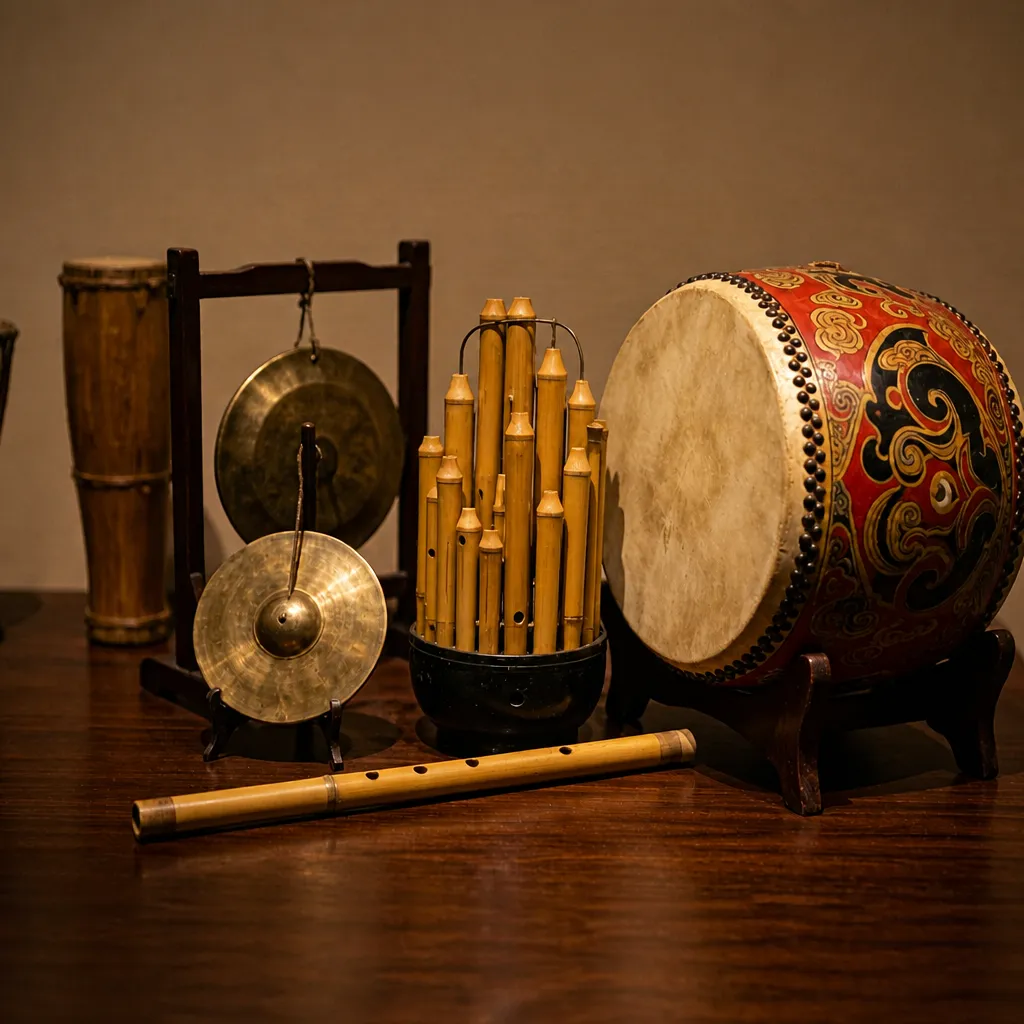
The instruments of Xi'an Drum Music — drums, gongs, and flutes that have sounded for thirteen centuries
Of ten thousand songs and countless dances, the favorite of poets and emperors was the Rainbow Skirt Dance — a piece composed by Emperor Xuanzong himself, inspired by a melody he heard in a dream. While that particular dance has been lost to time, the music that accompanied it — Xi'an Drum Music — is still with us. Still playing in a narrow alley in Xi'an. Still waiting for you to stop and listen.