Romance Through the Ages · Love Stories
The Legend of the White Snake
China's Most Romantic Mythological Love Story
Bai Suzhen was a white snake who had cultivated for a thousand years. She came to Hangzhou and fell in love with a mortal named Xu Xian. A story of love across species, a mother who fought heaven itself — this is the most cherished romance in Chinese mythology.
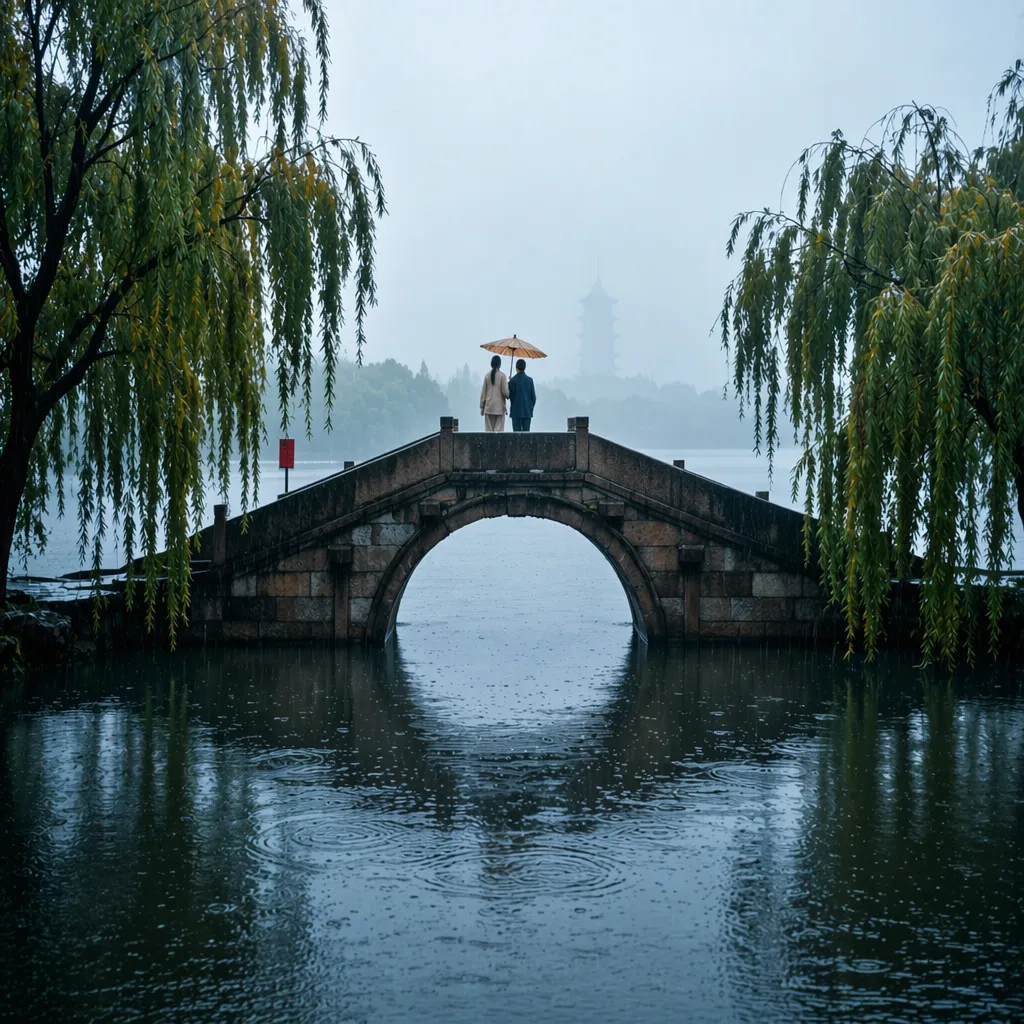
Rain in Hangzhou comes without warning. A moment ago the sky was clear, and then, suddenly, raindrops patter onto the surface of West Lake, creating a dense web of expanding ripples that merge into the mist. In the distance, Leifeng Pagoda fades to a hazy silhouette in the rain and fog, a gray shape barely visible against the skyline. Wind sweeps across the lake, carrying moisture that cools your face. Your sleeves and pant legs quickly grow wet, clinging to your skin with a refreshing chill. The air smells of lake water and earth — fresh, like newly turned wetland.
People on the Broken Bridge don't run for shelter. Some open umbrellas; others walk slowly in the rain. Couples huddle under one umbrella, shoulders pressed together. The sound of rain on the umbrella is muffled, like fingers gently drumming on a drum. A thousand years ago, it was also a rainy day, also this bridge. A young man handed an umbrella to a woman in white. And so, a story spanning a thousand years began.
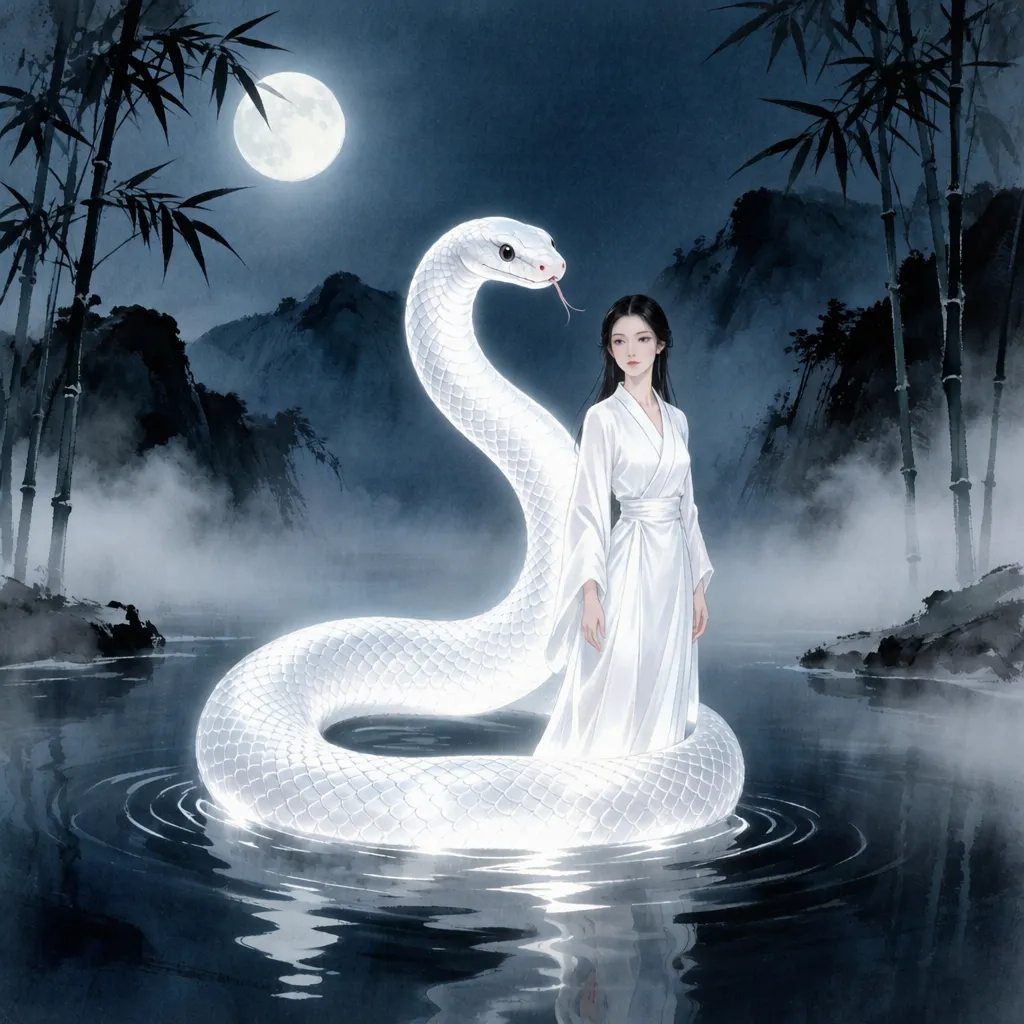
Bai Suzhen after a thousand years of cultivation — she looked at her reflection and gave herself a human name
Bai Suzhen was a white snake who had cultivated for a thousand years. Over that time, she transformed from a cold-blooded creature into a human form. She gave herself the name Bai Suzhen. When her companion Xiao Qing asked what was so good about the mortal world, she answered with two words: to have feelings, to love.
She came to Hangzhou and met a young man named Xu Xian on the Broken Bridge. Xu Xian was an honest apprentice at a medicine shop, soft-spoken, who would scratch his head when he laughed. That day it suddenly rained, and Bai Suzhen lent him an oil-paper umbrella — the bamboo ribs were covered with peach-blossom paper, which smelled faintly of tung oil when opened. When he took the umbrella, his fingers brushed her hand — her skin was warm, human-warm. Both paused. The rain was loud, yet neither heard it. The back of Xu Xian's ears turned red; Bai Suzhen lowered her head. Xiao Qing giggled beside them.
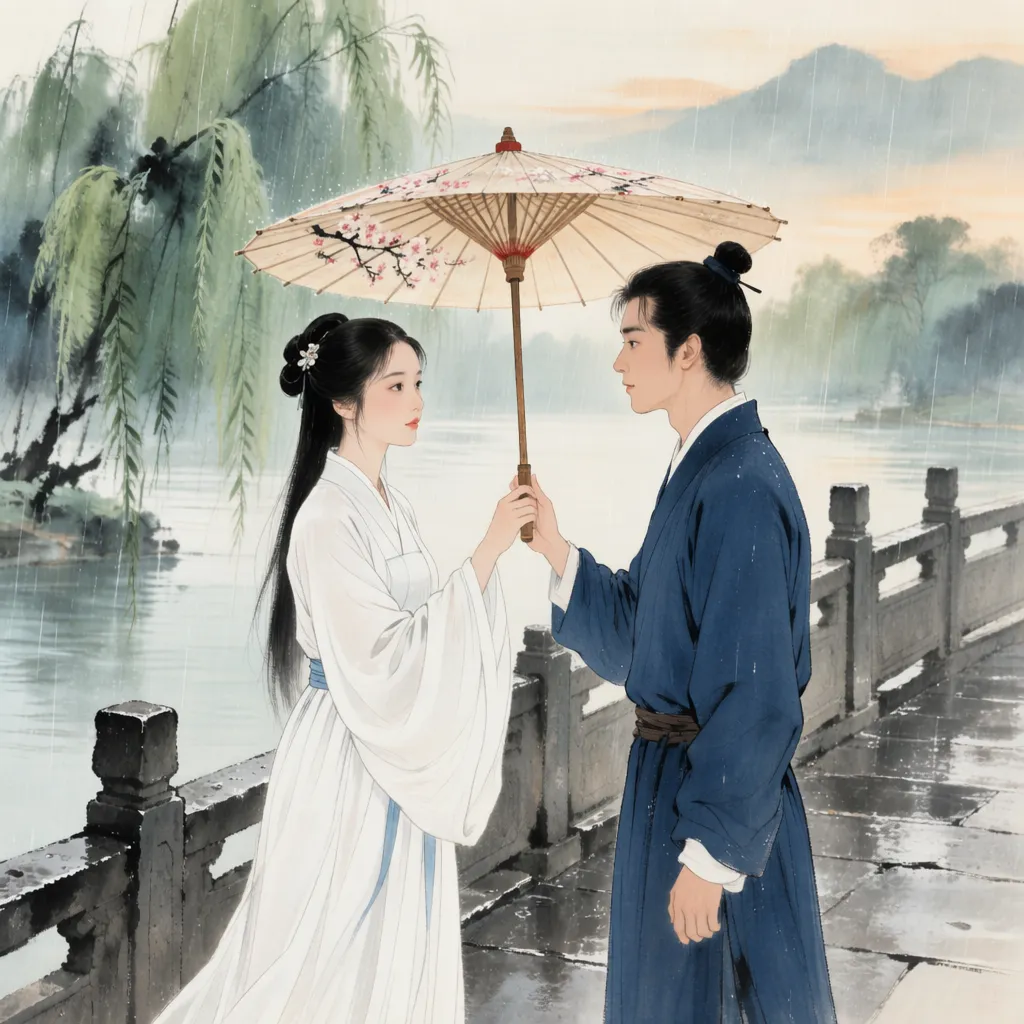
"Borrowing an Umbrella at the Broken Bridge" — the most famous romantic scene in Chinese folklore
They married, opened a medicine shop, and lived a peaceful, good life. Bai Suzhen was a skilled doctor who never charged the poor for treatment. Their shop became famous, and the neighbors all loved her — she gave medicine free to children with fevers, visited elderly neighbors with leg pains, and did everything a human should do, except she wasn't human.
The oil-paper umbrella is a traditional craft that has been made in Hangzhou for over a thousand years. You can still make one at a workshop by West Lake — shaving bamboo ribs, pasting paper, painting peach blossoms. When you open it, the peach blossoms on the umbrella shine through in the light, pink and delicate. This is exactly the umbrella that Xu Xian gave to Bai Suzhen.
But then a monk named Fahai appeared. He said Bai Suzhen was a snake spirit, and humans and demons cannot be together. He told Xu Xian to give Bai Suzhen a special herbal wine on the Dragon Boat Festival — a brew so pungent that opening the bottle filled the entire room with its sharp, medicinal smell. Bai Suzhen took one sip and couldn't hold her form — she transformed back into a snake. Xu Xian saw the white snake on the bed and fainted on the spot. He never woke up.
When Bai Suzhen woke, Xu Xian's body was already cold. Without hesitation, she flew to Mount Kunlun to steal the magical mushroom that could bring the dead back to life. The journey was three thousand miles; the wind cut her face like a knife, and her palms and feet bled from the effort. When she stole the mushroom, mountain guardians blocked her. She fought, her clothes torn, hair loose — but she got the herb. Xu Xian came back to life.
But Fahai came again, taking Xu Xian to Jinming Temple and confining him there. Bai Suzhen went to demand his release; Fahai refused.
In desperation, Bai Suzhen summoned the waters of West Lake to flood the temple — waves crashed against the courtyard walls, shattering stone bricks, sending spray three stories high. But she was pregnant and couldn't defeat Fahai. She was captured and sealed beneath Leifeng Pagoda inside a golden bowl.
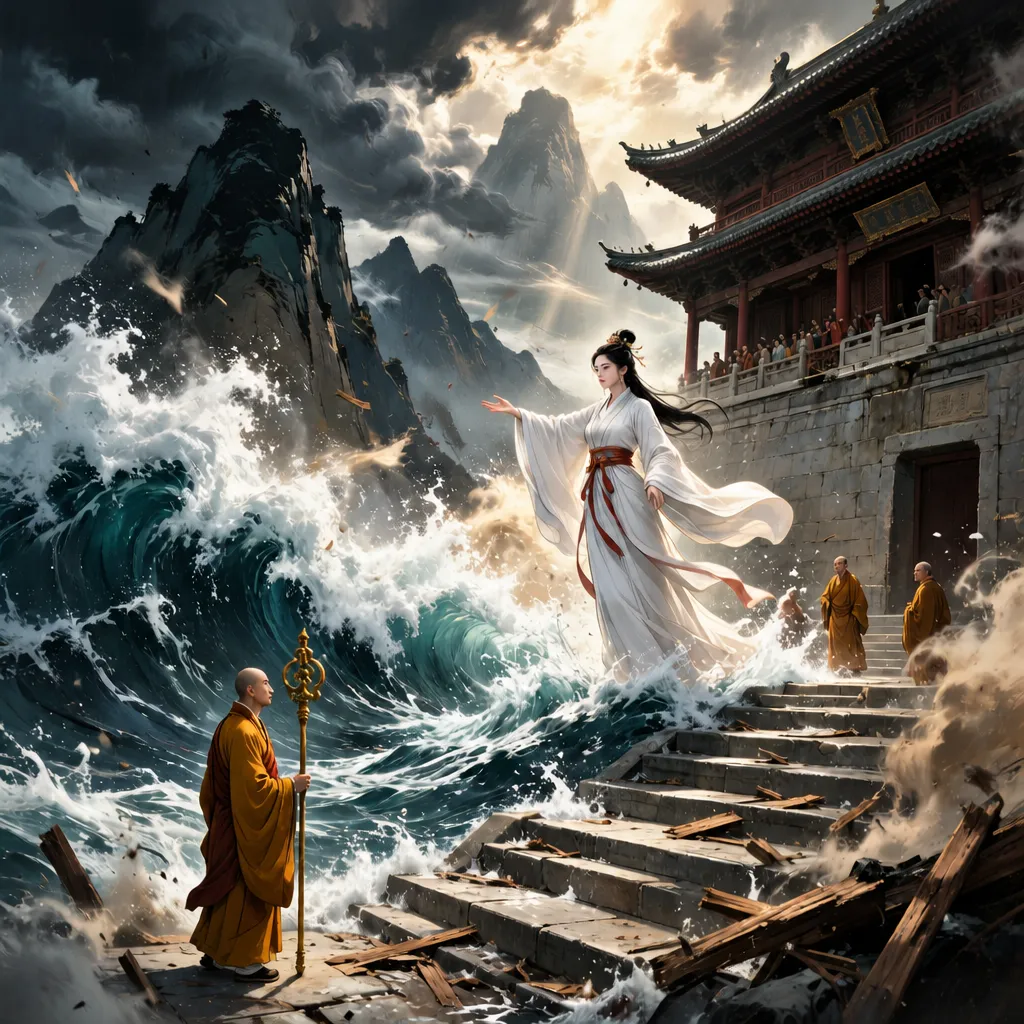
Bai Suzhen summoned the waters of West Lake to flood Golden Mountain Temple — a mother's desperate fight for love
Before the pagoda gate closed, she shouted words that have been sung on Chinese opera stages for centuries: "The mountains and waters of West Lake remain as before... I see the Broken Bridge is not broken, but my heart is broken; my deep love flows east with the water!"
Later, their son grew up, passed the imperial examinations, and came to the pagoda to honor his mother. The tower fell, and Bai Suzhen emerged. The family was finally reunited. But what Chinese people remember most is not the reunion — it's the separation: the last glance Bai Suzhen gave before the gate closed, the trembling hands of Xu Xian as he set up the incense table before the pagoda, and the endless rain on the Broken Bridge.
"The mountains and waters of West Lake remain as before... I see the Broken Bridge is not broken, but my heart is broken; my deep love flows east with the water!"
— White Lady's Aria from the Chinese Opera "The Legend of the White Snake"
Walking south from the Broken Bridge along Bai Causeway through a willow grove, you reach the southern shore of West Lake, where Leifeng Pagoda comes into view. The pagoda is about 71 meters tall, five stories, octagonal, its bronze body gleaming with a muted golden light in the sun. The original pagoda was built in 977 AD and collapsed in 1924. What you see now is the rebuilt version from 2002. Inside the new pagoda lie the ruins of the old one — step onto the glass floor at the ground level, and you can see the thousand-year-old brick foundation, broken into a pile of earth-colored rubble, covered in moss, with dark water pooling in the corners reflecting a dim light. The air smells of damp earth and stone — dry, heavy, like opening a very old book no one has touched in years.
There's an elevator inside the pagoda that takes you directly to the fifth floor. When the doors open, the wind hits you suddenly, blowing your hair into disorder. Standing on the observation deck and turning around, all of West Lake spreads out beneath you — Bai Causeway and Su Causeway are two green lines, one heading east, one west, enclosing a sparkling body of water. Three small stone pagodas rise from the lake surface — those are the ones on the Chinese one-yuan banknote. To the north, a slender pagoda pokes out on the top of Precious Stone Hill, facing Leifeng Pagoda across the distance — Hangzhou people call this "One Lake, Two Pagodas." The distant mountains fade from clear outlines to silhouettes; the skyline is like a rolling wave.
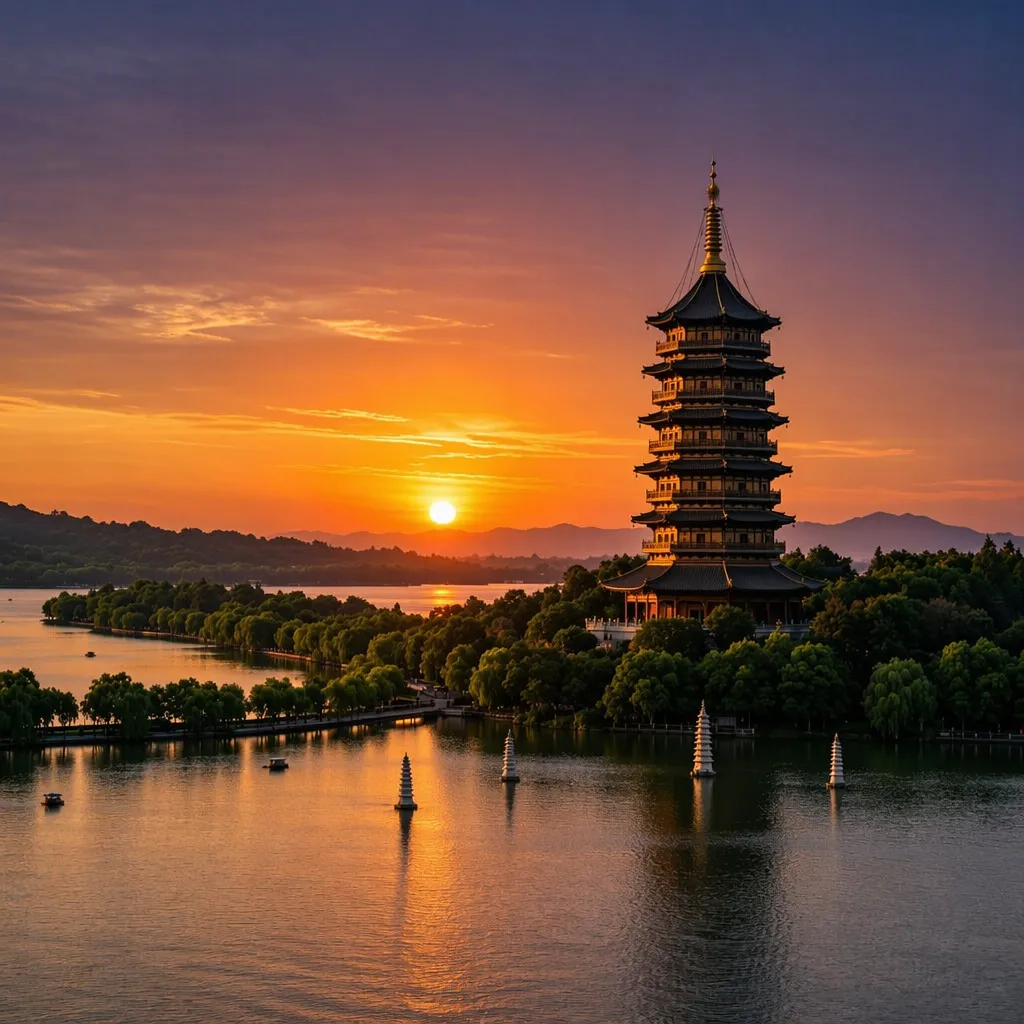
"Leifeng Pagoda in Evening Glow" — the most romantic of the Ten Views of West Lake
Hidden in the pagoda's interior floors is the most worthwhile thing to see: a set of large wood carvings depicting the White Snake story. Eight wood carvings tell the tale from "Borrowing an Umbrella at the Broken Bridge" to "Flooding Golden Mountain" to "Breaking the Pagoda for Reunion." Each scene is vividly carved. Bai Suzhen's sleeves follow the wood grain as if truly caught in the wind. Subtle expressions can be seen on Xu Xian's face — fear, hesitation, reluctance. Fahai's kasaya is covered with intricate lotus patterns. Leaning in close, you can smell the wood itself — dry and warm, like old furniture. Touching the edges of the carvings, the wood is smooth and slightly warm. These carvings use the Dongyang woodcarving technique — one of China's four great woodcarving traditions, with over a thousand years of history, known for rich layers and exquisite craftsmanship.
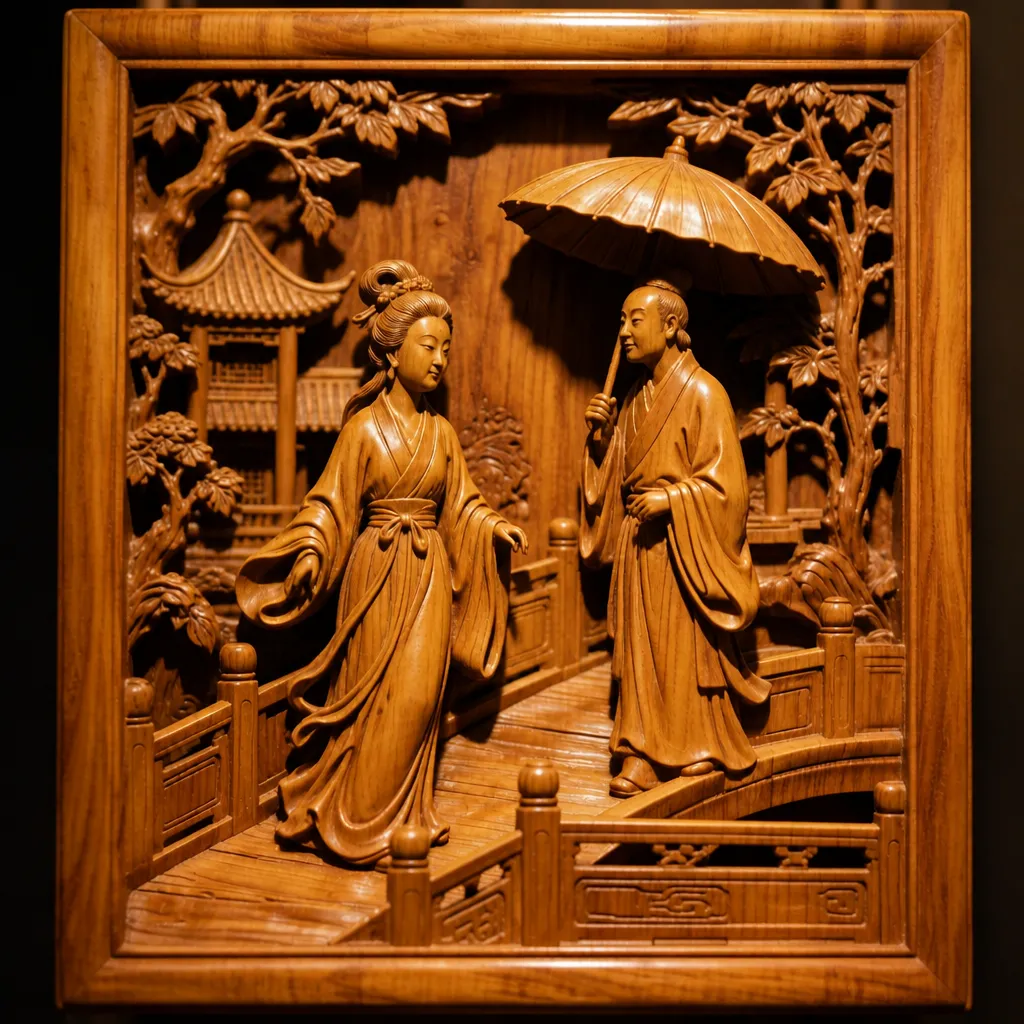
Dongyang wood carvings inside Leifeng Pagoda — a thousand-year story carved into wood
It is recommended to climb the pagoda after 4 PM. As the sun sinks toward the west, golden light breaks through the clouds onto the bronze pagoda, making it glow entirely, mirrored on the lake surface below — one above, one below, like two pagodas kissing. This is "Leifeng Pagoda in Evening Glow" (Leifeng Xizhao) — the most romantic of the Ten Views of West Lake. The sky changes from blue to orange-red to deep purple. At around 5:30 PM, the pagoda lights up. Warm yellow light spills from every window lattice, turning the entire pagoda into a giant lantern, its reflection on the lake shattering into golden fragments on the water.
Since 2025, Leifeng Pagoda offers night tours, with closing time extended to 8 PM. Night wind rises from the lake, carrying the smell of water plants and earth, chillingly cool at the collar. An unforgettable experience.
Today's Broken Bridge is a single-arch stone bridge on West Lake, connecting Bai Causeway to Solitary Mountain. Though called "Broken," it's not actually broken — the bridge is intact. Walking on it, you can feel the stone slabs worn smooth by centuries of footsteps, some places slightly worn down. The stone railings on both sides are low; when you place your hand on them, the stone is cold, with fine, textured lines.
After winter snow, the snow on the bridge melts from the middle first, while both ends remain white. From a distance, the bridge looks as if it's broken in half. Standing on Precious Stone Hill and looking down, the bridge's gray stone slabs emerge from the white snow at both ends like a thin line that breaks and reconnects. This is "Broken Bridge in Snow" (Duanqiao Canxue) — one of the most famous Ten Views of West Lake.
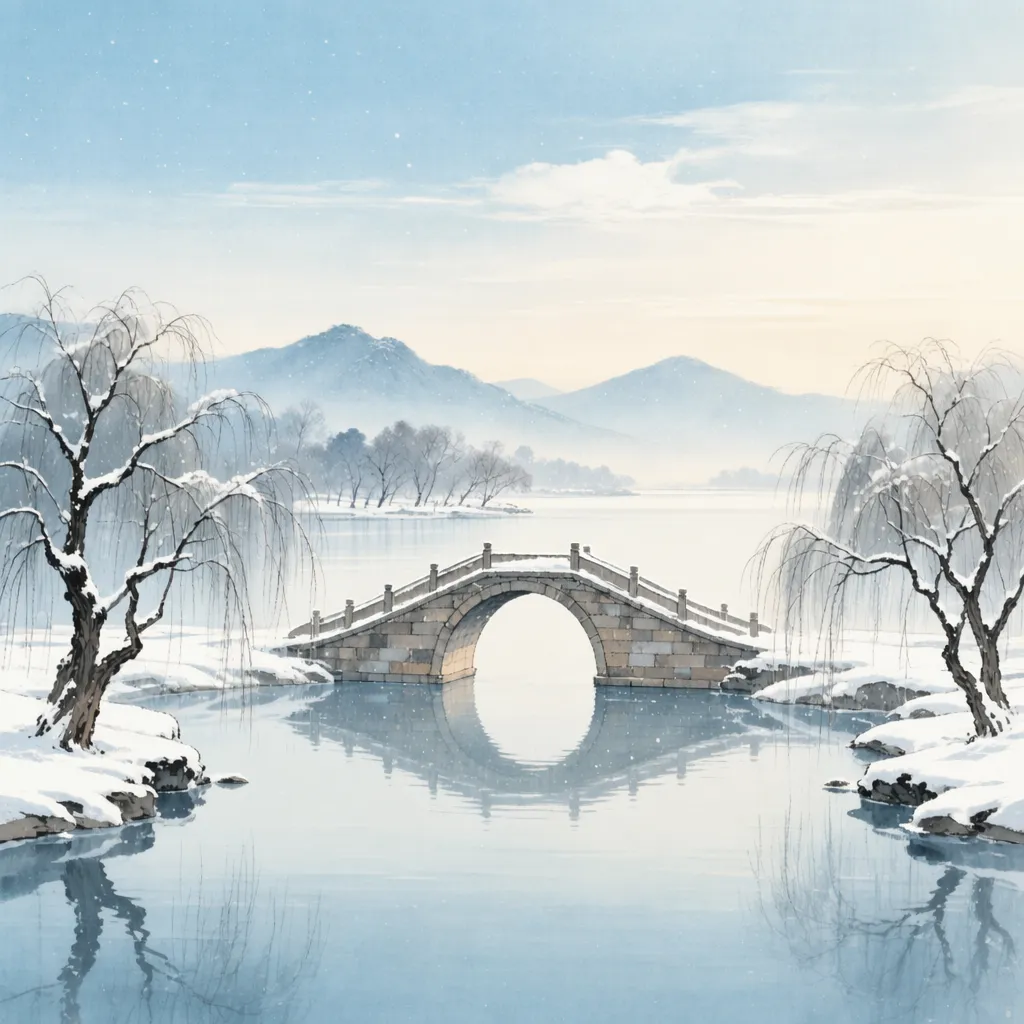
"Broken Bridge in Snow" — one of the Ten Views of West Lake, the bridge appears broken when snow melts from the middle first
But most of the time, the most conspicuous thing on the bridge isn't snow — it's people. In spring, the bridge is crowded — hand-holding couples, tourists taking photos, elderly people leaning on the railings lost in thought, young people in traditional hanfu costumes posing for pictures. The Broken Bridge has one of the highest concentrations of couples in Hangzhou. Some say that walking on the Broken Bridge, even if you don't meet your White Lady, at least you can see all the peach blossoms and willow branches over the lake.
Between 7 and 9 in the morning is the quietest time at the Broken Bridge. The mist hasn't fully cleared; the lake surface is grayish. Occasionally, a hand-rowed boat emerges from beneath the bridge, the oar blades splashing crisply. The boatman stands at the stern, swaying back and forth as he rows. As the boat passes through the bridge arch, you can hear your own footsteps echoing under the vault — an empty, hollow sound, like walking into a giant stone bowl. Standing on the bridge then, the fog obscures everything except the stone slabs beneath your feet and the umbrella in your hand.
"Walking on Broken Bridge at sunrise, with mist on the lake and only the sound of oars in the water — I finally understood why this place inspired a love story."
— Trip.com Foreign Tourist Review
One fact that might surprise you: this story was not originally a love story — it was a horror story. About twelve hundred years ago, during the Tang Dynasty, there was a novella about a scholar who met a beautiful woman in white on the streets of Chang'an and went home with her. On the fourth day, when he returned, his servant smelled a fishy, damp odor on him. That night, the scholar said "I cannot get up," and his lower body dissolved into water. The family found the woman's residence — it was an abandoned garden with a massive white snake coiled in a tree. In that era, snakes were harmful demons, and the story's theme was warning: don't be fooled by appearances.
But over the following centuries, the story changed, little by little. The snake spirit began to have human emotions — she could love, save people, and fight desperately to protect her family. By the Ming Dynasty, four to five hundred years ago, the basic framework was set — White Lady was no longer a harmful demon but a passionate and loyal woman. Then in the 20th century, a line was added: "Even if you are a snake immortal, my heart will not change." For the first time, Xu Xian openly refused Fahai and chose to stand by his wife. The snake didn't change; the people telling the story did. Over a thousand years, fear became understanding, rejection became acceptance. Each era added something to Bai Suzhen: the Tang gave her fear, the Song gave her a tower, the Ming gave her love, and the modern era gave her "my heart will not change." Her snake scales fell off one by one, revealing human skin, human warmth, human tears.
This story is one of China's Four Great Folk Love Legends, along with Liang Shanbo and Zhu Yingtai, Meng Jiangnu Weeping at the Great Wall, and the Cowherd and the Weaver Girl. The White Snake is the boldest — it tells not just love between two humans, but a "non-human" who is willing to give everything to become human, to gain human emotions.
In 1992, a TV series called "New Legend of White Snake" aired, starring Zhao Yazhi as Bai Suzhen, and she became the White Lady in the hearts of an entire generation. The theme song "A Thousand Years of Waiting" — "If fate brings us together, we'll meet even a thousand miles apart; without fate, we can't hold hands even face to face" — is known by almost everyone in China.
In 1834, French sinologist Stanislas Julien translated it into French. In 1958, Japan made an animated film "The White Snake" — a teenager who watched it decided to become an animator. His name is Hayao Miyazaki. In 2011, an English opera "Madame White Snake" won the Pulitzer Prize for Music. In 2025, the Peking Opera version was performed in Stockholm, Sweden, and the Wu Opera version in Vienna, Austria. Almost every culture has snake myths — but in the West, snakes often represent danger and temptation; in this Chinese story, snakes represent love and courage.
From Broken Bridge to Leifeng Pagoda, the walk is about forty minutes. Along Bai Causeway, you'll have lake on both sides. The causeway is lined with willows and peach trees. In spring, when the peach blossoms fall onto the water, fish rise from below to grab the petals, creating small ripples. Willow branches droop to the water's surface; when the wind blows, the leaves brush across the back of your hand, tickling, carrying the fresh scent of broken grass. At the end of Bai Causeway, you can look up and see Leifeng Pagoda.
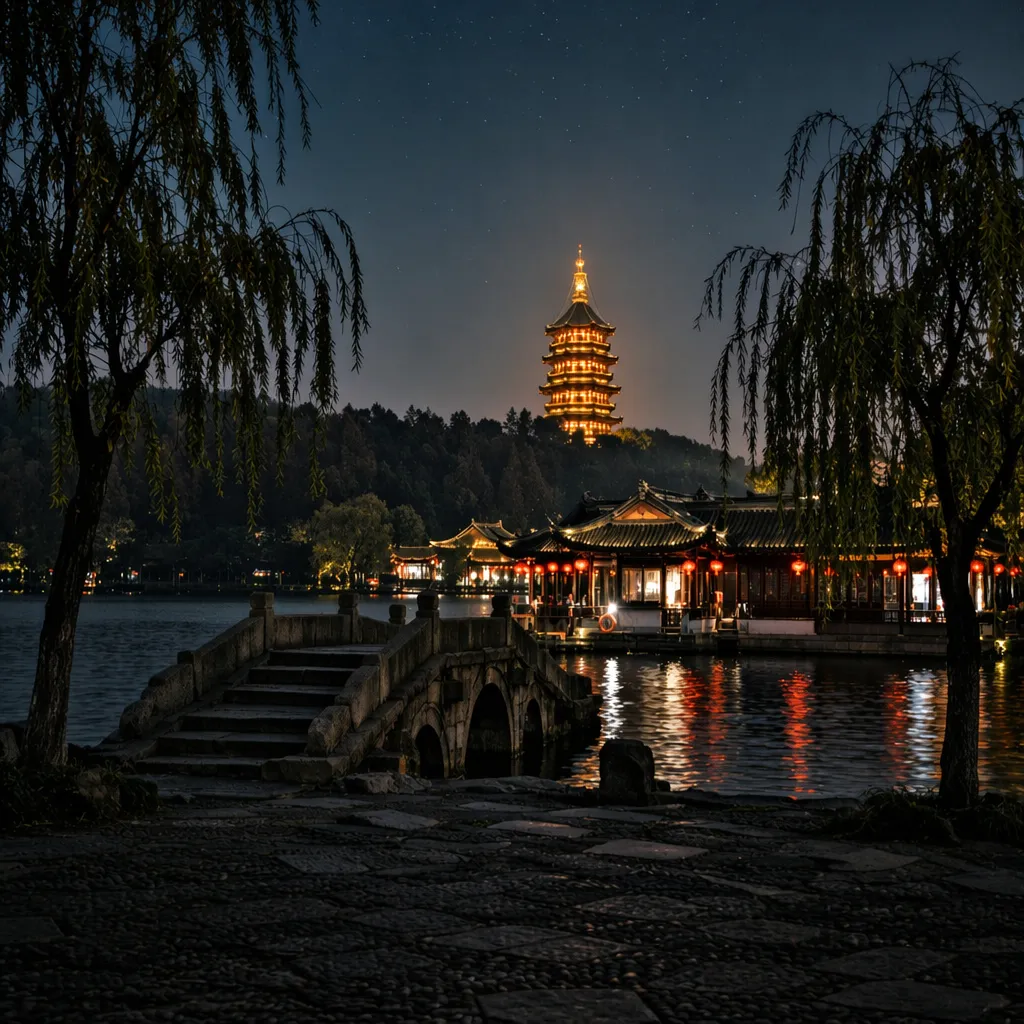
West Lake at night — the same water that witnessed a love story a thousand years ago
A thousand years ago, Bai Suzhen walked this path. She received an umbrella on the Broken Bridge and was sealed beneath Leifeng Pagoda. A thousand years later, this path is filled every day with people — couples, tourists, young women in hanfu costumes taking photos, travelers who brought their children from the other side of the world. The bridge is still that bridge, the pagoda is still that pagoda, the water is still that water. The sound of rain falling on the lake is exactly the same as a thousand years ago.
West Lake was inscribed on the UNESCO World Heritage List in 2011 and receives tens of millions of visitors each year. In 2025, Hangzhou received over 800,000 overnight international tourists, a year-on-year increase of over 20%. Many of them came because of a story.
• Broken Bridge: Free, open all day. Early morning (7-9 AM) offers fewer crowds and beautiful scenery.
• Leifeng Pagoda: Ticket 40 RMB (~$5.50). 8:00-20:00 (May-October peak season). Recommended to climb after 4 PM for sunset and night lighting.
• Transportation: Metro Line 1 to Longxiangqiao Station, then bus.
• Walking route: Broken Bridge to Leifeng Pagoda takes about 40 minutes along Bai Causeway — lake on your left, lake on your right.
• UNESCO: West Lake was inscribed on the UNESCO World Heritage List in 2011.
Come to Hangzhou. Stand on the Broken Bridge and wait for rain — though you may not have to wait; rain in Hangzhou always comes without warning. Climb Leifeng Pagoda once and watch the sunset over the lake. Pause in front of the wood carvings in the interior and see how a thousand-year-old story is carved into wood. Perhaps while walking on Bai Causeway, when the wind blows, willow leaves brush your cheek, and peach petals fall on your shoulder — you'll suddenly understand: why a story from a thousand years ago is still told today, still listened to, still draws people flying from the other side of the world just to stand on that bridge.
The bridge remains; love remains.
A thousand-year love story still waits by West Lake.