Animation · Box Office Record
Ne Zha: How a "Monster" Rewrote Destiny
The $2.26 billion blockbuster that surpassed Titanic
"My fate is mine, not heaven's." — A child labeled a "monster" says this to destiny. And 324 million people bought tickets to hear him say it.
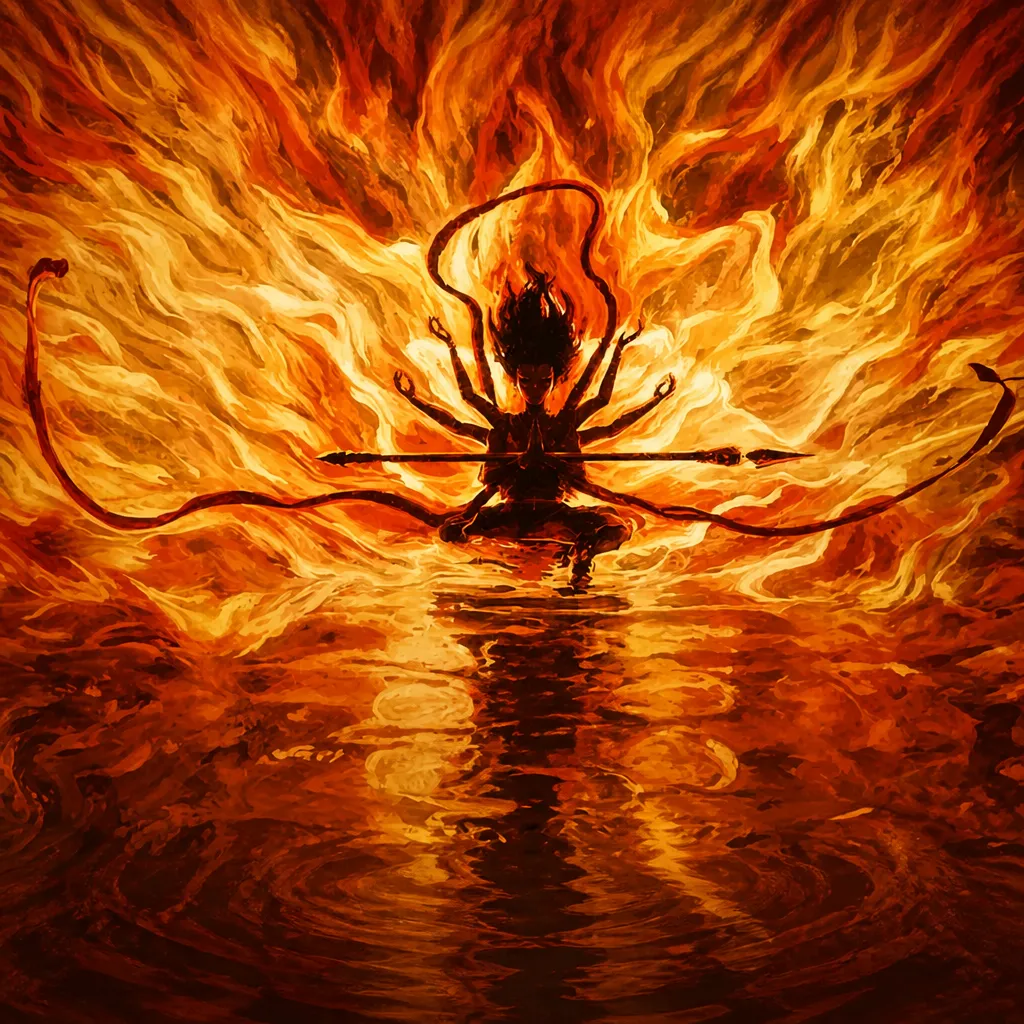
January 29, 2025 — the first day of the Chinese Lunar New Year. In a movie theater in Chengdu, hundreds of audience members sat in the dark, waiting for the film to begin. The screen lit up. A small boy walked out of the flames — with dark circles painted around his eyes, bared teeth, a long spear gripped in his hand, and two burning wheels beneath his feet. He was short in stature, but his eyes held a defiant fire that refused to lose.
Drums sounded, and the entire theater fell silent. The child on screen is called Ne Zha — a mythological figure in China whose story has been told for over five hundred years. Nearly every Chinese person has grown up hearing his legend. But this time, the animated film starring him would far exceed everyone's expectations.
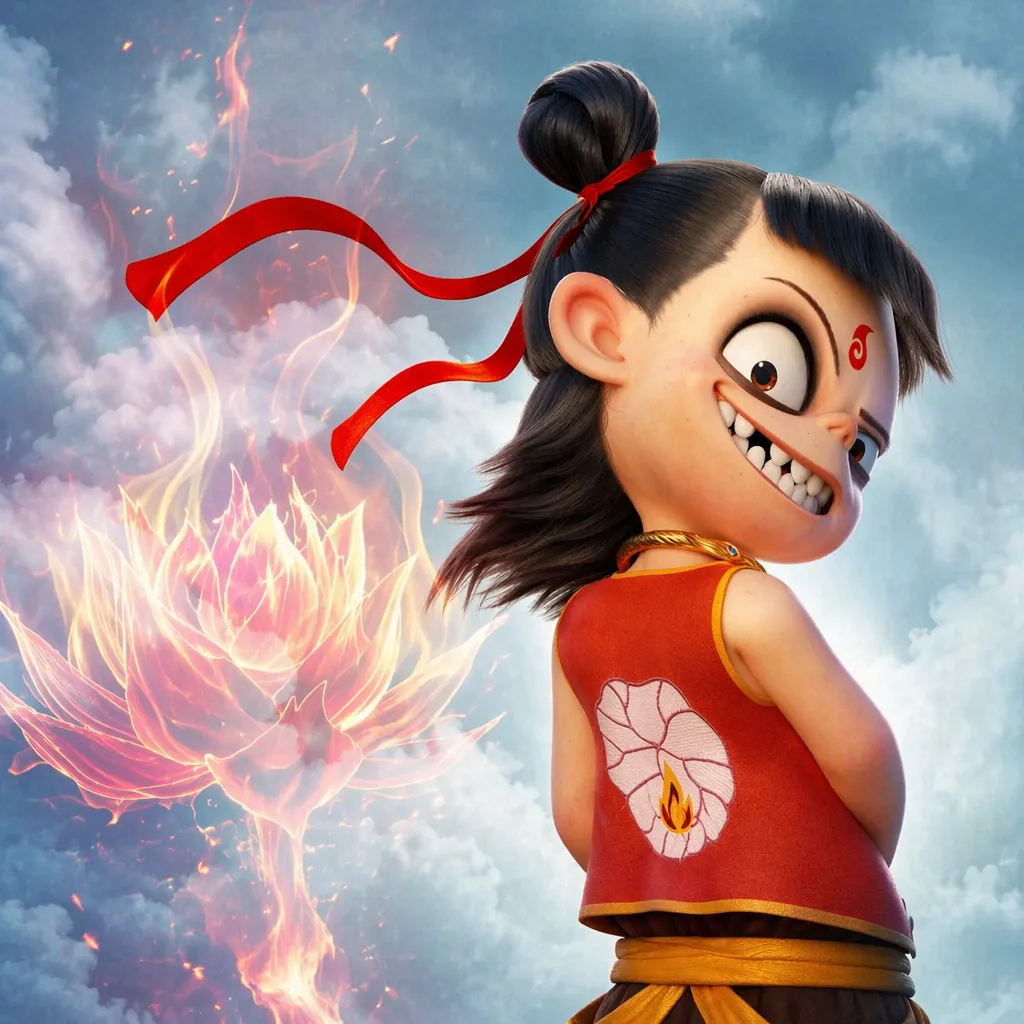
Ne Zha the "demon child" — dark circles, jagged teeth, yet the protagonist of China's highest-grossing film ever
The film is called "Ne Zha 2: Demon Child Conquers the Sea Dragon." It played in Chinese theaters for 153 days. 324 million people bought tickets — more than the entire population of the United States. Domestic box office reached 15.445 billion RMB. The film then opened in North America, Southeast Asia, and Europe. By April 2026, its global cumulative box office reached $2.267 billion, surpassing "Titanic" to become the fourth highest-grossing film in global cinema history. Among the top five films at the worldwide box office, it is the only non-Hollywood film — and the only animated film.
A "monster child" from Chinese mythology out-earned "Titanic" and "The Avengers." Someone no one believed in, standing at the very top — that is exactly Ne Zha's own story.
The film is available on Bilibili and Netflix with English subtitles. But some things — the roar of a packed Chinese theater, the collective gasp when Ne Zha's mother embraces him — cannot be felt through a screen.
To understand why Ne Zha moved so many people, you first need to know his story. In the Ming Dynasty novel "Investiture of the Gods," Ne Zha is the son of a military general, born with divine strength, who runs amok in the Eastern Sea and tears out the Dragon King's third son's tendons. In the traditional version, he is a born hero — righteous, brave, enforcing justice on behalf of heaven. But the films flipped this story completely upside down.
In this version, Ne Zha is labeled a "Demon Pill" from the moment he is born. In the Heavenly Court's system, he is destined to be a monster, destined to be destroyed by heavenly lightning. He did nothing wrong — a pair of mystical pearls was simply swapped at birth. The Spirit Pearl, meant to create a hero, and the Demon Pill, destined for evil, were switched. So Ne Zha grows up carrying the identity of a "demon." Villagers run when they see him. Children throw stones at him. He can't even find someone to play shuttlecock with.
"Prejudice in people's hearts is a great mountain — no matter how hard you try, you cannot move it." — Shen Gongbao, a line from the "Ne Zha" film series. This quote has been shared over a billion times on social media.
The character who speaks this line is Shen Gongbao — a leopard spirit who cultivated himself into human form. He worked harder than anyone, pushed himself more than anyone, but because he was born a "demon," the Heavenly Court never gave him a fair chance. His master saved the best resources for another disciple — Taiyi Zhenren, a man of mediocre talent but "legitimate" birth. Shen Gongbao did decades of dirty, thankless work, and in the end got nothing. Does this story sound familiar? In workplaces in every country, someone has lived through something similar.
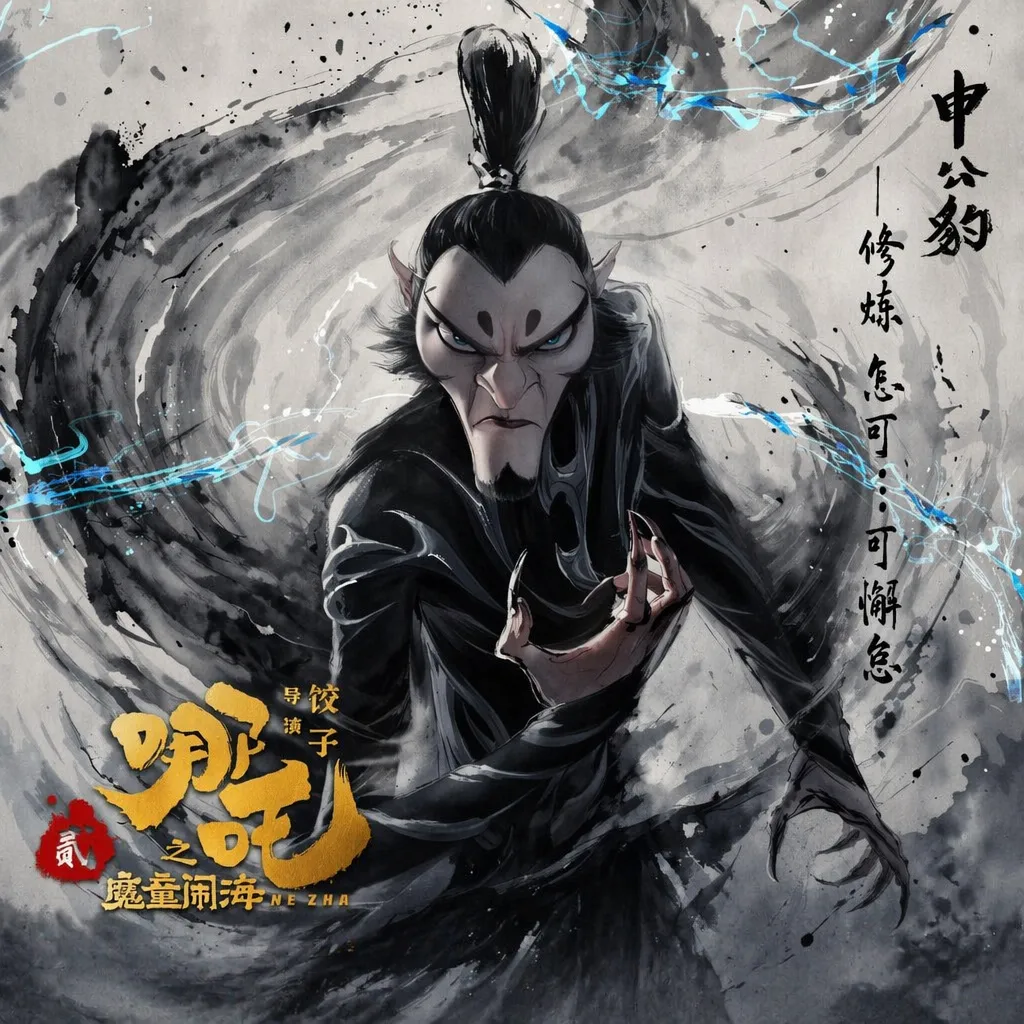
Shen Gongbao — a single line about prejudice made him the mirror of the entire film
The sequel pushes this injustice even deeper. There is a scene in the film: Ne Zha's mother is trapped by a Heart-Piercing Curse, her body covered in thorns, blood beads seeping through her skin. The Wuliang Immortal uses the parents' lives to force Ne Zha to kill himself. Lady Yin — Ne Zha's mother — breaks free in the final moment, rushes forward, and tightly embraces her son, who is covered in thorns. The thorns pierce her arms, blood soaks through her sleeves, but she refuses to let go.
"I never cared whether you were a demon or an immortal. I only know that you are my child." — Lady Yin, "Ne Zha 2." When this scene played in theaters, the sound of sniffling filled every screening.
This line needs no translation. In any language, a mother saying to her child, "No matter what you are, you are mine," means the same thing. This is why the film transcends culture — its core is not Chinese mythology, but something everyone has experienced: being labeled, being misunderstood, being crushed by prejudice, and then, in a single moment, deciding that you will no longer accept the script others have written for you.
If a film is a window, then Hengdian is the world behind that window. In central Zhejiang Province, within Dongyang City, there is a small town called Hengdian. Twenty-some years ago, it was nothing but barren hills. Today it covers 121 square kilometers and has been dubbed "China's Hollywood" by The Hollywood Reporter. Over ten thousand film and television productions have been born here — from Zhang Yimou's martial arts epics to palace intrigue dramas, from historical series to immortal fantasy spectacles. Walking through Hengdian's streets, the air carries the scent of sandalwood incense and roasted chestnuts. The stone-paved paths beneath your feet have been polished to a shine — every stone may have borne the footprint of a celebrity.
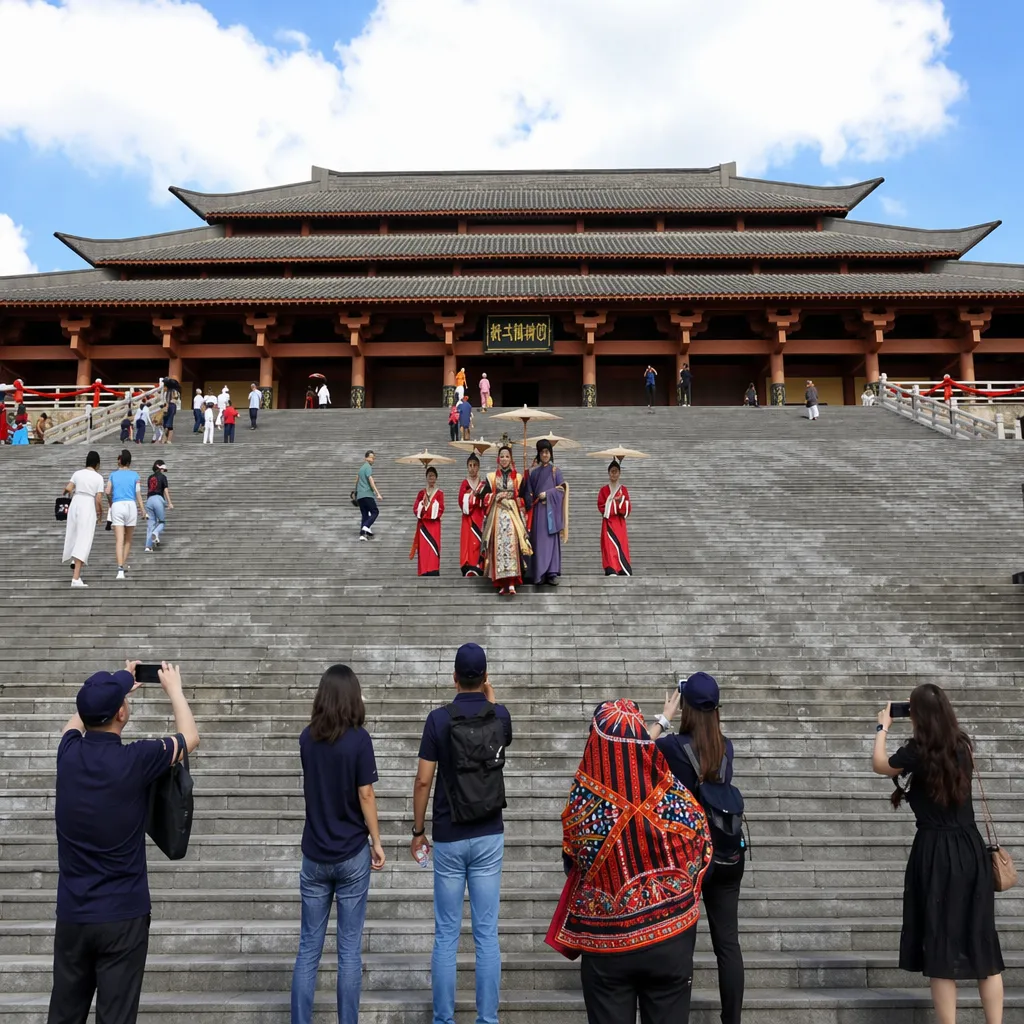
Hengdian's Qin Royal Palace — not just a set, but a place where actors can truly don costumes and film
Hengdian has five main scenic areas, like a three-dimensional picture book of Chinese history. The Qin Royal Palace recreates the palace of Qin Shi Huang from over two thousand years ago. The Ming and Qing Palace is a 1:1 replica of Beijing's Forbidden City — the same red walls and yellow tiles, the same Golden Water Bridge, even the patterns on the floor bricks are identical. The Qingming Riverside Scene recreates the street life depicted in the famous Northern Song painting by Zhang Zeduan. The Guangzhou Street and Hong Kong Street area turns the clock to the modern era — neon tubes light up at dusk, the air mixing the bitter fragrance of herbal tea with the sweet richness of char siu roast pork, as if you've stepped into a Wong Kar-wai film.
"I Was an Extra at Hengdian" is one of its most popular experience programs. Put on a costume, get your makeup done, walk onto the set, and hear the director shout "Action!" — your sweaty palms grip the props, your heart pounds against your ribs. The clapperboard snaps with a "crack," the lights blaze on all at once, and the temperature instantly rises several degrees. In that moment, you are not watching a movie — you are inside the movie.
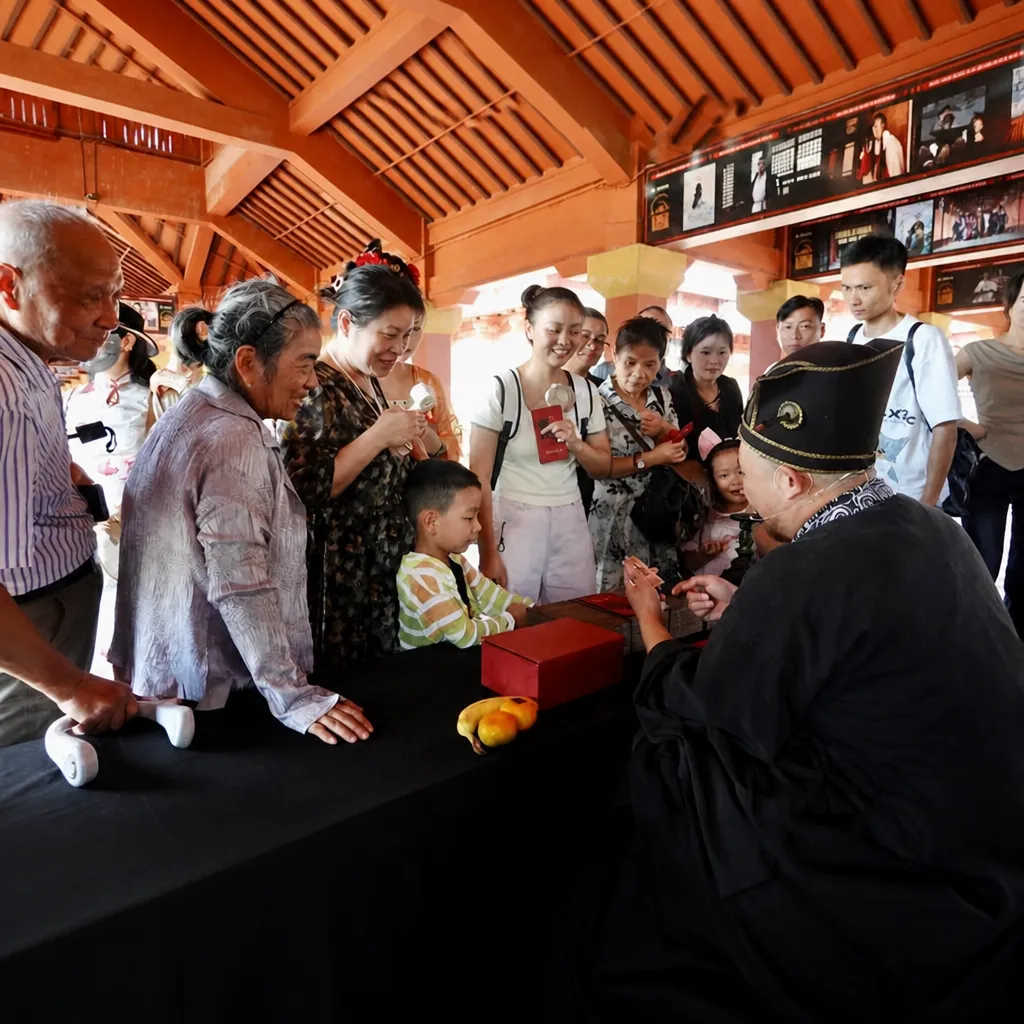
Visitors can act alongside costumed performers, take photos, and even "solve cases" together
Over 20 themed performance shows run daily, with more than 100 street performances scattered throughout the scenic areas. The Flood Disaster Show unleashes 500 tons of water pouring from the sky. The Danuo Performance uses masks and drumming to recreate ancient sacrificial rituals — drumsticks striking hide drums produce a sound so deep it seems to surge up from underground. Walking down the street, you might stumble into a performance at any moment — a "general" in full costume rides past on horseback, hooves clopping on stone paving in a crisp, rhythmic beat, fine dust swirling up into the air.
A foreign audience member may have never heard of "Investiture of the Gods," may not know what a "Chaos Pearl" is, may not be able to tell the difference between the Chan Sect and the Jie Sect. But when they sit in a theater and see Ne Zha being shunned by the entire village, they will understand that feeling. Being labeled knows no borders — the child mocked at school for an accent, the young professional looked down upon in the workplace for a degree, the teenager attacked on social media for their appearance. Labels are the cheapest weapon in the world: they cost nothing, requiring only a glance or a single sentence.
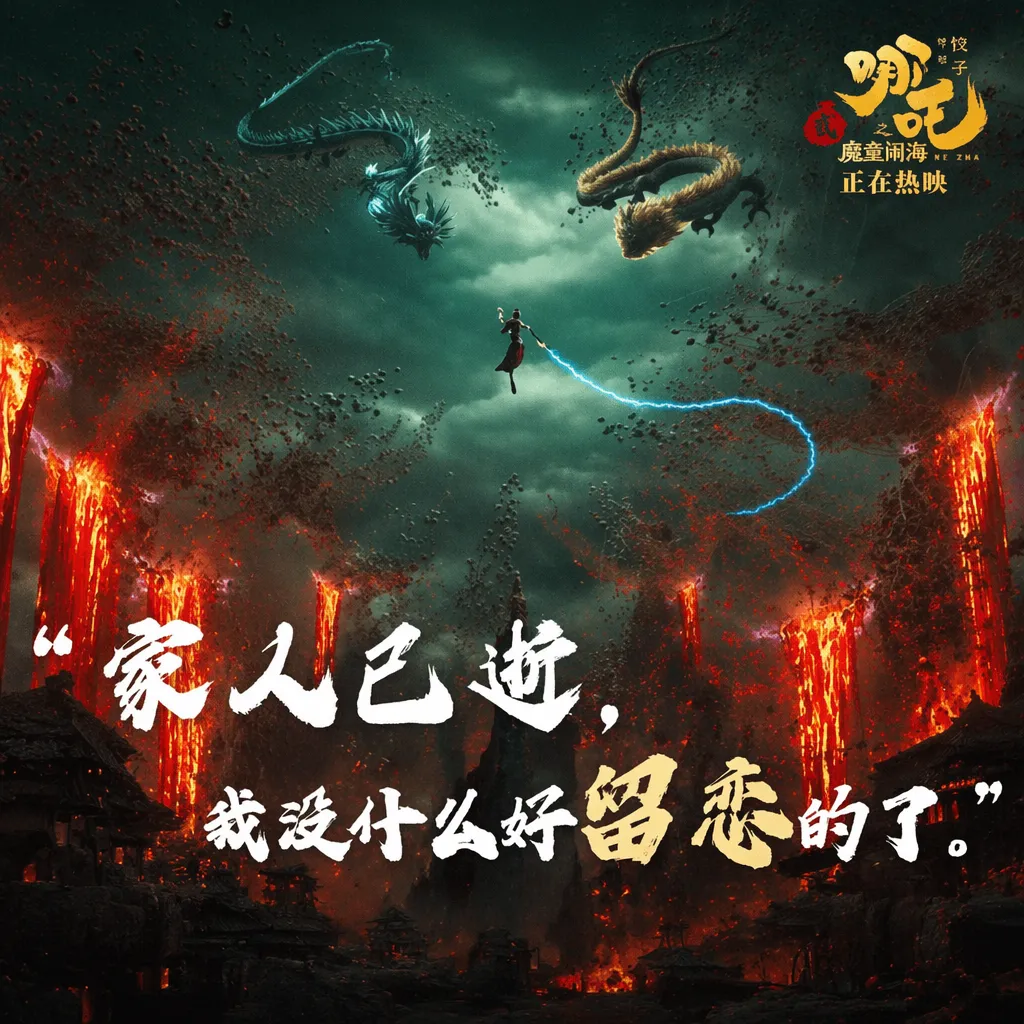
"I want to try." — three words, light as a feather falling to the ground, yet the entire theater heard them
Ne Zha's story crosses cultures because it is not about Chinese mythology — it is about a truth everyone understands: your identity is not determined by your birth. Ne Zha is the reincarnation of the "Demon Pill." By the Heavenly Court's rules, he is destined to be a monster. But he refuses to accept it. He shouts at destiny — "My fate is mine, not heaven's." This line has been printed on T-shirts, tattooed on arms, and written in college entrance exam essays.
Near the end of the film, the Dragon King of the Eastern Sea asks Ne Zha: "Do you really think you can change this world?" Ne Zha falls silent for a moment, then says: "I want to try." Three words. Light — like a feather drifting to the ground. But everyone in the theater heard it.
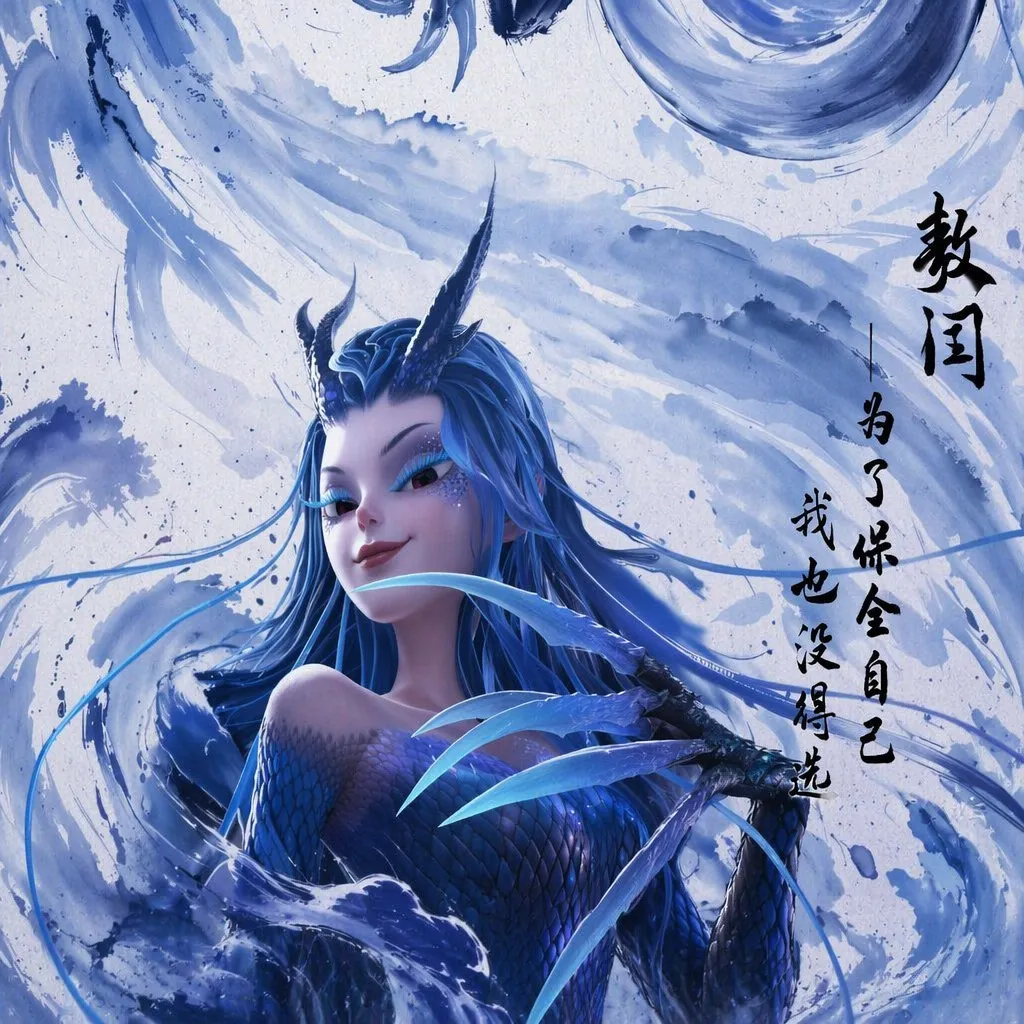
Ao Guang, Dragon King of the Eastern Sea — a father thousands of years old who ultimately learned to let go
The director goes by the name Jiaozi (literally "dumpling") — his real name is Yang Yu, from Luzhou, Sichuan. He spent four years in pharmacy school, but instead of putting on a white coat and walking into a hospital, he shut himself in a small room and taught himself animation. In 2008, he made a 16-minute animated short that scored 8.8 on Douban (China's IMDb). Then came a long ten years — borrowing money, being rejected, revising, revising again. When the first "Ne Zha" film premiered in 2019, he was nearly forty. The sequel took another five years. The end credits rolled for a full seven minutes, densely packed with the names of 138 animation studios.
Jiaozi once said he originally planned to outsource part of the production to foreign companies, but they did not put in their best effort. So he made a decision: everything would be done by Chinese teams. The team behind "Deep Sea" came. The team behind "White Snake" came. Even the makers of "Boonie Bears," a competing franchise, pitched in. Everyone took on work at a loss — like the Dragon Clan in the film, pulling off their hardest scales one by one to forge a suit of armor made of ten thousand dragons' scales.
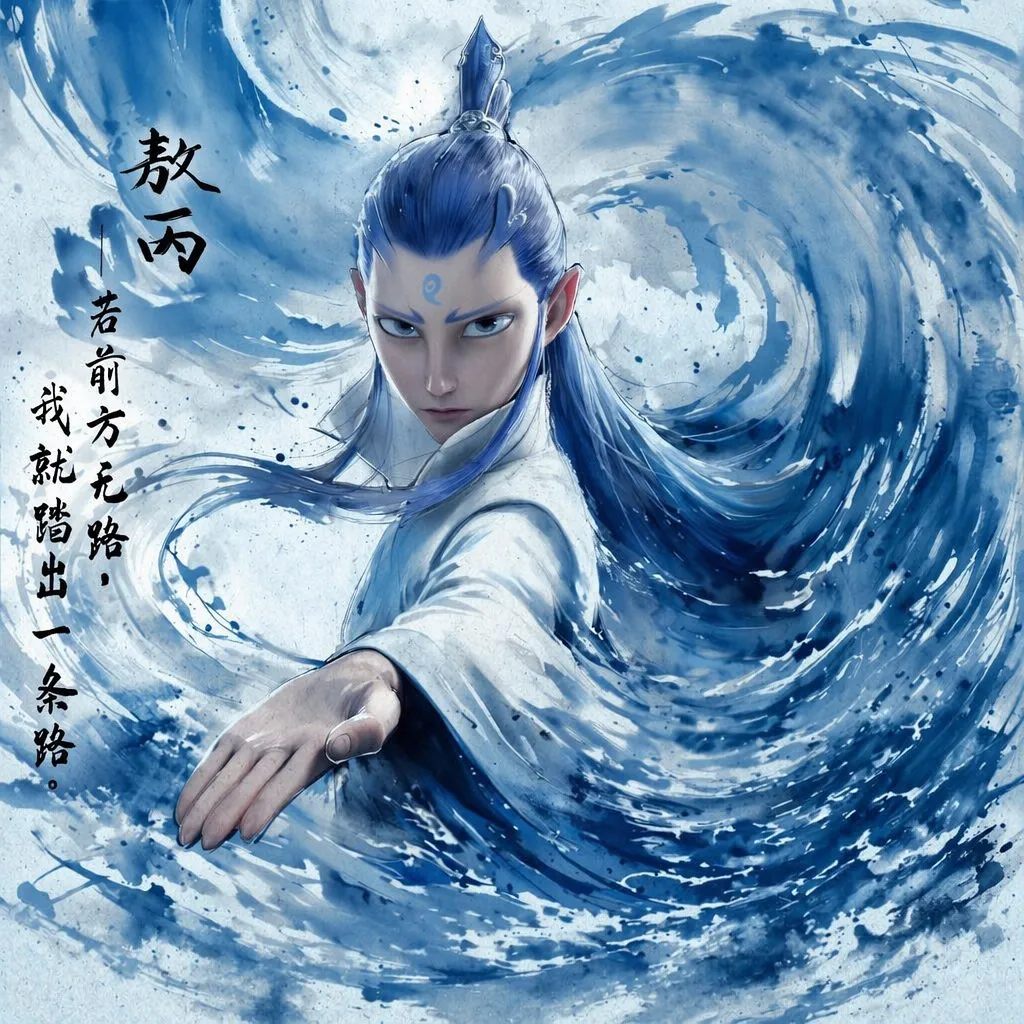
Ao Bing — the Dragon Prince reincarnated from the Spirit Pearl, mirror image of the Demon Pill Ne Zha
Back to that Chengdu theater at the beginning. The lights came on, the credits finished rolling, and the audience filed out little by little. Someone was rubbing their eyes. Someone was still sitting in their seat, not moving.
This film is available on Bilibili, Netflix, and other platforms, all with English subtitles. But some things cannot be felt through a screen.
Hengdian is in central Zhejiang Province — China's largest film and television production base. The majority of China's costume dramas and historical films are shot here. The steps of the Qin Royal Palace are much higher than you'd imagine. The red walls of the Ming-Qing Palace grow hot in the sunlight. The neon lights of Guangzhou Street don't come on until dusk. Put on a hanfu and walk the stone-paved roads — the wind blows in from a distant film set, carrying the sound of drums and galloping hooves.
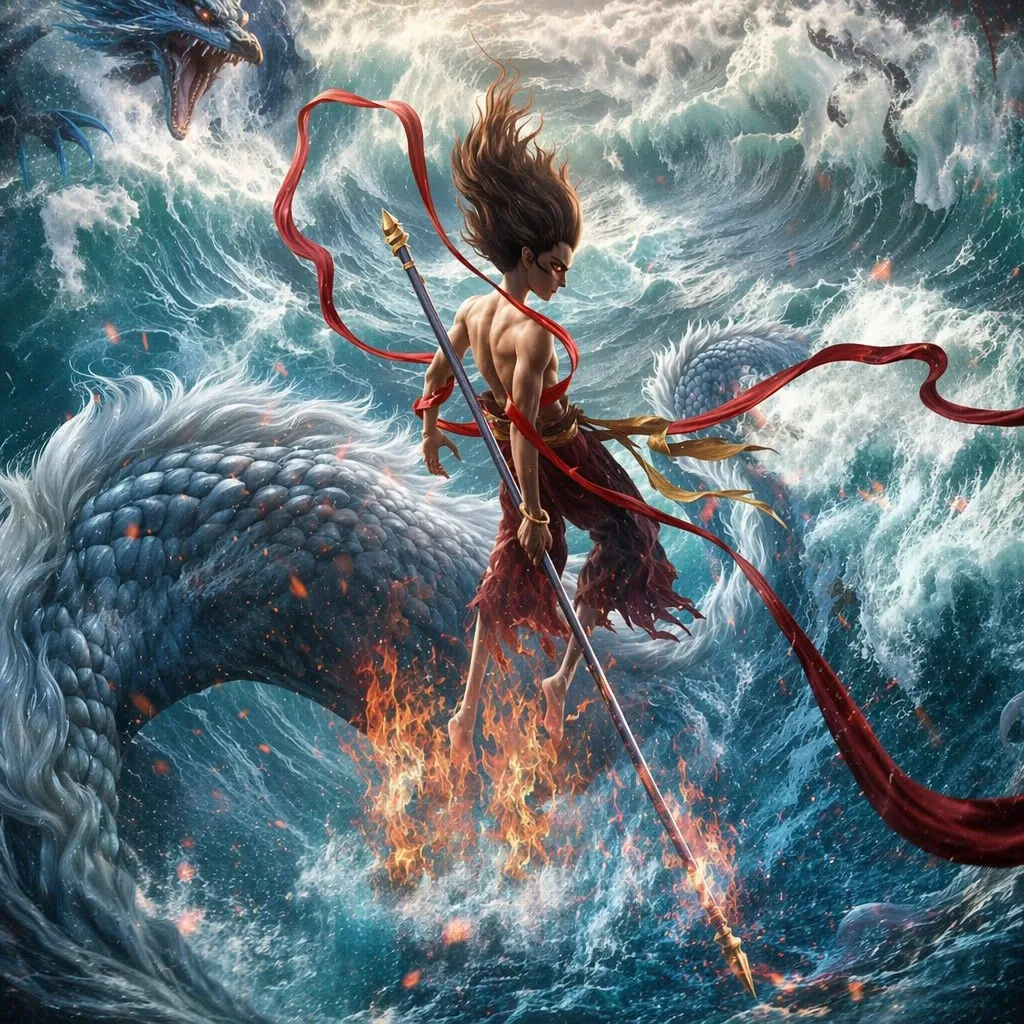
From the palace steps of Hengdian to the Dragon King battle on screen — the mythical scenes in the film have their real-world starting point here
Five hundred years of mythology, ten years of animation, two hours in the dark — in the end, it all lands on this piece of land. Come and see.
"My fate is mine, not heaven's."