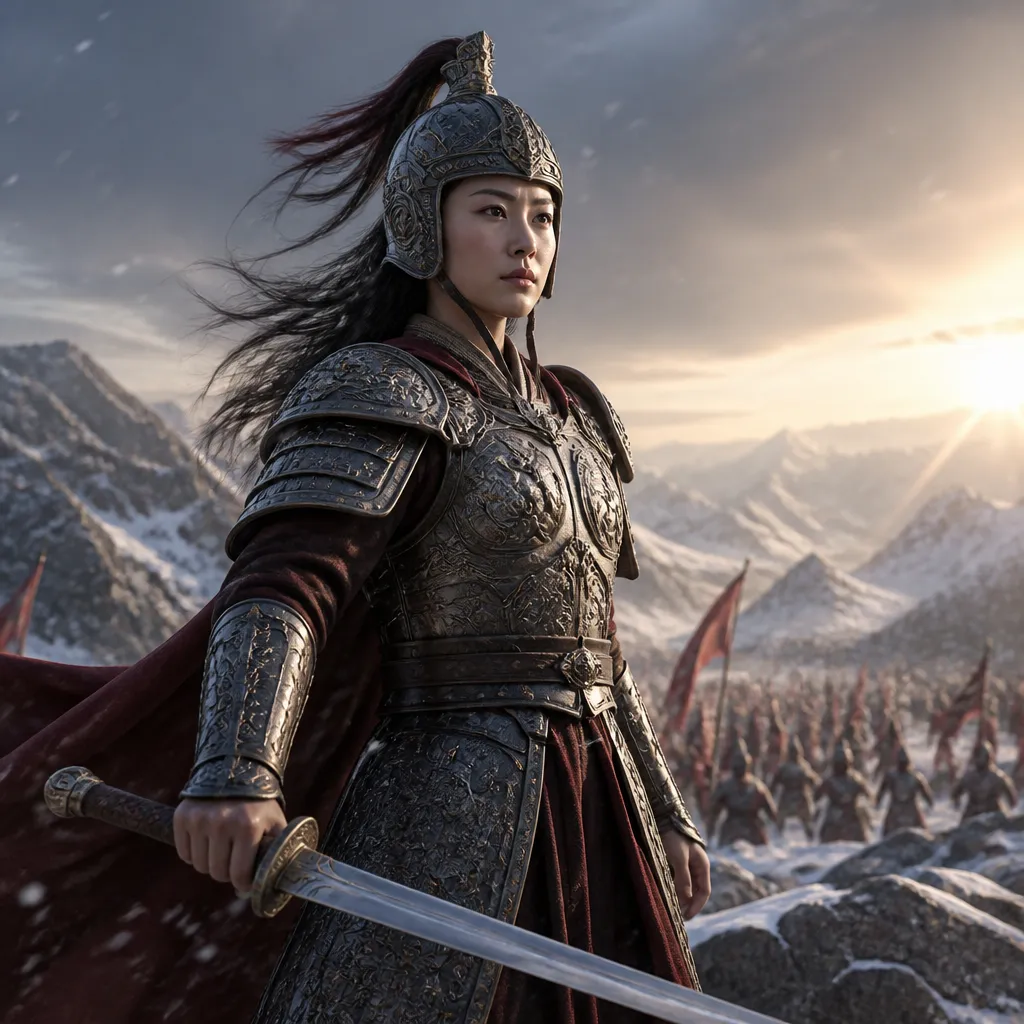
Animation · Cultural Icon
Mulan
From a Sigh 1,500 Years Ago to the 99 Steps of Hengdian
"Ji ji fu ji ji, Mulan dang hu zhi." So begins a 1,500-year-old folk song. A young woman cuts her hair, takes her father's armor, and rides to war. This is the story of that journey — from a loom in a border town to the global screen.
In a northern Chinese town fifteen centuries ago, the rhythmic sound of the loom suddenly stopped. A young woman of seventeen or eighteen sat by the window, gazing at the distant mountains whose ridges cut across the horizon like cold knife blades. She did not look up at her mother, did not speak a word — she only gripped the shuttle tighter, because outside the window came the clanging of gongs: the conscription officers had arrived again. This was a border town in Northern Wei China, and the girl had not yet learned to write her own name. Yet her sigh that day would travel through the pages of the Music Bureau poetry collections, through the drums and strings of Ming dynasty opera, through Disney's animated cel sheets, through the wind machines of a 2020 New Zealand battlefield, finally coming to rest at the 99 stone steps of a small southern Chinese town.
If you think the "Ballad of Mulan" was written simply as a script for Disney's animation, prepare to be surprised. This narrative poem, also known as the "Mulan Song," was composed around the Northern Wei period (386–535 CE) and contains just over 300 characters. In Chinese literary history, it stands alongside "Southeast the Peacock Flies" as one of the "Two Masterpieces of the Music Bureau" — a northern female hero and a southern lovesick woman, together establishing the two peaks of Chinese narrative poetry.
"Ji ji fu ji ji, Mulan dang hu zhi.
Bu wen ji zhu sheng, wei wen nv tan xi."
"The sound of one sigh after another,
As Mulan weaves at the doorway.
No sound of the loom and shuttle,
Only that of the girl lamenting."
You can almost smell the cotton fiber from that old loom, hear the whoosh of the shuttle passing through the warp threads. A northern girl's sigh was not about romantic troubles — it was about her father's graying hair, her younger brother's still-too-young shoulders, the fear of seeing her father's name written on the conscription notice. In the dead of night, she sharpened her father's old sword, bound her hair into a topknot, and exchanged her cotton robe for battle armor.
"Wan li fu rong ji, guan shan du ruo fei.
Shuo qi chuan jin tuo, han guang zhao tie yi."
"She goes ten thousand miles on the business of war,
She crosses passes and mountains like flying."
The wind poured through the passes of the Yanshan Mountains, and metal armor glistened with a cold gray sheen under the winter sun. "Ten thousand li" is a number; "like flying" is speed — mountains and passes, frontier camps, watchtowers, cold light, iron garments — five images that capture the bitter cold of the north and the urgency of war.
The story does not end at the battlefield. Twelve years later, when Mulan returns home, the ballad concludes with the lightest, softest touch: she removes her battle armor, stands before a bronze mirror to paint her eyebrows, apply facial powder, and rub on rouge. When she opens the door in her female attire, the comrades who fought beside her for twelve years are stunned — "For twelve years we marched together, never knowing Mulan was a girl."
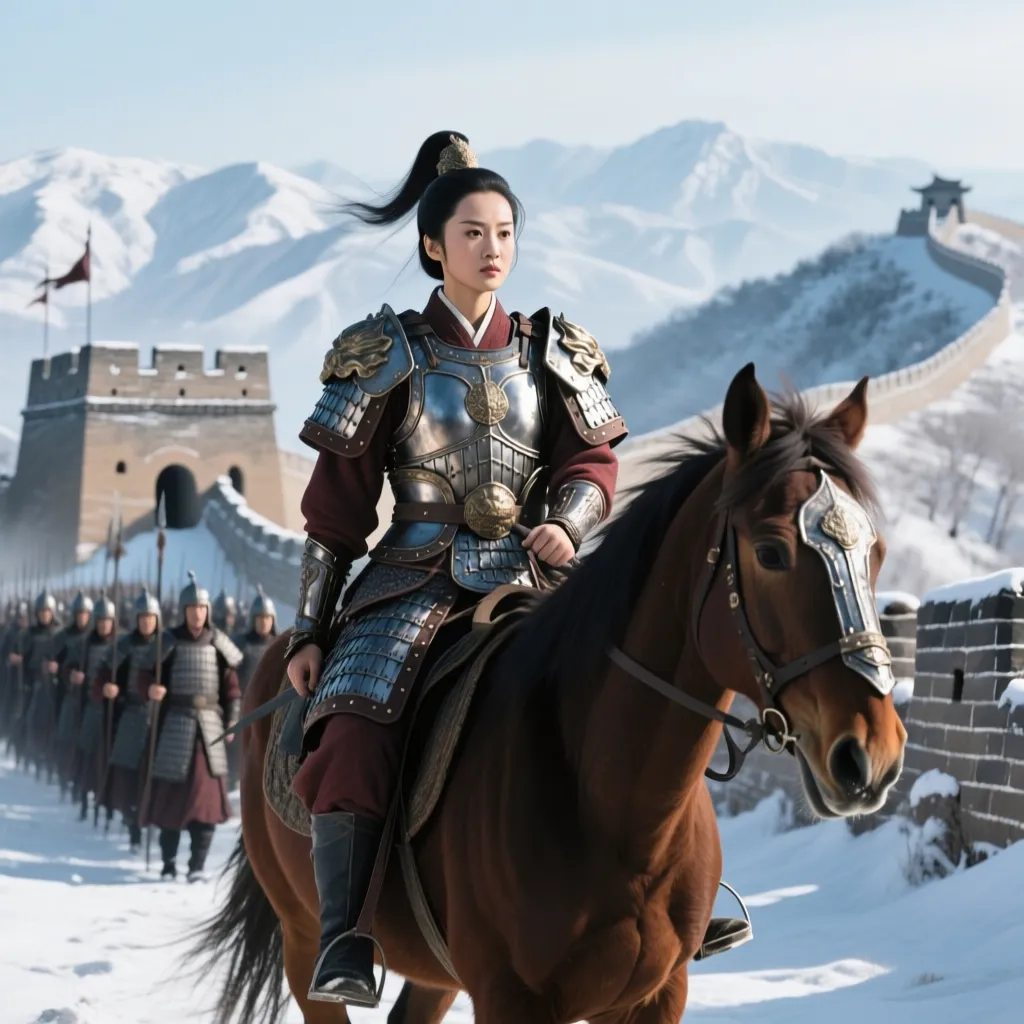
After twelve years in the army, she had become a general
"Xiong tu jiao pu shuo, ci tu yan mi li.
Shuang tu bang di zou, an neng bian wo shi xiong ci?"
"The male rabbit's feet go hop and skip,
The female rabbit's eyes are blurry and dim;
But when two rabbits run side by side on the ground,
How can you tell which is male and which is female?"
This rhetorical question traveled through the Northern and Southern Dynasties, through Tang and Song, through Ming opera, through Qing dynasty ballads, crossed the Pacific into Disney's animated script, and finally landed on the English-language poster of the 2020 live-action film. Its sharpness lies not in the gimmick of "a girl disguising herself as a man," but in this: gender was never meant to be identified — it was meant to be lived.
Disney did not create Mulan — it simply retold a 1,500-year-old legend for the entire world through animation. In 1998, Disney released the animated film "Mulan," which grossed over $300 million worldwide — $120 million in North America and $180 million overseas — ranking seventh in global box office that year. With a production budget of $90 million, the worldwide gross was 3.4 times the investment. The film received Oscar and Golden Globe nominations and won nine Annie Awards including Best Animated Feature, becoming Disney's first animated film based on a Chinese story and also Disney's first film to openly discuss war.
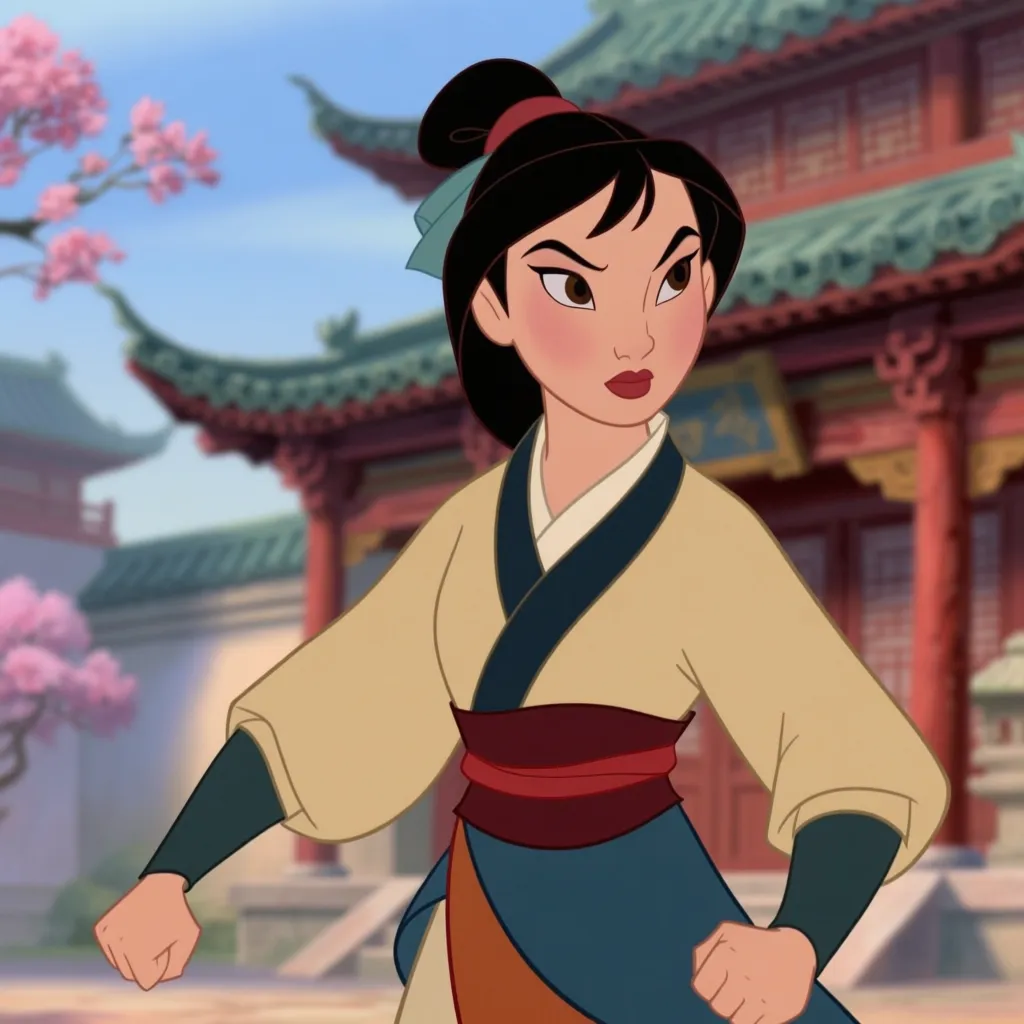
Disney's 1998 animated "Mulan" — the film that introduced China's warrior woman to the world
On June 7, 2008, China's State Council announced the second batch of the National Intangible Cultural Heritage List, and "the Mulan Legend" was included. A story passed down through folk songs, opera, shadow puppets, New Year pictures, and paper-cutting was officially recognized by the nation as a cultural heritage worth preserving.
In September 2020, Disney's live-action "Mulan" premiered globally. With a production budget of $200 million, starring Liu Yifei alongside Chinese cinema legends Jet Li, Gong Li, Donnie Yen, and Cheng Pei-pei, the film was shot in both China and New Zealand. The epic battle scenes on snow-capped mountains, but the "Chinese" elements like palaces and training grounds were filmed at two locations: Hengdian World Studios in Dongyang, Zhejiang, and the Tang Dynasty Film City in Xiangyang, Hubei.
This poem of just over 300 characters has no author, no specific location — yet it has been passed down for 1,500 years. In the cave temples of Dunhuang, fragments of the "Ballad of Mulan" from the late Tang dynasty rest alongside Buddhist sutras. Ming dynasty playwright Xu Wei's play "Female Mulan" gave her the surname "Hua" for the first time. Opera troupes across China — Yu, Qin, Beijing, Hebei, Yue, and Sichuan — all performed her story.
From Shanghai, take a two-hour high-speed train to Yiwu or Dongyang, then a thirty-minute drive — you will arrive at an ordinary Jiangnan town that you might almost overlook. Low-rise houses, breakfast stalls steaming with hot food, electric bikes threading through narrow alleys — if you didn't know, you might miss it entirely. But turn one corner, and vermillion walls rise abruptly, blocking the entire horizon. This is Hengdian.
Hengdian World Studios is called "China's Hollywood," but it is even more "real" than Hollywood — it has rebuilt all 5,000 years of Chinese history at 1:1 scale in this small Zhejiang town. Just over two decades ago, this was ordinary farmland. Today, 27 magnificent palaces rise within the Qin Palace scenic area, and films with epic names — "Hero," "The Assassin," "The Untamed," "Mulan" — were all shot here.
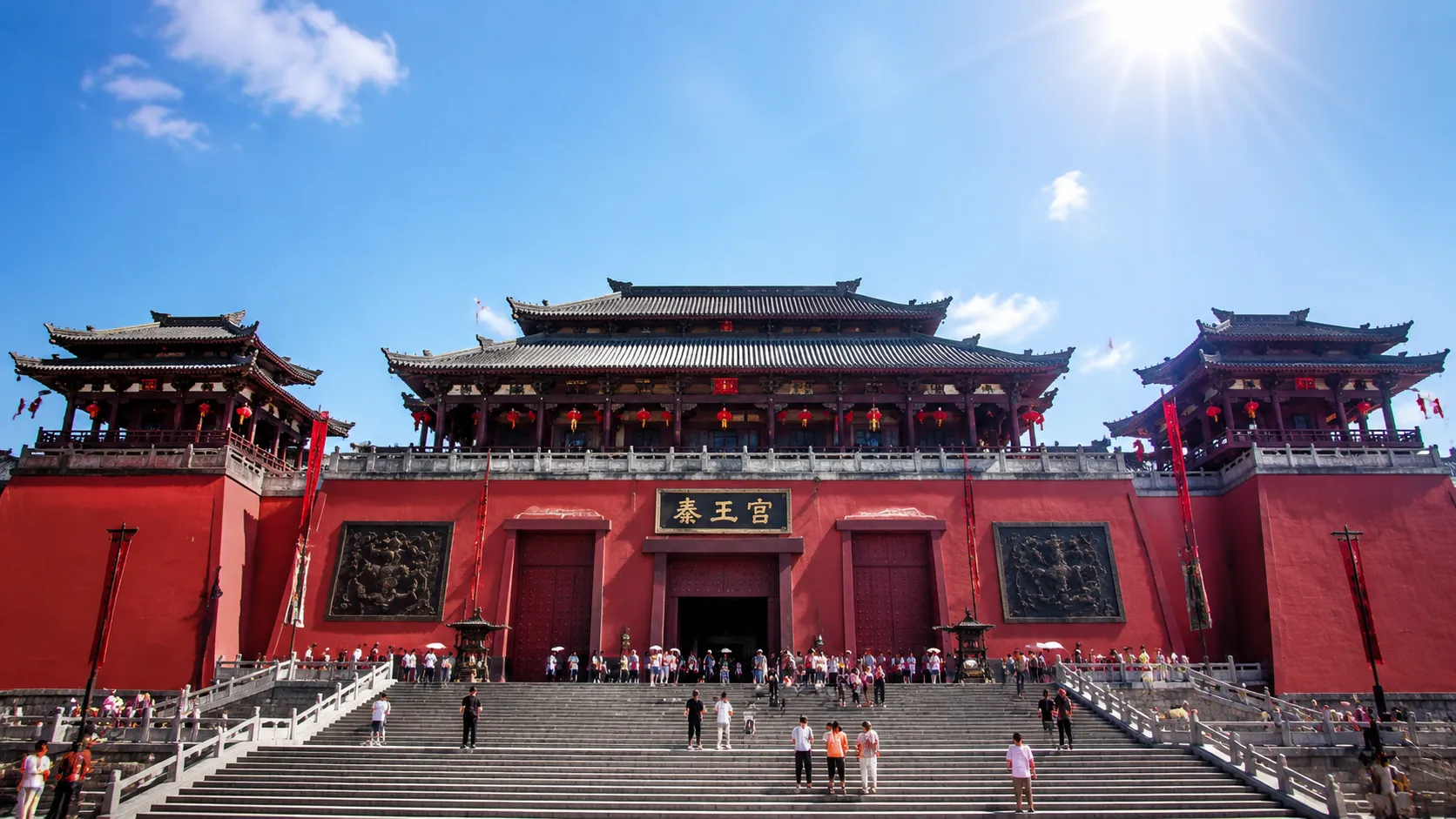
Hengdian Qin Palace — filming location for Disney's live-action "Mulan"
The Qin Palace was the filming location for Disney's live-action "Mulan." Director Niki Caro chose this location because the steps here are "extremely dramatic" — 99 stone steps lead straight up to a Han-style main hall, and four long corridors spread out like open arms, enclosing the entire plaza in a concave shape. Standing at the bottom looking up, you feel the wind blowing from all directions, carrying the dust from the film set and the plastic smell of reflectors. Walking through the city gate, you genuinely feel as if you are about to lead troops out to battle.
You can rent a set of hanfu or Warring States robes (costume rental points are scattered throughout every scenic area), and a makeup artist will style your hair into a high topknot and apply traditional facial decorations. Wearing a plain white or crimson robe, the sound of the wind through your sleeves immediately feels different. Standing at the top of those 99 steps, having a photographer press the shutter — in that photo you will not look like a tourist. You will look like the girl who prepared to go to war for her father fifteen centuries ago.
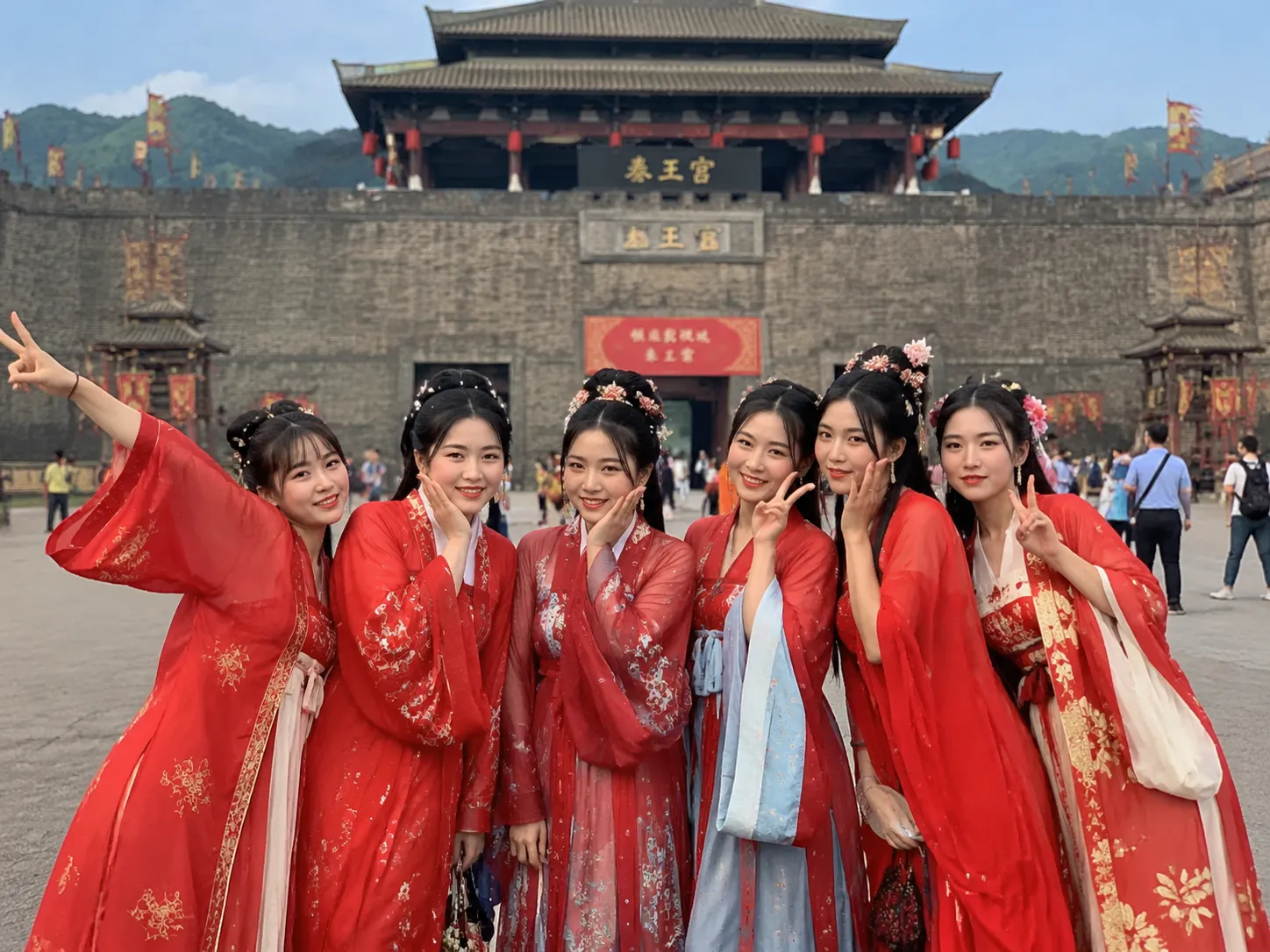
Put on hanfu and stand on the 99 steps — you become the protagonist
Don't rush to leave. Hengdian also has over a dozen scenic areas including the Ming-Qing Palace, Guangzhou Street, Hong Kong Street, and the Riverside Scene at Qingming — "in one city, in three days, see 5,000 years." When darkness falls, Guangzhou Street reveals another face. 1920s neon signs light up one by one, wet stone-paved streets stretch the red lantern reflections long. The aromas of grilled sausages, egg tarts, and sugar-roasted chestnuts drift from street vendors.
If you stay an extra night, consider staying in a homestay outside the scenic area. Wake at five in the morning, before the studios open, when breakfast stalls in the alley have already fried their first batch of youtiao. The smell of hot oil and flour drifts through the window, soy milk steams white. Take the first shuttle into the park before the crowds arrive, and claim an empty palace all to yourself. Morning sunlight slants across the vermillion walls, dust floats slowly in the light beams, and dew still clings to the moss at the palace base.
If you're lucky, you might bump into extras wrapping up their shoot at the scenic area entrance. They have removed their makeup, wearing their own T-shirts and flip-flops, faces carrying exhaustion mixed with excitement — one just finished playing a palace maid, another a soldier. Chat with them and you'll hear stories of the production crew's daily life: assembling at 4 AM, wearing padded coats in forty-degree heat, eating only two boxed meals a day. These authentic voices explain better than any brochure how Chinese films are made — frame by frame, from sets, lights, boxed meals, and the sweat of extras.
In 2024, Hengdian World Studios saw foreign tourist numbers increase by nearly 10 times year-on-year. Behind this number lies China's relaxed visa policies, extended transit stay durations, and the emerging trend of "traveling to China following the films." Foreign tourists come to Hengdian not just to see "Chinese-style" sets — they come to "walk into" the scenes they have already watched on Netflix and Disney+.
"I really like Chinese movies. We see Chinese kung fu in them, there is history — Jackie Chan, Jet Li, Bruce Lee." — Dabira Viyani (Italian tourist)
On a morning fifteen centuries ago, the loom in a northern border town paused for a beat. A girl put down the shuttle, lifted her head, and looked out the window. She did not know where her sigh would travel through history — she only knew her father could not go, her brother was still too young, and there was no other man in the family. She made a decision. This decision was written into the Music Bureau poetry, painted into Dunhuang cave murals, scripted into Xu Wei's Ming dynasty play, sung through Chinese opera for over a millennium, adapted by Disney into animated and live-action films, and finally came to rest before the vermillion gates of a small southern Chinese town.
1,500 years of story, $200 million in investment, 2 hours of film. From the Northern Wei border town to Hollywood editing rooms, from the hooves of horses by the Yellow River to the hooves on screen — this path itself is a miracle. And this miracle now rests beneath the walls of Hengdian, waiting for you to push open that gate.
The power of a story lies not in its ending, but in how many times it is willing to be told. For 1,500 years, Mulan has been told, drawn, sung, performed, and animated — each retelling different, but each time someone stops to listen.
What is even more remarkable is that Mulan may not have been Han Chinese at all. Some scholars believe she may have been Xianbei or Tujue — the Northern Wei regime was originally Xianbei-centric, fusing various ethnic groups. A non-Han female hero became a cultural symbol beloved by all of China and the entire world. This in itself is a miracle — crossing ethnicity, crossing national borders, crossing 1,500 years of time, still touching everyone's heart.
So when you next turn the page of your Asia travel list, please write Hengdian down. You don't need to finish reading the "Ballad of Mulan" beforehand, nor memorize every English translation. You only need to bring a pair of curious eyes and feet willing to step onto those stone steps. When wind blows through the battlements, when your feet touch those stones worn by countless others — you will understand: some stories have been waiting for you, for fifteen hundred years.