Archaeology · World Wonder
The Underground Army
The Terracotta Warriors of Qin — How You Can See Them With Your Own Eyes
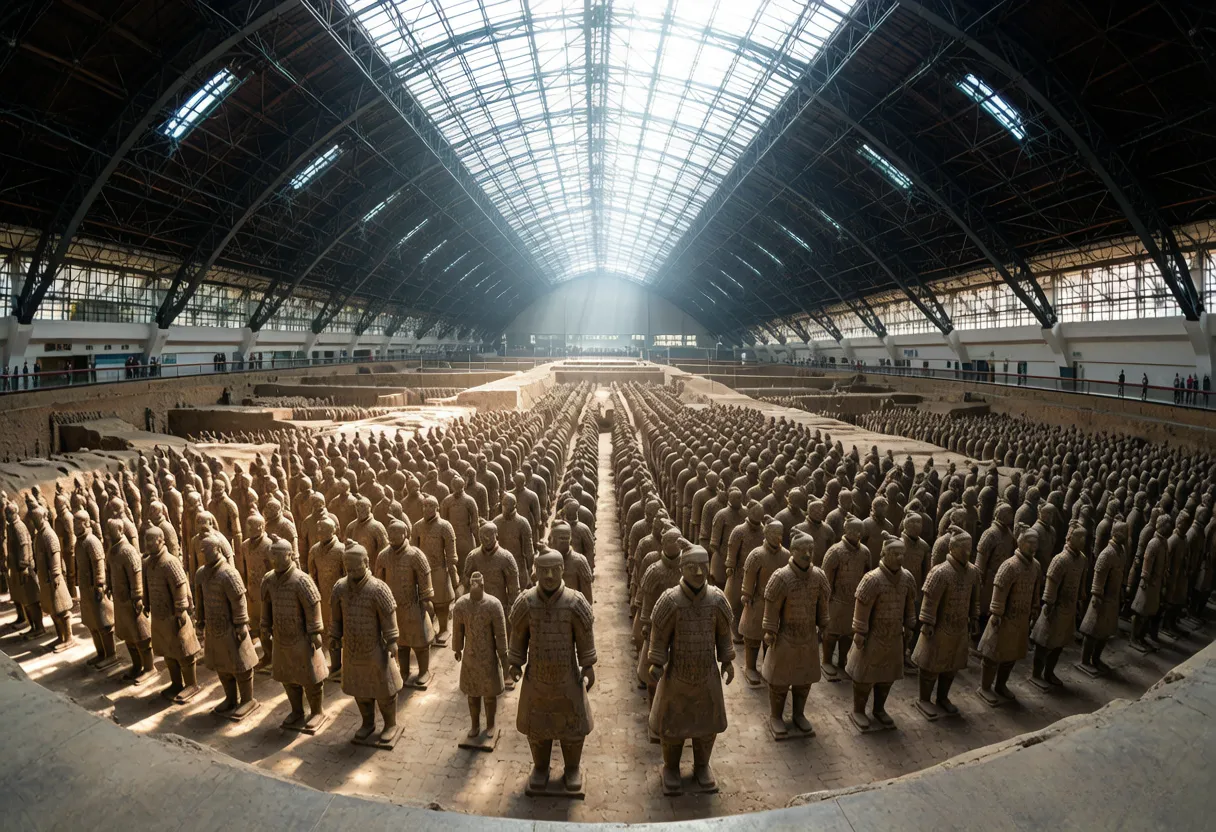
The moment you step into Pit One, the light suddenly dims.
Not an uncomfortable darkness, but a mysterious shade, as if you have stepped through time itself. Your eyes haven't yet adjusted, but before you already lies a scene that renders any language powerless —
On four thousand square meters of earth, row upon row of terracotta warriors stand in silent formation. Clad in armor, weapons in hand, they stand in precise military array. Twenty-three centuries of dust have settled on their faces, yet they cannot hide the different expressions each one carries. Some are solemn, some are calm, some frown slightly, some have blazing eyes. Sunlight streams through the glass dome above, casting scattered light patterns across the warriors. You suddenly realize these "people" have been standing here for twenty-three centuries, and now, they are waiting for you.
This is a kind of shock that no photograph can convey. When you stand at the edge of the pit, looking down at this underground army, you understand why some say this is not merely an "archaeological discovery" — it is "the Eighth Wonder of the World."
The story begins on March 29, 1974.
That day, several farmers from Xiyang Village in Lintong County, Shaanxi Province, were digging a well in the south of the village. The leader was named Yang Zhifa. He swung his iron pickaxe into the earth. Layer by layer of soil was turned up, the well grew deeper. Around four in the afternoon, the pickaxe struck something hard. Yang Zhifa bent down and dug with his hands. In the evening light, he saw a human face — no, a terracotta face.
"It's a 'wa ye'!" someone shouted. In the Shaanxi dialect, "wa ye" means terracotta warrior. The farmers thought they had unearthed something inauspicious, both frightened and curious. They reported to the commune, which reported to the county cultural bureau. The news traveled upward layer by layer, eventually reaching Beijing.
On July 10, 1975, Xinhua News Agency published a report: "Terracotta Pit from Qin Dynasty Discovered in Lintong County." This was the first time the official world was informed of this discovery. The report was short — just a few hundred words — but it was like a stone dropped into a lake, the ripples of which continue to spread to this day.
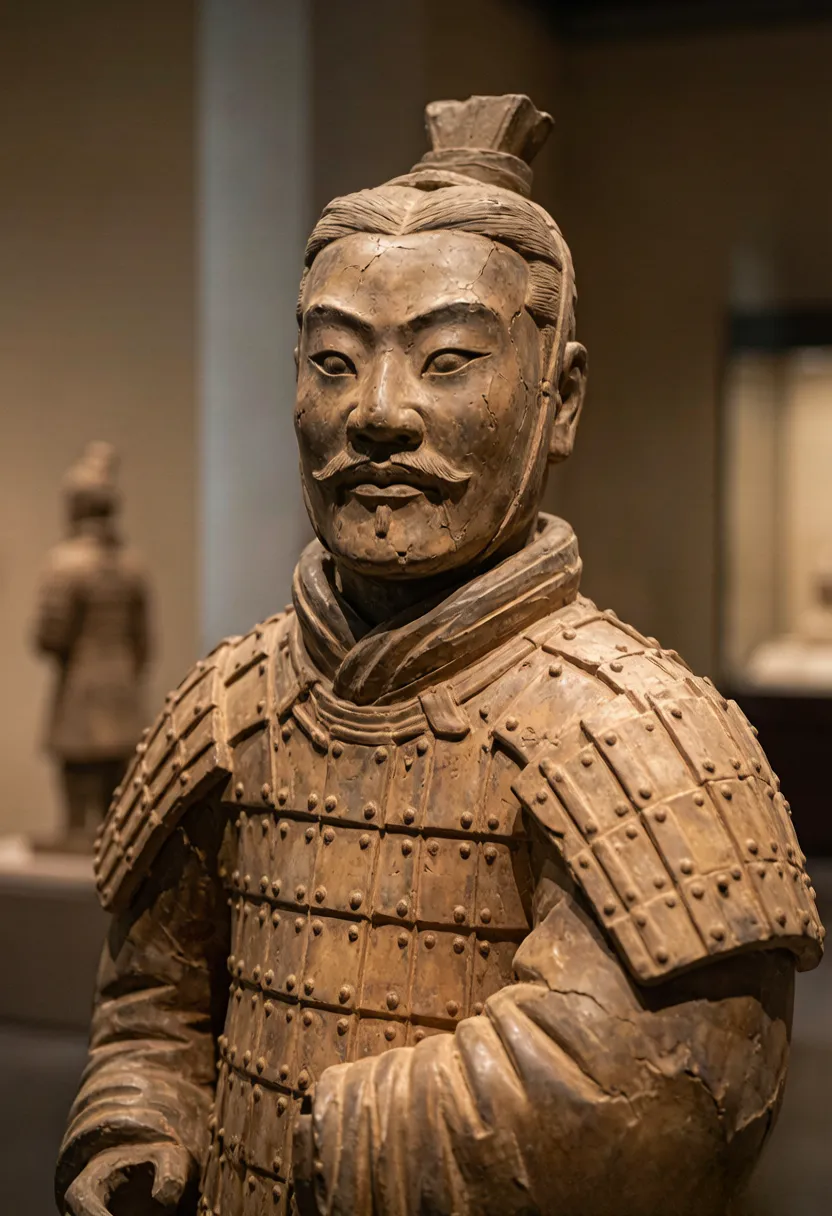
A general of the Terracotta Army — the rank is visible in the detail of his armor and the style of his headdress
On October 1, 1979, the Emperor Qin Shi Huang's Terracotta Army Museum officially opened to the public. On opening day, tourists from all over the country packed the small exhibition hall. People stood at the edge of the pit, looking at the warriors, unable to speak for a long time. Some said that at that moment, they heard the wind from two thousand years ago.
The news reached Europe. In 1978, French President Jacques Chirac visited China. After visiting the Terracotta Warriors in Xi'an, he said something that has been quoted ever since: "There are seven wonders of the world. The discovery of the Terracotta Warriors can truly be called the eighth wonder." The international media went wild with this quote, and from then on, "the Eighth Wonder of the World" became the most famous nickname for the Terracotta Warriors.
In 1987, UNESCO listed the Mausoleum of Emperor Qin Shi Huang and the Terracotta Warriors on the World Heritage List. It was one of the first Chinese cultural heritage sites to receive this distinction. The evaluation committee wrote in its report: "This site is an outstanding representation of human civilization, showcasing the superb artistic and technical level of the Qin Dynasty."
"There are seven wonders of the world. The discovery of the Terracotta Warriors can truly be called the eighth wonder."
— French President Jacques Chirac, 1978
Pit One is the largest excavated terracotta pit. Standing at its edge, you cannot help but be overwhelmed by its scale — the pit is 230 meters long, 62 meters wide, covering 14,260 square meters. What does this mean? It's equivalent to two standard soccer fields.
Inside the pit, nearly 6,000 terracotta warriors are displayed, with estimates of total numbers reaching nearly 8,000 when including those yet to be excavated. As you walk on the wooden walkway, your footsteps echo through the vast space. Looking up, the warriors stand in rows and columns, extending to the edge of your vision. You suddenly understand why Emperor Qin built such an underground army — he wanted to continue his rule in another world.
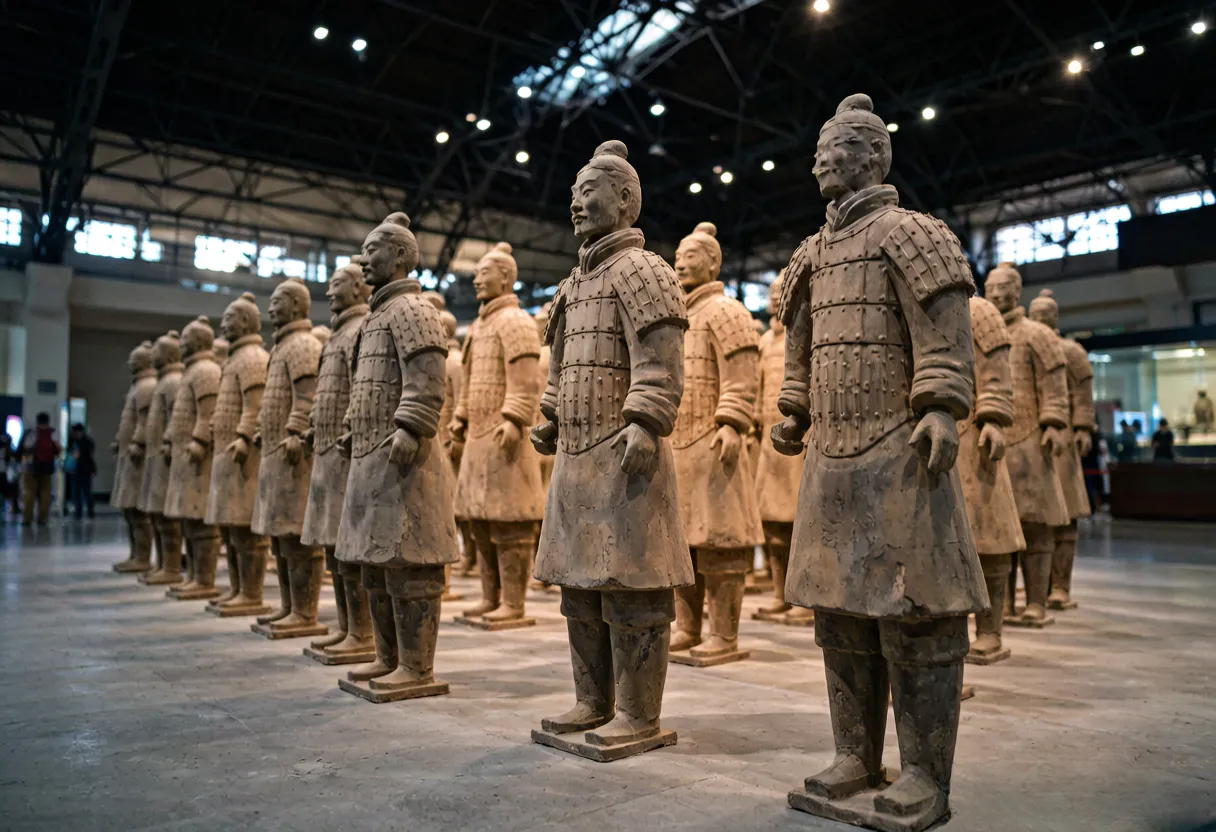
Row upon row, column upon column — 8,000 life-sized warriors, each with a unique face
But what truly amazes isn't the quantity — it's the details.
Every single warrior's face is different. Archaeologists discovered that these terracotta warriors have subtle differences in their hairstyles, eyebrows, eyes, noses, mouths, and beards. Some have round faces, some have square faces, some have narrow eyes and brows, some have blazing gazes. The warriors also vary in height, from 175 centimeters to 195 centimeters, arranged in military formation with deliberate variation.
Archaeologists studied the crafting techniques and discovered that the artisans used a method called "clay strip coiling." First, the basic shape of the warrior was formed from clay, then clay strips were layered and pressed to create the body's contours. The head and hands were made separately and then inserted into the body. This technique allowed each warrior to have unique expressions and postures.
Even more surprising is the "name-inscribing system." Archaeologists found numerous inscriptions on the Terracotta Warriors, recording the names of craftsmen, government offices, and even dates of manufacture. This means every warrior can be traced to its specific maker. If made well, there was reward; if made poorly, there was punishment. This strict quality management system meant every warrior carries the dedication of its craftsman.
In the weapon restoration area, you can see these weapons from over two thousand years ago up close. Bronze swords, ge daggers, spears, and bi spears are neatly arranged. Many weapons were unearthed still sharp, their blades flashing coldly after thousands of years underground. Guides will tell you these weapons used chromium salt oxidation treatment — a technology not rediscovered in the West until over two thousand years later.
"It's hard to imagine people more than two thousand years ago could create such lifelike sculptures. Every warrior's expression is different — you can even feel their emotions."
— Trip.com American Tourist Review
Many people think the Terracotta Warriors are the entirety of the Qin Emperor's mausoleum. In fact, they are only one part of the burial complex — a small part of the entire mausoleum area.
When Emperor Qin ascended the throne at age thirteen, he began building his own mausoleum. The construction lasted thirty-nine years. Seven hundred thousand people participated, using one-third of the nation's labor force. The scale of the mausoleum and the number of burial pits far exceed anyone's imagination.
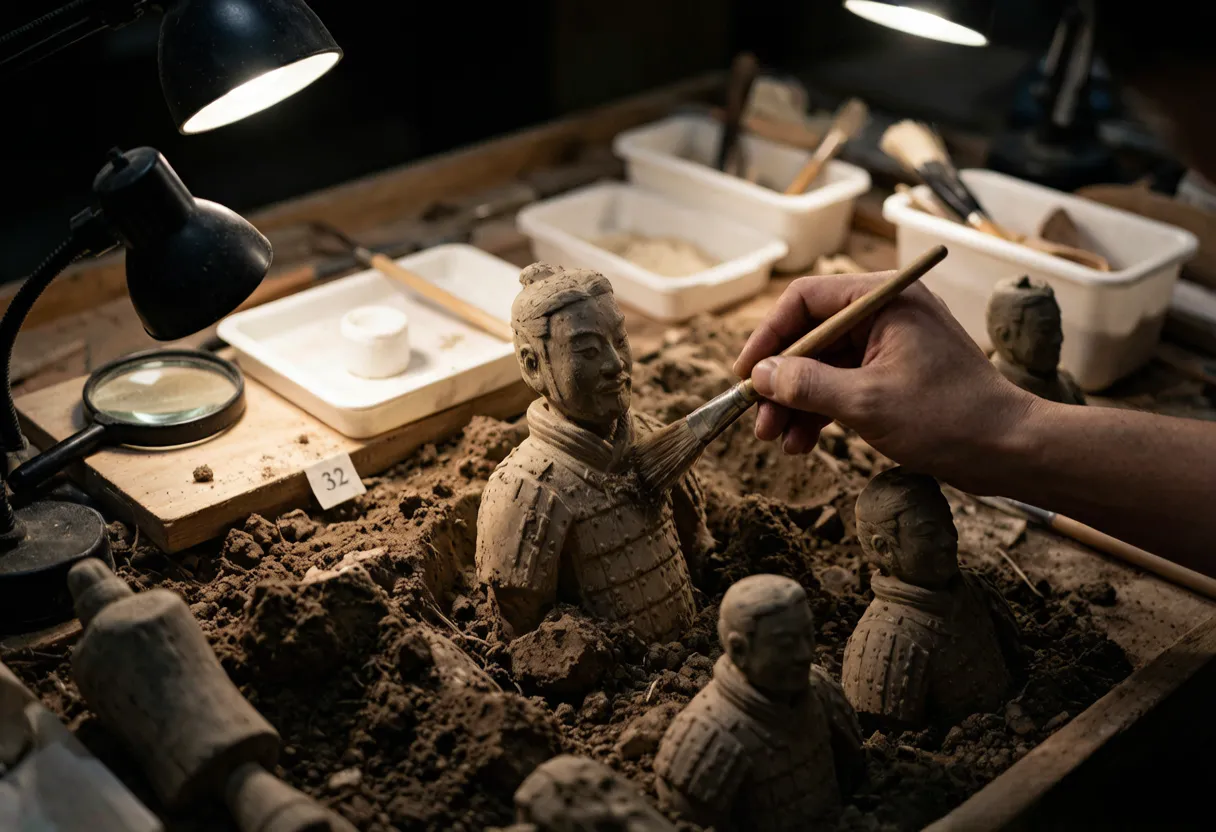
Archaeologists at work — each warrior is carefully excavated, restored, and studied by hand
To date, archaeologists have discovered over 600 burial pits in the mausoleum area, uncovering more than 50,000 cultural artifacts. These burial pits are widely distributed and rich in variety: pits containing weapons, pits containing chariots, pits containing musical instruments, pits containing exotic animals. Most shocking is the large amount of mercury found in the mausoleum area.
According to the "Records of the Grand Historian," the underground palace of Emperor Qin contained "mercury used as rivers, seas, and great waters." Archaeologists, using satellite remote sensing and soil mercury detection, found significantly higher mercury levels in the underground palace area compared to surrounding areas, distributed in a river-like pattern. This proves Sima Qian's account was not fiction — the underground palace indeed contains large amounts of mercury, which not only preserved but also symbolized rivers and seas.
What makes one imagine even more is that the underground palace has never been looted. Over two thousand years, numerous tomb raiders visited the Qin Emperor's mausoleum, but no one ever entered the underground palace. The mercury layer formed a toxic barrier that made robbers step back.
However, precisely because the underground palace has never been opened, we know very little about it. The former Chairman of ICOMOS said: "The excavation of the Qin Emperor's mausoleum must be approached with extreme caution. Our current cultural relic protection technology cannot ensure that excavated artifacts will be properly preserved."
Currently, archaeologists follow the principle of "protection first, rescue priority." They use high-tech methods to survey the mausoleum area but refrain from lightly disturbing the earth. Perhaps someday in the future, when technology is sufficiently mature, we will see the true face of the underground palace. But until that day comes, Qin Emperor's underground world will remain a mystery.
There are two main ways to travel from downtown Xi'an to the Terracotta Warriors Museum.
The first is by subway and bus. The terminus of Xi'an Metro Line 1 is Fangzhicheng Station. From there, take bus 307 or 914 directly to the Terracotta Warriors Museum. The journey takes about an hour and a half, and the fare is just a few yuan. This is the most cost-effective option, and along the way you can also see Xi'an's urban scenery.
The second option is by taxi or joining a day tour. Taking a taxi from downtown Xi'an to the museum takes about forty minutes, costing around 100 yuan.
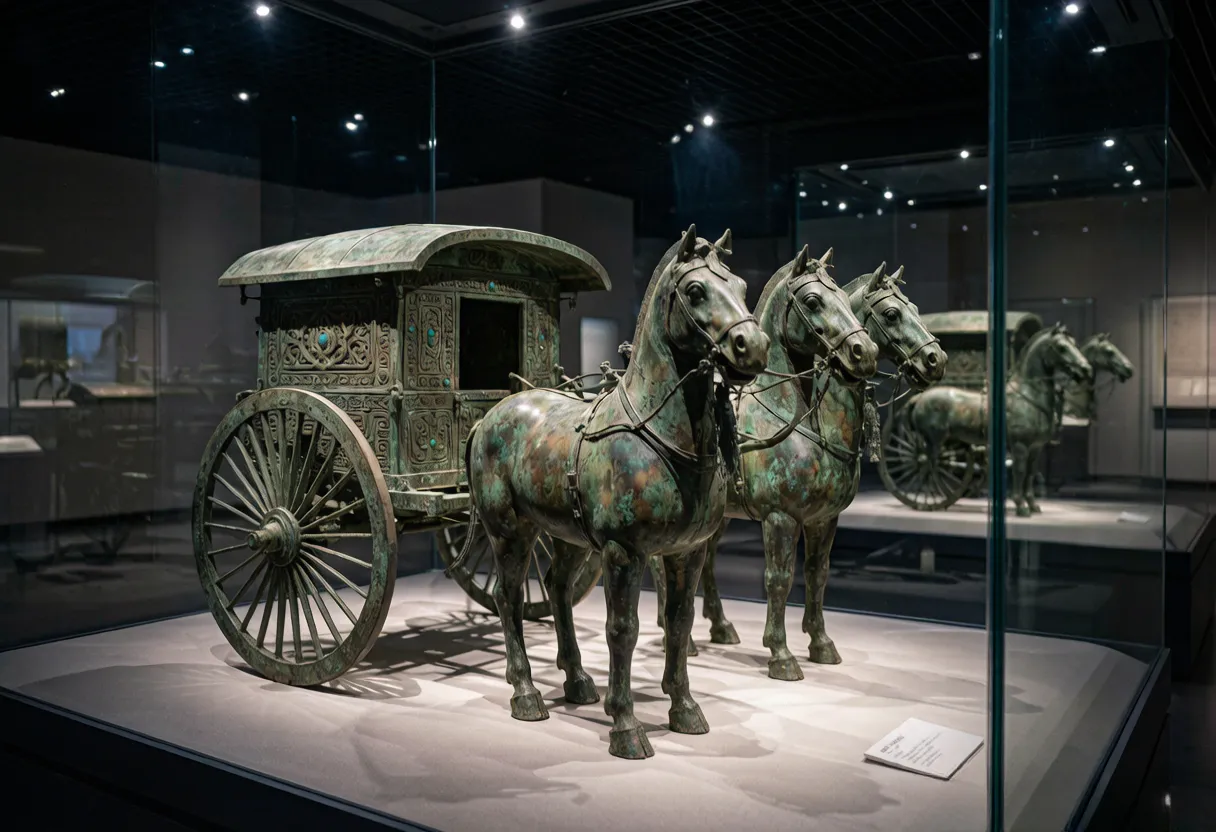
The Bronze Chariots and Horses — hailed as the "Crown of Bronzes," each composed of over 3,000 parts
The most sensible visiting route starts with Pit One. This is the largest pit and the most awe-inspiring. Standing on the viewing platform at the pit's edge, you can overlook the entire military formation and feel that overwhelming sense of scale. Walking to the bottom and observing the warriors up close, you'll discover more details — some stand with swords grounded, some with hands raised ready to strike, some with heads slightly tilted, as if listening to something.
From Pit One, walk north for a few minutes to reach Pit Three. This is the smallest of the three pits, but its significance is special. Archaeologists believe this was the command center of the entire army — the fewest warriors but highest ranks, including generals, staff members, and ceremonial guards.
Finally, there's Pit Two. Here the warriors retain the best color preservation — you can still see red, green, purple, and white clinging to their bodies. Pit Two also has the greatest variety of military units: cavalry, archers, infantry. If you're lucky, you can also see archaeologists conducting restoration work on-site.
After visiting the three pits, don't forget to visit the Bronze Chariots and Horses Museum. These two bronze carriages are hailed as the "Crown of Bronzes," each composed of over 3,000 parts with remarkable complexity. The proportions of the bronze horses nearly match real horses, with manes, nostrils, and hooves all vividly depicted.
The museum also offers digital experience programs. You can download the official app and scan warriors with your phone to learn about their manufacturing process and historical background. In the XR experience space on the basement level, you can "travel" back over two thousand years and feel the awe-inspiring scene of Emperor Qin's military review.
"I spent a full five hours here and still felt it wasn't enough. Every pit has its own story, every warrior has its own personality. This was the most unforgettable experience of my trip to China."
— Russian Tourist Ekaterina
If you think you can only view the Terracotta Warriors, you're wrong.
On the east side of the museum, there's a "Qin Warriors Village." The villagers here have been making terracotta replicas for generations. In 2008, the Qin Warriors craftsmanship was listed as a National Intangible Cultural Heritage. Today, Qin Warriors Village has become a cultural experience base, attracting hundreds of thousands of tourists annually.
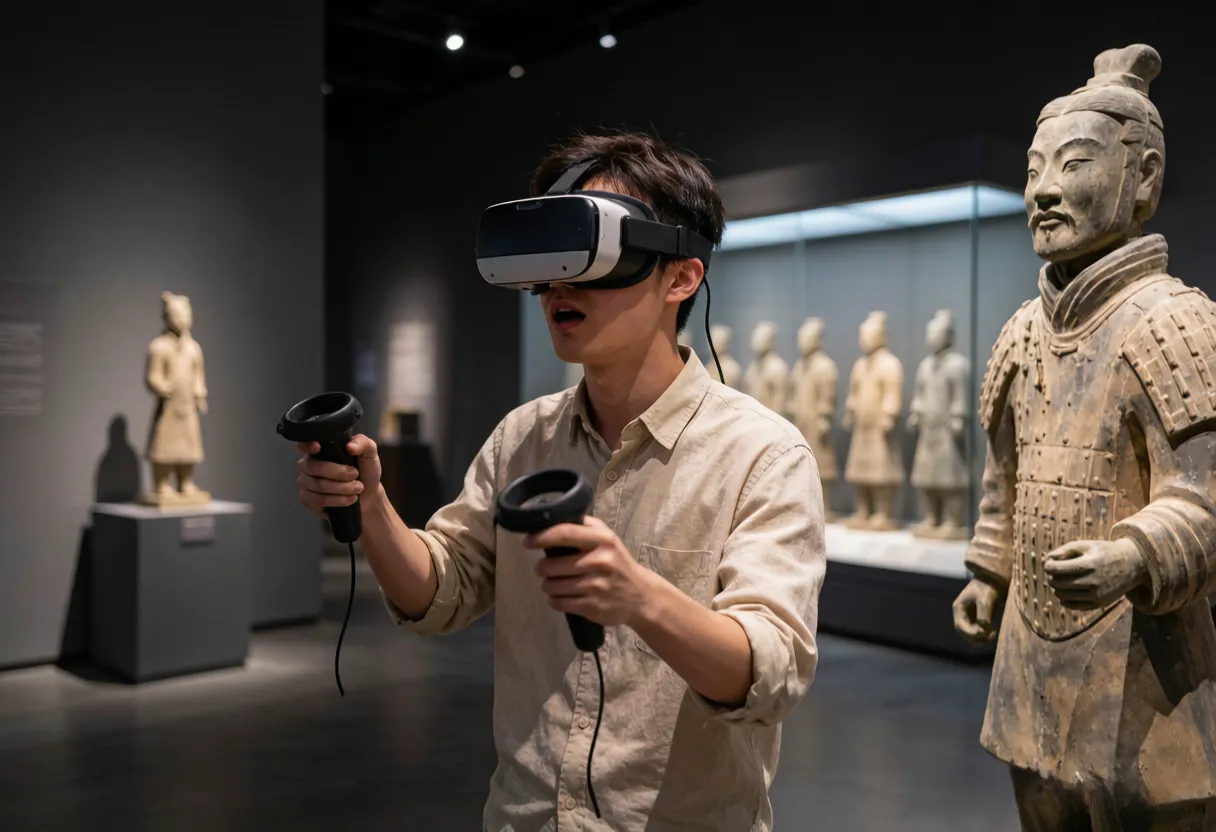
Modern technology meets ancient history — experience the Qin Dynasty military review through XR
In a spacious workshop, intangible cultural heritage inheritor Han Mi is teaching a group of foreign tourists to make terracotta warriors. She first explains the steps in English, then demonstrates kneading clay, shaping, and carving. The tourists sit around the workbenches, copying her movements with earnest effort.
After completing the making, you can inscribe your name at the bottom of the warrior. One tourist from Spain inscribed "CLARA 2024 XI'AN" on the bottom of her creation. She said: "I want to take this warrior home and put it on my desk. Every time I see it, I'll remember this journey, the craftsmen from two thousand years ago, and the eternity they left behind."
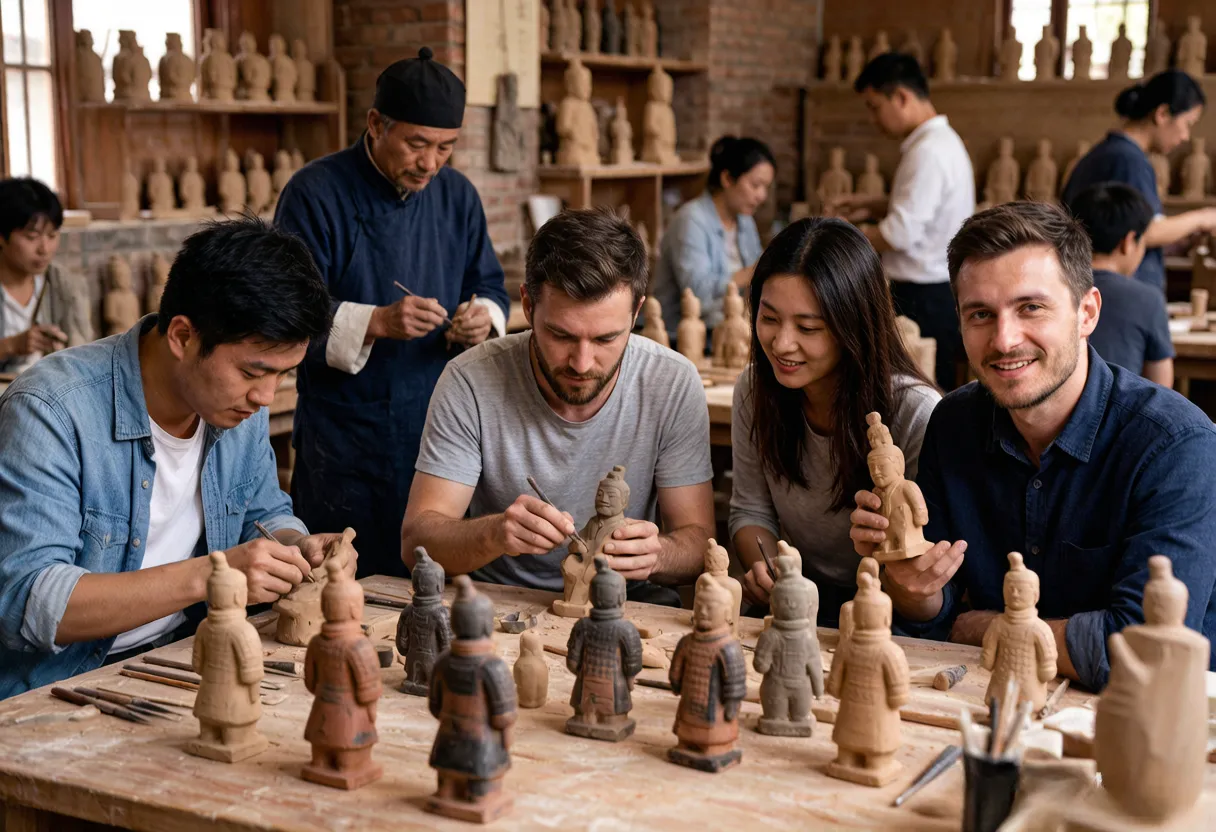
Shaping your own warrior — a hands-on connection with a two-thousand-year-old craft
After the terracotta experience, you can also stay at the nearby "Great Qin Military Camp" themed hotel. This hotel takes the Qin Dynasty military camp as its theme. Before falling asleep at night, you can hear distant drum beats, as if you have traveled back to that era.
If you want to understand the Terracotta Warriors even more deeply, you can also join the museum's "Little Archaeology Expert" research camp. Children can enter a simulated archaeological site under the guidance of professional archaeologists and use professional tools to "excavate."
"This trip left me with profound cultural memories. The Terracotta Warriors are not just clay figures — they are the dream of an empire, the dedication of countless craftsmen, a time capsule spanning two thousand years."
— Spanish Tourist Clara
You stand at the railing in front of Pit One, looking into the eyes of warriors from over two thousand years ago.
They are looking at you too. On those weathered faces, in those deep-set eye sockets, seems to lie the secrets of two thousand years. You cannot hear their breathing, yet you can feel a kind of gaze — not cold, not hollow, but warm, full of stories.
Over two thousand years ago, tens of thousands of craftsmen shaped these warriors with their own hands. They poured their emotions, skills, and hopes into the clay. They did not know their works would be discovered two thousand years later, did not know people from around the world would stand here marveling. They simply did their work seriously, like everyone in every age.
Chirac said: "Not seeing the Terracotta Warriors means not truly having visited China." Perhaps there is exaggeration in these words, but one thing is certain — some things can only be truly understood when seen with your own eyes.
Images can replicate the shape of cultural relics, but they cannot replicate the feeling of standing before them — that sense of time passing, that sense of dialogue with history. That feeling can only be experienced when you stand here yourself.
So come. Xi'an is waiting for you. The Terracotta Warriors are waiting for you. Those eyes from over two thousand years ago are gazing at you.
"Not seeing the Terracotta Warriors means not truly having visited China."