Ancient Trade · Silk Road
The Silk Road
Through Two Thousand Years of Wind and Camel Bells
There was a road that began in the ancient Chinese city of Chang'an, crossed deserts and snow mountains, and reached Rome on the shores of the Mediterranean. It carried not only silk, but grapes, Buddhist scriptures, and a thousand years of curiosity. That road was called the Silk Road.
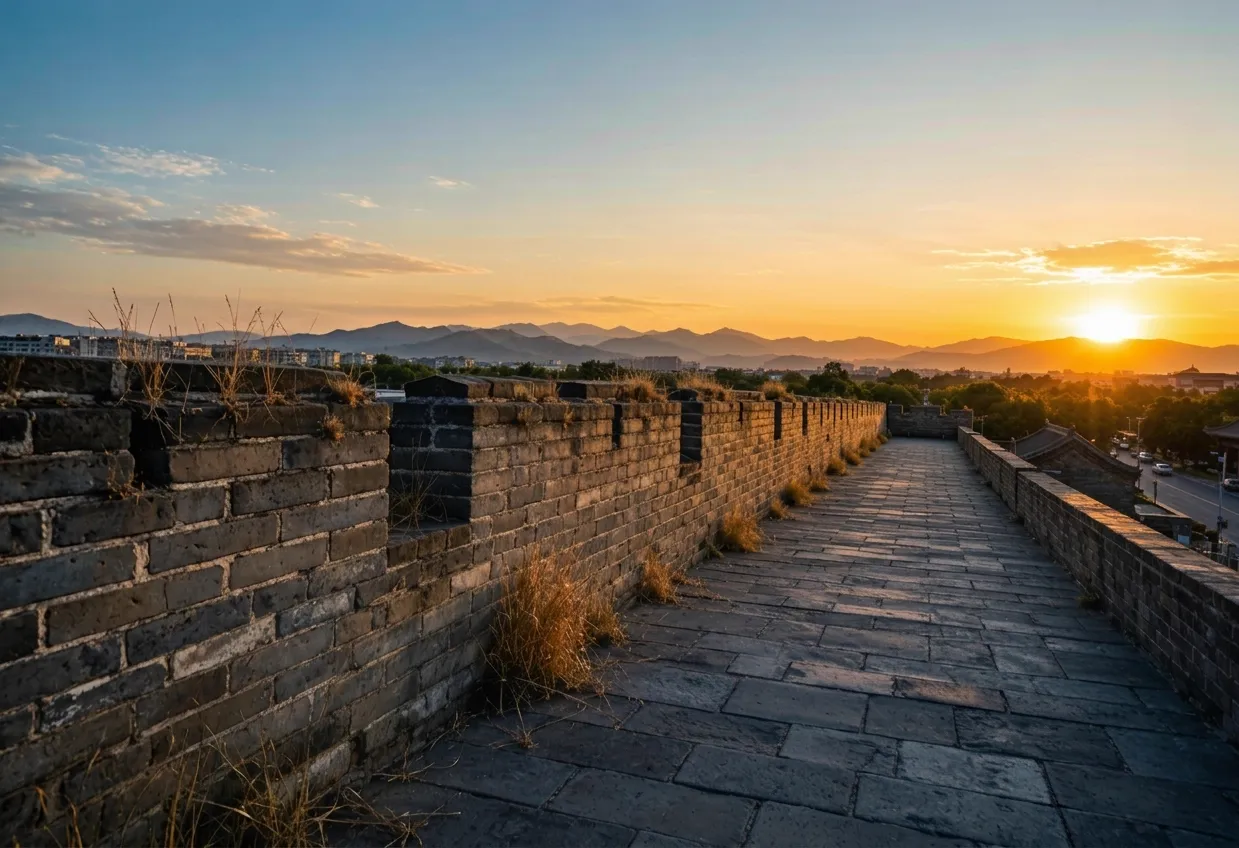
In the cracks between the bricks of Xi'an's city wall, a few stalks of dried grass cling to life. Run your fingers across a blue-gray brick, and you can see the year it was fired inscribed on its surface — "Wanli Year Four," which is 1576 CE, more than twenty years before Shakespeare wrote Hamlet. And beneath this wall lies an even older city: Chang'an.
Two thousand years ago, this city was home to one million people — at a time when London was still swampland and Rome had barely a quarter of its population. Chang'an was the largest city on Earth, bar none.
Close your eyes and try to picture it: Persian merchants haggling in the Western Market, their voices loud enough to carry three streets away; Sogdian camel caravans squeezing through narrow alleys, the copper bells on the camels' necks clinking ding-dang, ding-dang; a Central Asian barmaid pouring wine that glowed amber, a single cup worth three bolts of the finest silk; Buddhist monks who had walked three years from India, their straw sandals worn through seventeen pairs, just to translate a single scripture in this city.
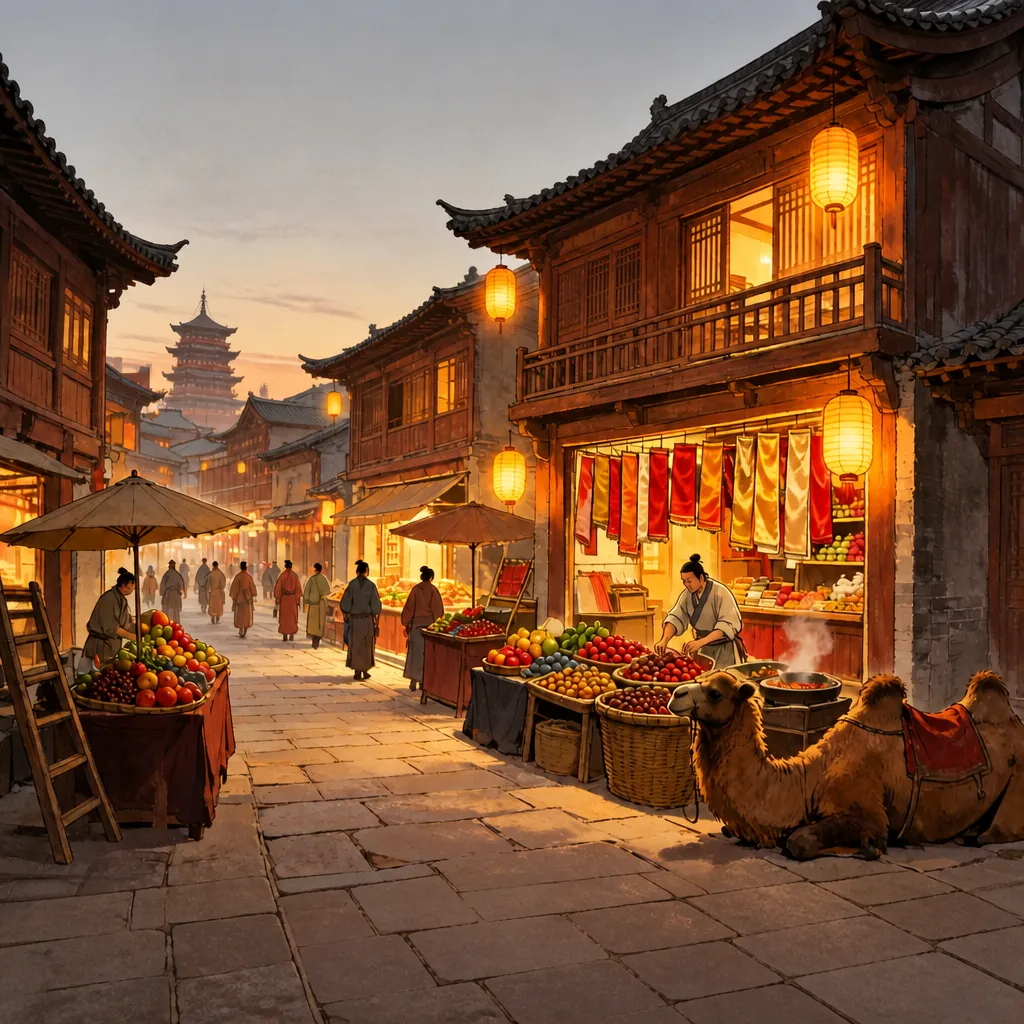
Imagine: thirteen hundred years ago, this street had more camels than the taxis you've seen all day
Stand on the city wall and look west. At the edge of the horizon, you can see the gray-blue silhouette of the Qinling Mountains, like a folding screen blocking the sky. Beyond the Qinling lies the Hexi Corridor — a narrow passage sandwiched between the Qilian Mountains and the Gobi Desert, only a few kilometers wide at its narrowest point. Beyond the corridor lies the Taklamakan Desert, the Pamir Plateau, the mountains of Afghanistan, the Persian highlands, and finally the Mediterranean Sea.
That is the direction of the Silk Road.
This was once the crossroads of the world. East met West here — they shook hands and traded the treasures from their pockets. Even now, the wind blowing from the west still carries grains of sand from a thousand years ago — you can taste that dry saltiness on your lips.
If this is your first time in China, Xi'an is the best starting point for understanding this country. It is not political like Beijing, not modern like Shanghai, not brand-new like Shenzhen. Xi'an is old — so old that every brick tells a story. And the most expansive of all those stories points west, and its name is the Silk Road.
The wall is 13.7 km in circumference. You can rent a bicycle at the gate entrance and ride the full loop — about 1.5 hours. Ride to the South Gate near sunset, when the dying sun turns the wall gold and crimson — the most beautiful moment of the entire route. Wall ticket: 54 RMB. Bike rental: 45 RMB / 3 hours.
In 138 BCE, a young man named Zhang Qian set out from this city.
He held a bamboo pole topped with yak-tail hair. This object was called a "jie" — you can think of it as an ancient diplomat's passport, but it was more poetic than that: it represented the emperor's authority, and whoever held it was an envoy of the Son of Heaven. One rule held throughout: as long as the person lived, the jie lived; if the person died, the jie was buried with them. Whether returning alive or dead, it never left their hand.
Zhang Qian's mission was to find the Yuezhi tribe, who had migrated westward, and persuade them to join forces with the Han Dynasty against the Xiongnu. The problem was: no one knew where the Yuezhi actually were. No maps, no navigation, no one had ever walked this route. He set out with over a hundred men, heading toward a direction that was "roughly west."
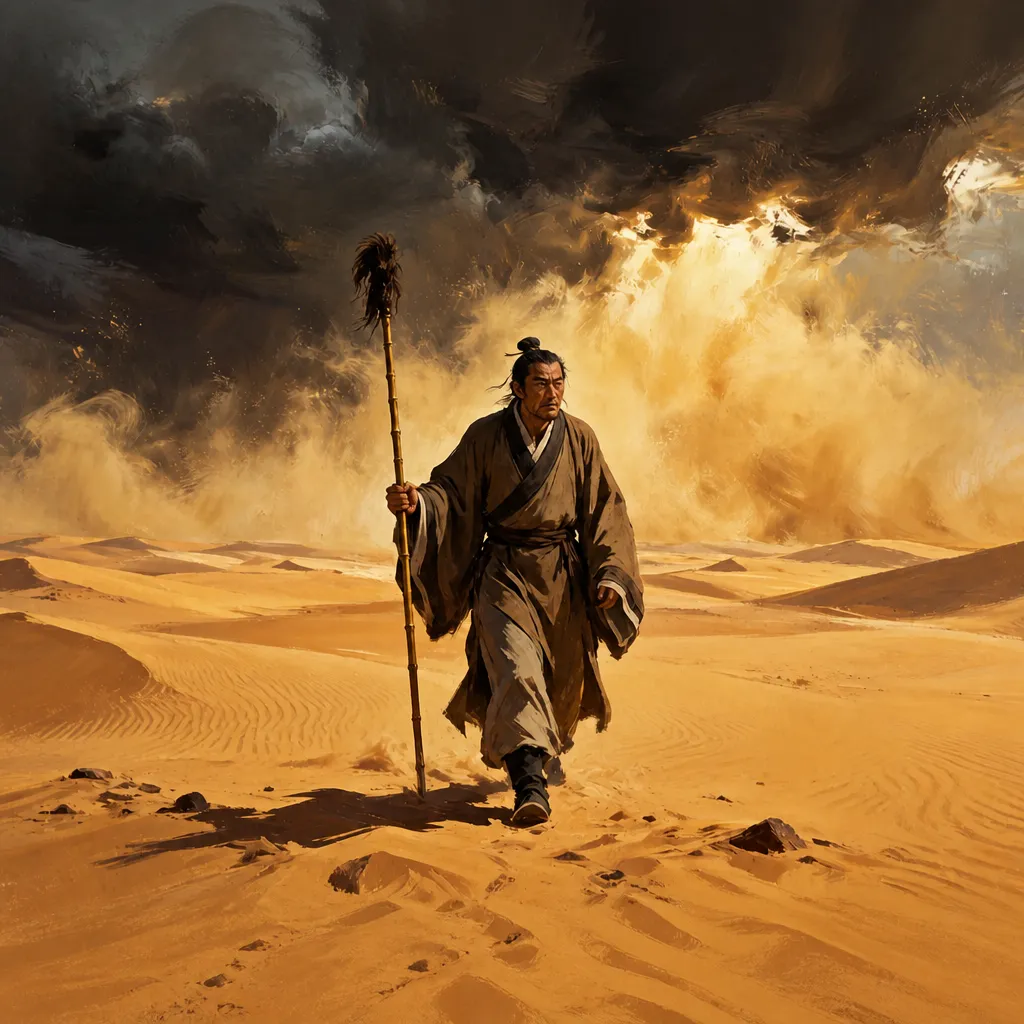
Holding the Han imperial staff, crossing the Gobi — he departed with over a hundred men, and returned with only two
They had barely entered the Hexi Corridor when Xiongnu cavalry captured them.
The Xiongnu chieftain did not kill him. Instead, he gave Zhang Qian a Xiongnu wife and set him to herding sheep and horses. He was held captive for ten years. During that decade, his Xiongnu wife bore him children, and the grass on the steppe turned green, then yellow, then green again. Anyone else might have accepted their fate — a wife, children, a flock of sheep. A life on the steppe was not a bad one.
But Zhang Qian did not. For ten years, he never loosened his grip on that yak-tail staff. In the dead of night, he would hold it to his chest and gaze in the direction of Chang'an. He was waiting for an opportunity.
Finally, on a night when the guards were slack, he made a cruel decision: he left behind his Xiongnu wife and children, and fled westward with his men. Can you imagine that scene — under moonlight, a man glances back at his sleeping family in the tent, then turns and walks into the vast darkness, never looking back.
They crossed the great Gobi Desert. By day, the sun baked the sand hot enough to blister the soles of their feet, and heat waves warped the horizon, making them think they saw a lake ahead — only to find nothing when they reached it. By night, the temperature plummeted, and the cutting wind slashed their faces like knives. Their rations ran out, and they survived by hunting wild game. Sometimes they went three days without a single drop of water. When they crossed the Pamir Plateau, the mountain passes were choked with ice and snow, and the wind could blow a person off a cliff. Some of them stayed there forever — frozen at a mountain pass, or collapsed on the Gobi, buried by wind and sand, their names lost.
He finally reached the Yuezhi. But the Yuezhi had already settled into their new land, raising cattle and farming, living comfortably. They had no desire to go to war with the Xiongnu again. Zhang Qian stayed for over a year, pleading his case, but they would not be moved.
Thirteen years after he had set out with over a hundred men, only he and a servant named Tangyifu walked back into Chang'an. He stood before Emperor Wu of Han, clothes in tatters, face aged beyond recognition — but his hand still clutched that yak-tail staff. Most of the tail hairs had fallen off; only a few sparse strands trembled in the wind.
The historian Sima Qian recorded this feat with two characters — "zao kong," meaning "to pierce the void."
Literally, it means "chiseling through emptiness." Imagine a pitch-black room that has never had a single window — no one knows what lies beyond the walls. One person gropes his way out and, blow by blow, chisels open the first ray of light. That light illuminated a ten-thousand-li road from Chang'an to Rome.
Zhang Qian brought back intelligence on 36 kingdoms of the Western Regions — names that had never before appeared in Chinese history. His oral report was recorded by Sima Qian in the "Records of the Grand Historian," becoming China's first "world geography." You could say Zhang Qian was China's Marco Polo — except he preceded Marco Polo by fourteen hundred years.
The most common thing traveling this road was not silk — it was camels.
A single camel could carry 150 kilograms of goods and travel 40 kilometers a day. The entire journey from Chang'an to Rome took two years. But silk was the most valuable cargo — a bolt of fine Shu brocade could fetch its weight in gold in the Roman market. Roman noblewomen were obsessed with it, and the Senate once even banned men from wearing silk, on the grounds that it was "indecent."
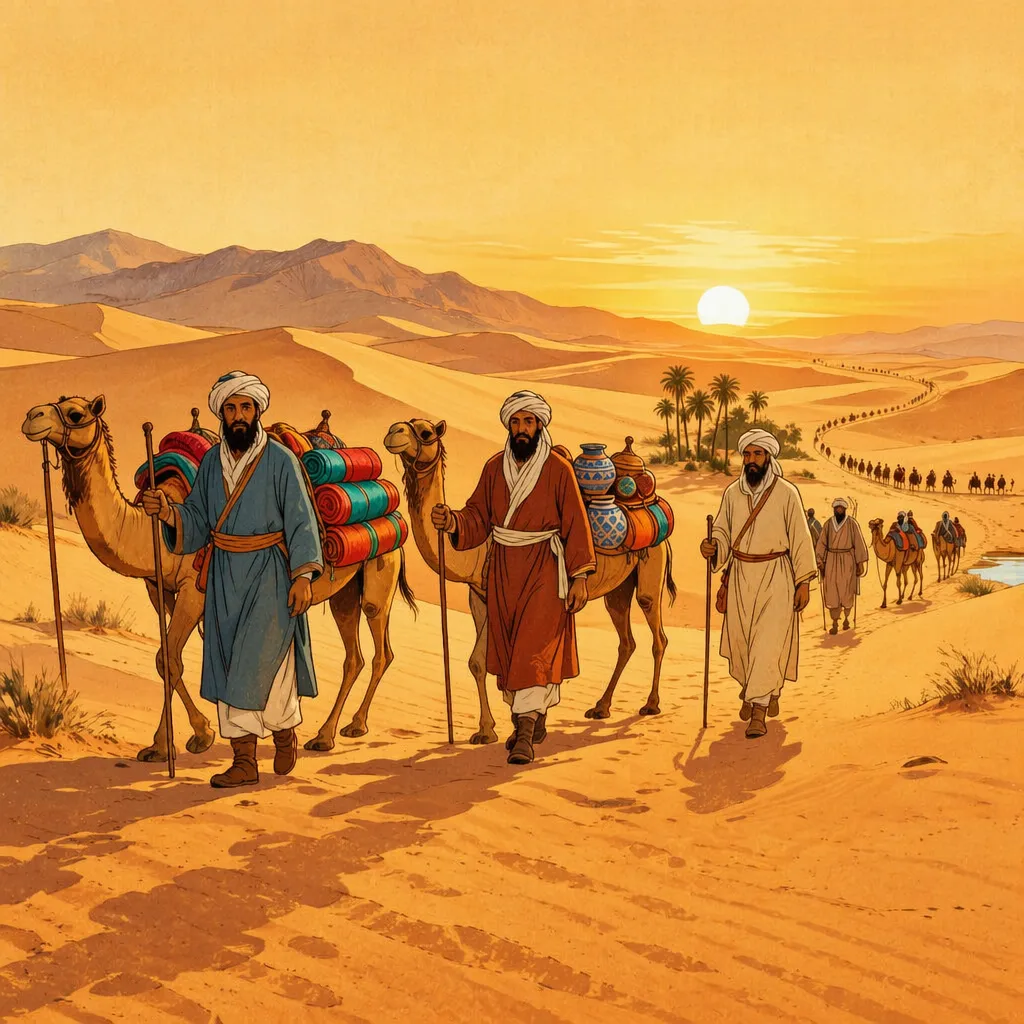
Camels were the true heroes of the Silk Road — 150 kg per camel, 40 km a day, two years from Chang'an to Rome
But the most fascinating thing was not silk — it was how the people at both ends of this road exchanged each other's daily lives.
While Roman noblewomen wore translucent silk robes to banquets, the common people of Chang'an were tearing open a freshly baked hu bing — a flatbread whose recipe came from the Western Regions, sprinkled with sesame seeds that were also from the West. Look east and west simultaneously: on the morning a Roman put on Chinese silk, a resident of Chang'an was tasting grapes from the Western Regions, with a cup of wine made using Western methods sitting beside him.
One road, people at both ends, unknowingly swapping each other's breakfast.
Wearing Chinese silk to banquets, drinking Eastern spiced wine
Eating Western flatbread, drinking Persian grapes, playing the hu fiddle
Grapes, pomegranates, walnuts, cucumbers, garlic, cilantro, sesame, fava beans, figs — these foods, now utterly ordinary on Chinese dining tables, all entered China along this road. To this day, the Chinese word for walnut is "hu tao," garlic is "hu suan," and sesame is "hu ma" — that prefix "hu" was what Chinese people two thousand years ago called all things from the Western Regions.
What traveled outward was silk, iron-casting technology, and lacquerware. The Ferghana horses of the Dayuan kingdom trotted eastward against the flow of merchant caravans and into the stables of Emperor Wu of Han — it was said that these horses sweated blood, and the emperor launched a war to obtain them. Buddhist scriptures, carried on the back of a white horse, crossed the Pamirs and arrived at the White Horse Temple in Luoyang — China's first Buddhist temple, whose name memorializes the horse that carried the sutras.
This road was never just about transporting silk. It carried the careful, tentative curiosity of two civilizations sizing each other up. The Chinese tasted the sweetness of the Western Regions in grapes and heard the wind of the steppe in the sound of the hu fiddle; Romans felt the warmth of the East in silk and saw moonlight from a distant land in porcelain. There were no conquerors on this road — only merchants and monks. They replaced swords with goods and scriptures, replaced hostility with curiosity. For two thousand years, this road proved that the best way for civilizations to interact is not war, but trade.
Next time you eat a bowl of noodles with garlic and cilantro at a Chinese breakfast spot, snack on some walnuts, and drink a glass of grape juice — congratulations, you've just eaten an entire Silk Road. All of these foods entered China two thousand years ago along the route Zhang Qian walked. Every flavor on your tongue is a two-thousand-year-old "import."
You stand at the entrance of Cave 45 at the Mogao Caves in Dunhuang.
Light pours in from behind you, illuminating an entire wall. A painted clay bodhisattva from the High Tang Dynasty gazes back at you — a faint smile on its lips, body tilted ever so slightly, robes seeming as though they might flutter at any moment. That smile is serene, subtle, carrying an indescribable tenderness. You stare at it, and it stares back. That gaze has watched for thirteen hundred years — it has seen countless merchants pass by, seen dynasties rise and fall, seen deserts swallow oases and spit out new ones.
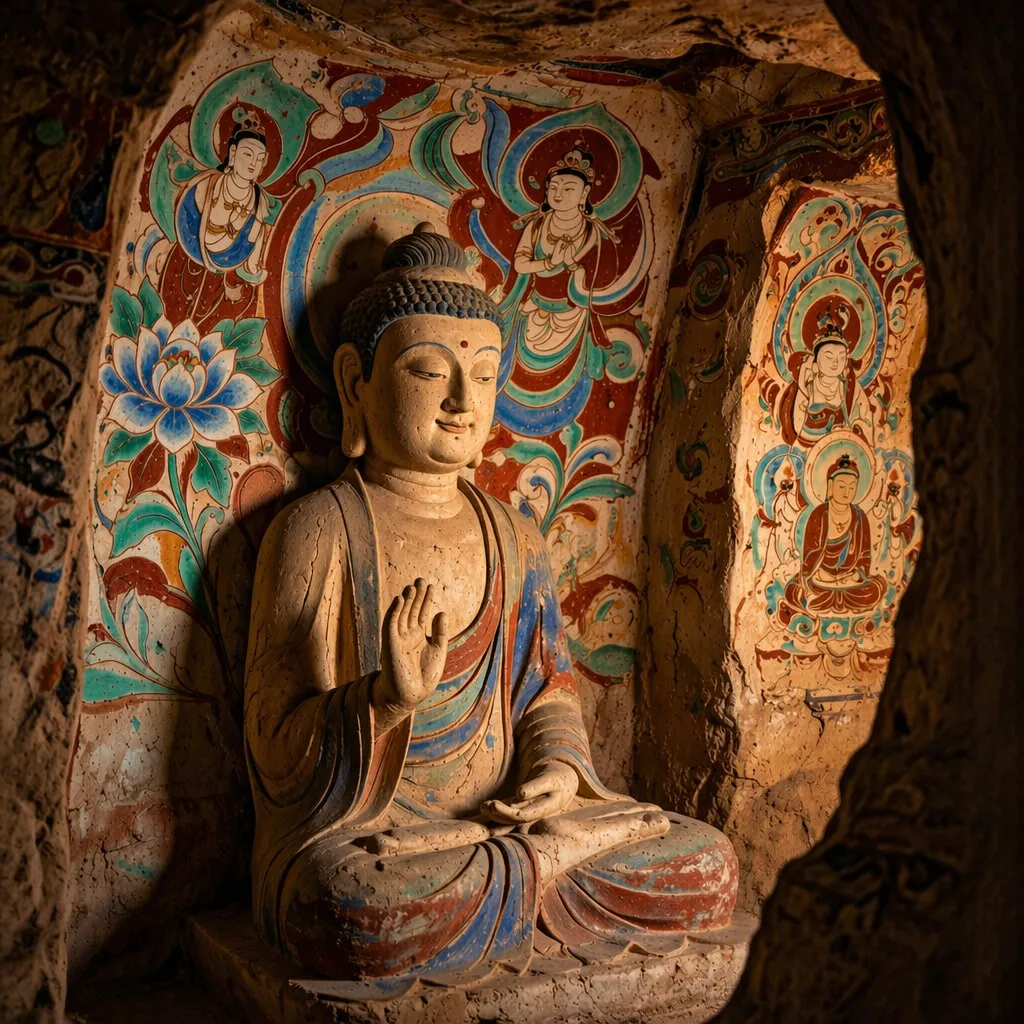
The moment you step inside the cave, thirteen hundred years of time freeze before your eyes
Step further in and look up — apsara murals cover the ceiling.
No wings, no feathers, no halos — none of the trappings of Western angels. A flying apsara soars through a blue void armed with nothing more than a trailing ribbon and a fluttering skirt. The ribbons stream behind, the fabric billows forward, the body tilts at an impossible angle — the painters captured the wind itself. They have been flying for thirteen hundred years, never pausing.
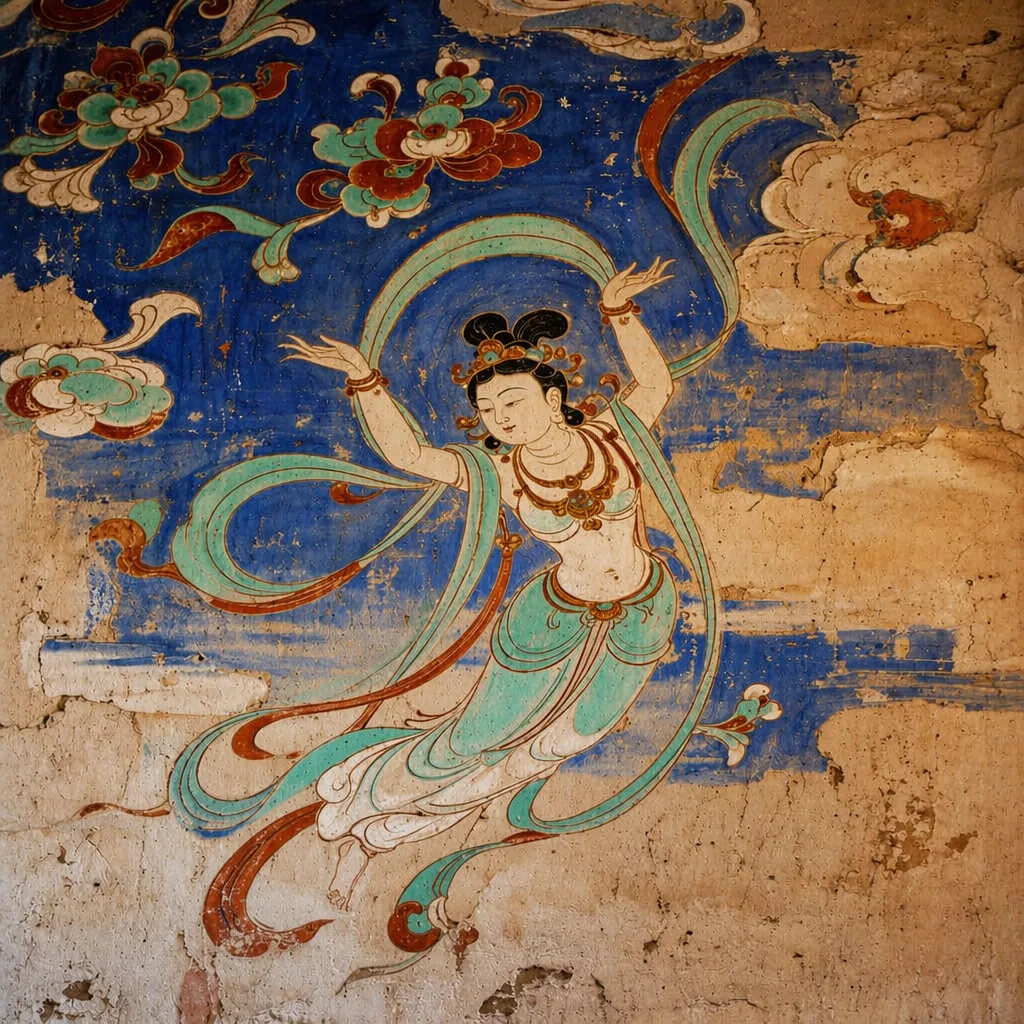
No wings, no feathers — soaring through the void on a single ribbon. The painters captured the wind itself
You will notice that the colors are extraordinarily still. Not cheaply bright, but a deep, time-polished saturation.
The blue is ground lapis lazuli. This mineral comes only from deep within the Hindu Kush mountains of Afghanistan — three thousand kilometers from Dunhuang, across the Pamir Plateau and the Taklamakan Desert. Caravans carried these blue stones over snow mountains, through deserts, traveling for months before reaching Dunhuang. Then painters ground them to powder, mixed them with animal glue, and brushed them onto the wall, stroke by stroke.
The green is turquoise. The red is cinnabar. The white is powdered shell — ground so fine that, once applied, it still glows warm and jade-like after a thousand years. These pigments, born of stone and mineral, share one trait: unlike plant dyes, they do not fade. They are stubborn enough to refuse being bleached by time. The blue of a thousand years ago is still that blue today. The red of a thousand years ago is still that red.
These mineral pigments traveled three thousand kilometers from Afghanistan to Dunhuang. Once the painters brushed them onto the walls, they stayed for a thousand years. Plant dyes fade — mineral pigments do not. That is the secret of why the Mogao murals remain as vivid today as the day they were painted.
The Mogao Caves have 735 caves, 45,000 square meters of murals, and over 2,400 painted sculptures. This is the world's largest art museum painted on mud walls — and it is not in Paris, not in Rome, not in New York. It was built in the desert, beside the loneliest stretch of the Silk Road.
Every merchant who passed this place — whether Persian, Sogdian, Tibetan, or Han Chinese — could look up and see those densely packed caves on the cliff face, like a row of silent eyes watching the comings and goings of camel caravans. Those merchants may not have been literate, may not have understood Buddhist scriptures, but they would stop, step inside a cave, light an oil lamp before the bodhisattva's smile, and pray for a safe journey ahead. Then they would walk out, mount their camels, and continue west.
A thousand years later, you step into the same cave, stand before the same bodhisattva, and see the same smile. The world outside the cave has been turned upside down — the Tang Dynasty fell, the Silk Road went silent, camels were replaced by trains and airplanes. But inside the cave, nothing has changed. The bodhisattva still smiles, the apsaras still fly, the lapis lazuli blue is still the same blue from a thousand years ago. Time stopped here — or rather, time here turned into color.
The Mogao Caves operate on a reservation system — book tickets up to 30 days in advance on the official website (peak season July-August sells out fast). Each visitor receives an audio headset, and a professional guide leads groups into 6-8 standard caves. Cave 45 is a "special cave" requiring an additional ticket, but it is absolutely worth it. Photography is prohibited inside the caves — put your phone away and let your eyes remember everything.
Today, you can still visit the site of Chang'an's Tang Dynasty Western Market and step on the soil layer that holds Tang-era cart ruts. Archaeologists have unearthed Tang Dynasty floor tiles, camel bones, and Persian silver coins there — the marks left by wheels fourteen hundred years ago are still clearly visible. Crouch down and run your fingers along a cart rut. The soil is cool, rough, carrying the musty scent of old earth. What your fingertips are touching is the imprint left on a certain day in the seventh century, when an ox cart loaded with silk rolled over this very spot.
At the foot of Dunhuang's Mingsha Mountain, you will hear a strange sound. The wind blows sand grains up the back of the dune, and as they rub against each other, they emit a deep hum — like distant drums, or the simultaneous ringing of copper bells on the necks of ten thousand camels. Locals call this "the clear chime of the sand ridge." They say it is the echo of camel bells from a thousand years ago.
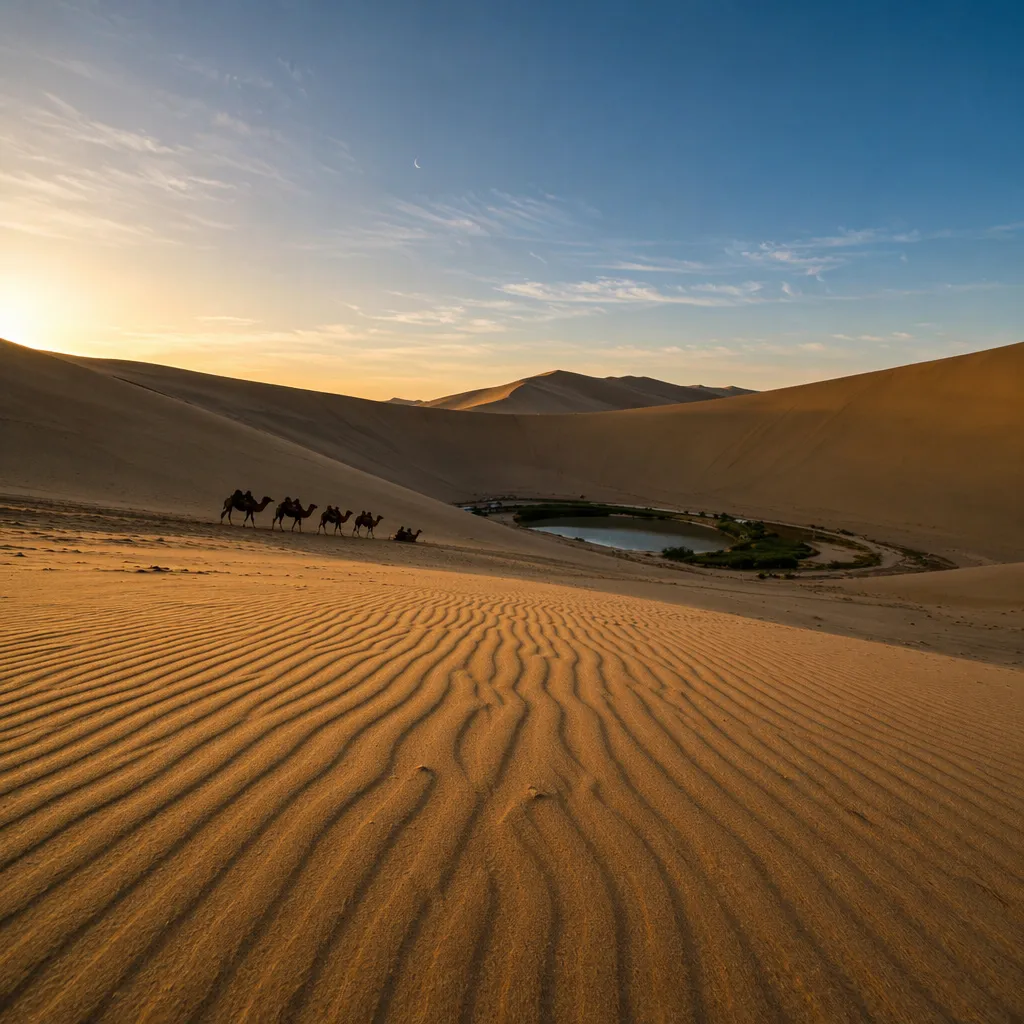
Ride a camel to the top of Mingsha Mountain at sunset — the dunes hum with the echo of ancient camel bells
At sunset, ride a camel to the summit of Mingsha Mountain. The dunes shift from gold to copper to deep purple, before sinking into the indigo twilight. At their feet lies Crescent Lake, like a green teardrop set in the heart of the desert — it has never dried up in over a thousand years. Sit on the ridge and feel the wind blowing from the west, carrying dry grains of sand — the very same wind that Zhang Qian felt on his face.
Ride the city wall loop (13.7 km) → Visit the Tang Dynasty Western Market Museum (free) → Shaanxi History Museum (Tang Treasure Hall is a must) → Evening stroll at Giant Wild Goose Pagoda Plaza
Fly to Lanzhou, then high-speed train to Zhangye (Danxia landforms) → Jiayuguan (western terminus of the Great Wall) → Train to Dunhuang
Mogao Caves (book 30 days ahead) → Mingsha Mountain & Crescent Lake (enter 2 hours before sunset, ride a camel to the dune top) → Shazhou Night Market for flatbread and apricot-skin tea
The bricks of the city wall are still there. The murals of the Mogao Caves are still there. The road is still there. The light that Zhang Qian chiseled through the void has never gone out in two thousand years.
From Xi'an to Dunhuang, from desert to oasis, from one city to the next. This road is worth measuring with your own footsteps, seeing with your own eyes, tasting with your own tongue — taste a grape, bite into a flatbread, touch an ancient brick on the city wall.
Two thousand years ago, a young man named Zhang Qian set out from here, walking into the unknown. Today, it is your turn.
Pack your bags and go.