Peking Opera
The Sound of Oriental Grand Opera — And Where You Can See It
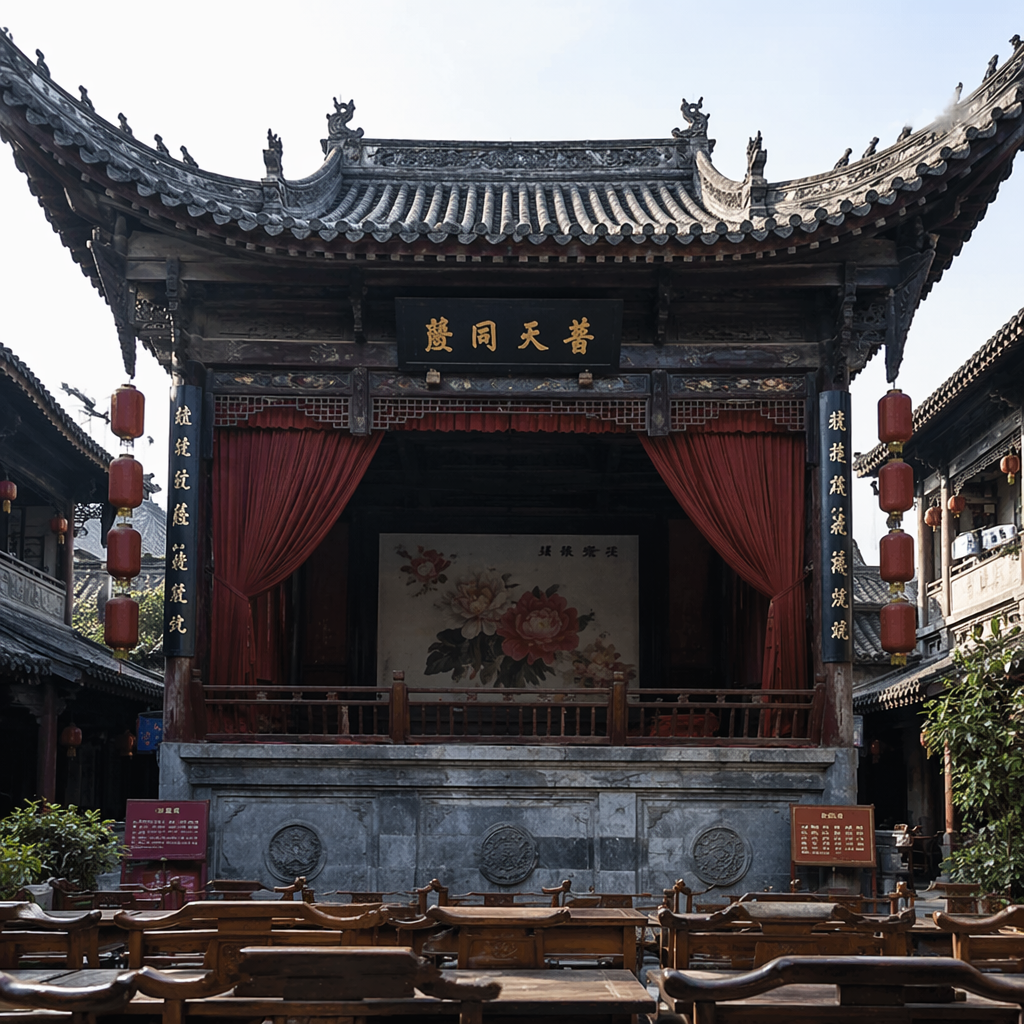
You step into a two-hundred-year-old opera house. The wooden floorboards creak softly beneath your feet. The air is filled with the faint scent of tea and aged timber—the same smell you remember from the old teahouses of your childhood. The audience is already full: well-dressed elderly locals, tourists with cameras, young parents with children. Everyone is waiting for something. The entire theater feels like an inflated balloon, waiting to be popped.
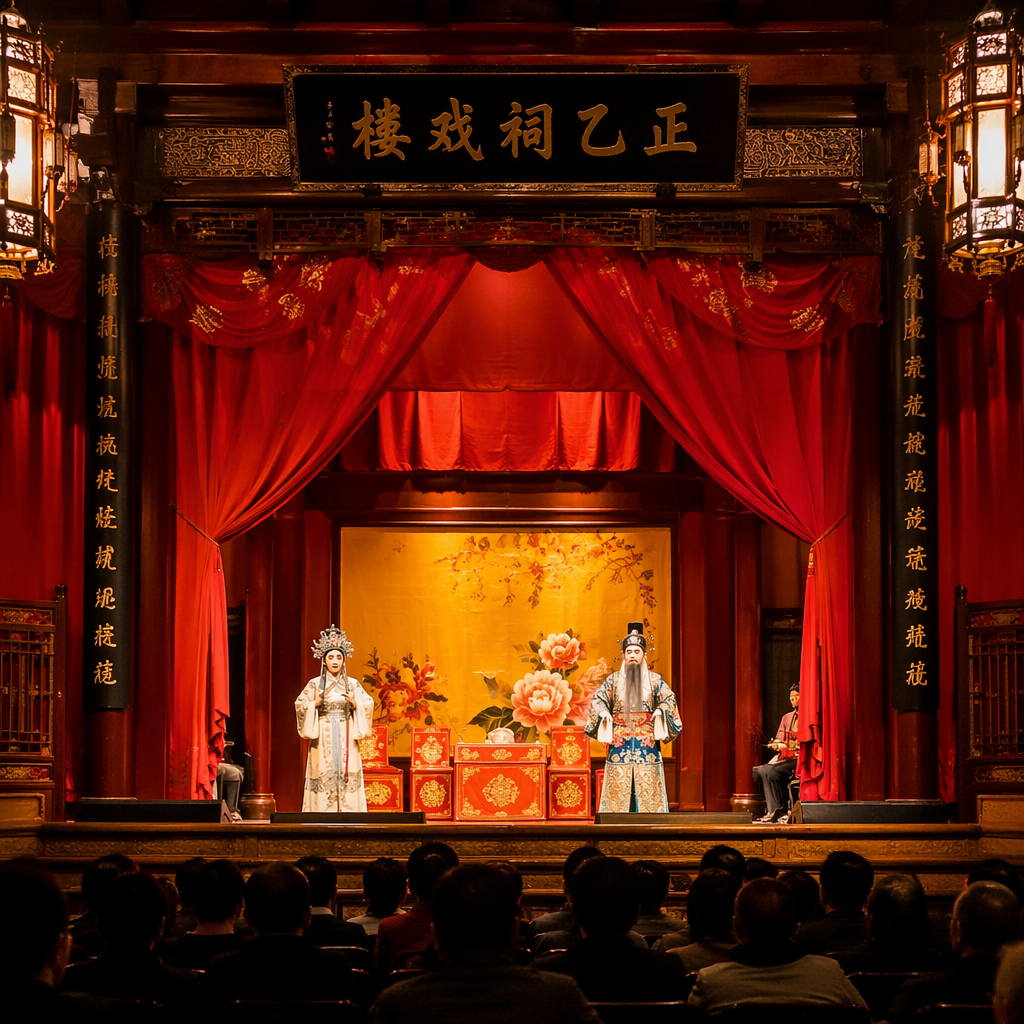
The lights dim. Three beats of gongs and drums ring out—"Clang! Clang! Clang!" The sound seems to rise from deep underground, vibrating through your chest. The sound doesn't come from speakers—it comes from the musicians on stage, dressed in black Chinese gowns, some striking gongs, some beating drums, some playing the huqin fiddle. When the lights come back up, a painted face emerges from the wing.
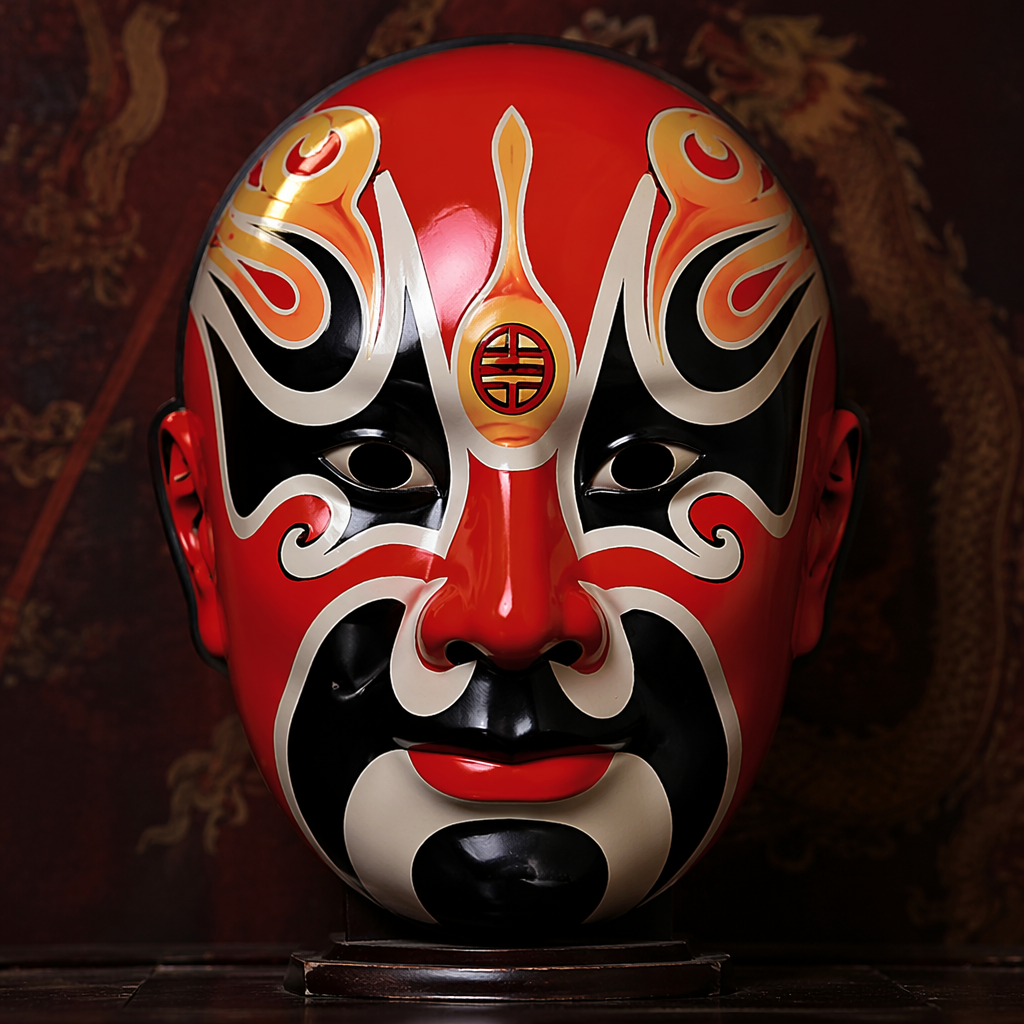
The eyes on the mask are larger than a bowl, their corners raised upward as if they could see through everything. The eyebrows are painted into inverted V-shapes, like two small knives. The face is red—red like blood, red like the sunset, red like the Spring Festival couplets you pasted as a child. He opens his mouth to sing—a sound. How to describe it? Like something drifting from very far away, like something growing from your heart. You freeze—not because you don't understand, but because of that impact. You don't need a translation.
This is Peking Opera. Not the fragments you've seen in movies, not the static exhibits in museums. It's a living art—you can hear it, see it, feel it. An art form that still breathes. It has been performed in China for over two hundred years. And you? You're sitting in the audience, right now. In this moment, you become part of these two hundred years of history.
If we must use a concept familiar to foreigners, Peking Opera can be called "the opera of the East." But this explanation isn't quite accurate—it's much richer than opera. Opera is mainly about "singing," but Peking Opera requires four essential skills—singing, speaking, acting, and martial arts. Think of it as China's version of Broadway musical + circus + Shakespeare drama combined, the premium version.
"Chang" (唱) is singing—the unique vocal techniques used to express emotions. Peking Opera's singing isn't random melody—it's strictly standardized with specific patterns and tunes for different role types, different emotions, and different scenes. A good Peking Opera performer can, the moment they open their mouth, tell you what they're expressing—whether it's sorrow or joy, anger or worry.
"Nian" (念) is speaking—dialogue. Peking Opera dialogue isn't ordinary speech—it's rhythmic, artistically processed language. It sounds like speaking, but better than speaking, like reading with melody. A skilled performer can get the audience to applaud with just one line of spoken dialogue.
"Zuo" (做) is acting—body language, expressions, movements. A glance, a gesture, a step—every movement conveys information. Peking Opera has specific names for hand gestures—"cloud hands," "orchid finger," "sword fingers"—each movement has its own rules. A performer doesn't need to speak; standing there silently, you can feel the emotions they're conveying.
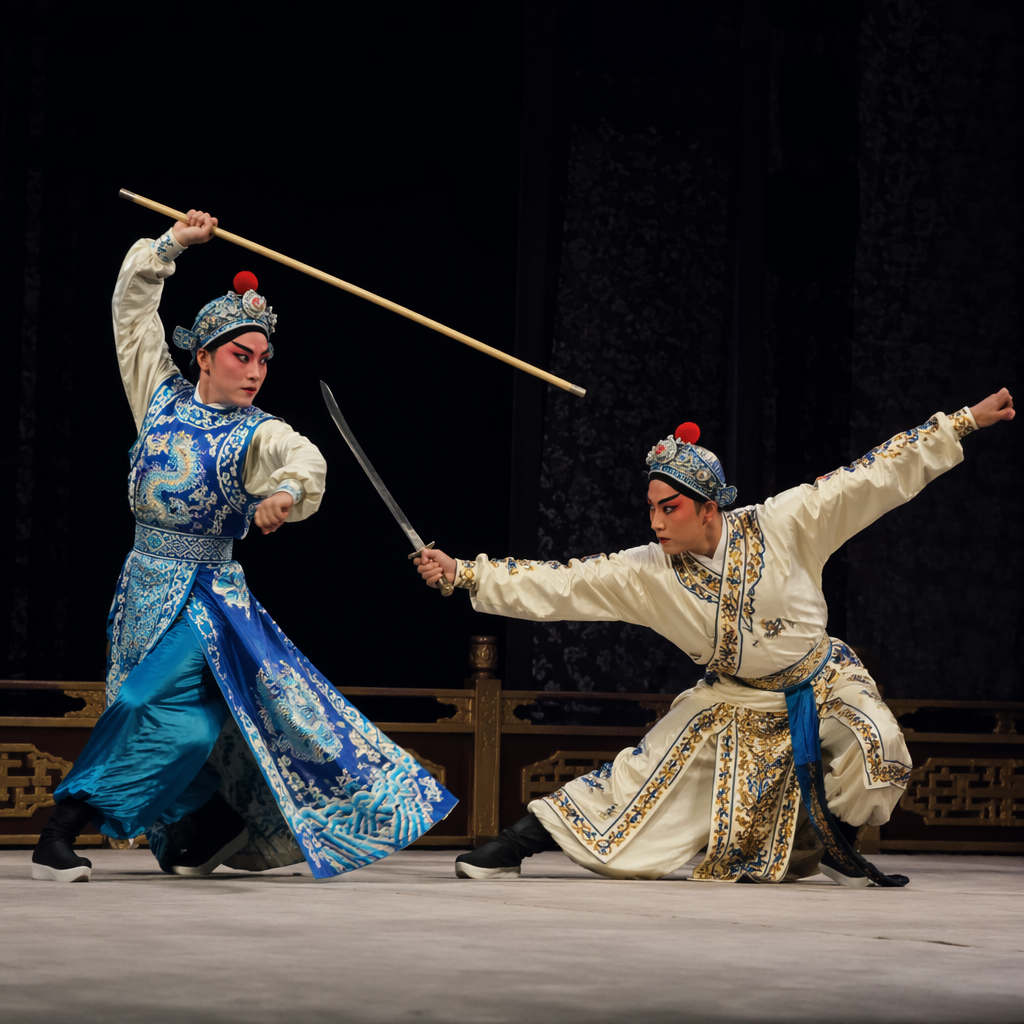
"Da" (打) is martial arts. But this isn't the flower boxing of wuxia films—it's real skill. Those tumbling jumps aren't acrobatics—they're real kung fu trained since childhood. Those sword fights aren't special effects—they're real weapons wielded by performers who've trained for decades. In "Battle of Changbanpo," one performer performs thirty-eight consecutive front flips on stage. The audience erupts with "Hao!"—a shout that finally releases the emotions they've been holding back, like watching a World Cup goal.
In 2010, UNESCO listed Peking Opera on the Representative List of the Intangible Cultural Heritage of Humanity. Peking Opera, along with Traditional Chinese Medicine, calligraphy, and martial arts, are known as China's "Four Great National Treasures." The description states: "Peking Opera is a comprehensive performing art integrating singing, speaking, acting, and martial arts, with unique aesthetic characteristics in its vocal music, music, performance, and stage design." In plain English: this art form is one of a kind in the world—you'll absolutely miss out if you don't see it with your own eyes.
There are three ancient dramatic traditions in the world: Greek tragedy/comedy, Indian Sanskrit drama, and Chinese opera. The first two have gradually faded into history, but Chinese opera has been passed down through generations and reached ever greater heights. Among more than 300 Chinese regional opera forms, Peking Opera is universally recognized as the brightest jewel.
In 1790, during the reign of Emperor Qianlong in the Qing Dynasty, four opera troupes from the south—Sanqing, Suxi, Chuntai, and Hechun—arrived one after another in Beijing. They collaborated with performers from Hubei (Han Tune), while also absorbing elements from Kunqu, Qinqiang, and other operatic traditions. Through continuous exchange and fusion, Peking Opera was born. The 1,300+ Peking Opera stories, strung together, form exactly a scroll painting of several thousand years of Chinese history.
Around 1850, famous performers like Cheng Changgeng, Yu Sansheng, and Zhang Erkui emerged—they're called the "First Three Greats" and laid the foundation of Peking Opera. Later came the "Four Great Dan" (Mei Lanfang, Cheng Yanqiu, Xun Huisheng, Shang Xiaoxian) and the "Four Great Sheng" (Ma Lianliang, Yan Jupeng, Zhou Wenchang, Wang Guifu)—Peking Opera schools flourished like never before.
In the twentieth century, Peking Opera produced a giant—Mei Lanfang. In 1930, he brought Peking Opera to Broadway in New York. He performed "Fishing at the River," "Sword Dance," and "Kunqu" in New York. The New York Times asked him: "You have no dialogue. How can the audience understand?" Mei Lanfang smiled and answered: "Our performance itself is speaking." That year, he showed Americans for the first time: drama doesn't need words one by one—it can tell a whole story through body, through eyes, through a single gesture.
Since then, Peking Opera has become China's brightest cultural calling card. Art classrooms around the world teach "Mei Lanfang"—a name that has become a legend in itself. Peking Opera troupes have toured internationally many times, causing sensations in the global art world.
You might think: without knowing Chinese, won't Peking Opera be completely incomprehensible? Wrong. This is precisely the most magical thing about Peking Opera—it is an art of "seeing."
The facial makeup is the first layer of the code. Peking Opera facial makeup techniques are basically divided into three types: rubbing,抹 (wiping), and勾 (outlining)—developing into a unique national art form using the human face as a means of expression. Color has fixed meanings: red face represents loyalty and courage (like Guan Gong), black face represents integrity and uprightness (like Zhang Fei), white face represents treachery and cunning (like Cao Cao), blue and green faces represent heroic outlaws, gold and silver represent gods and spirits—you don't need to read Chinese; the colors alone tell you who the good guys are, who the bad guys are, who the gods are, who the demons are.
On stage, a single table can be a bed, a door, a mountain; two chairs side by side become a sedan chair—a performer circling the stage with a horse whip represents traveling ten miles. This is the unique "virtual" quality of Chinese opera—achieving the complex through the simple, winning more with less. In Peking Opera terminology, this is called "one table, two chairs." The props are simplest to the extreme, but the performers' acting makes the audience believe it's really thousands of troops, really mountains and oceans.
A German tourist wrote after watching Peking Opera: "Despite the language barrier, I understood every emotion on stage. The actors speak with their bodies, their eyes, their fingers. It's universal."
That is the magic of Peking Opera—it needs no translation. Emotion is universal. Beauty is universal. Being moved is universal. A glance, a movement—and audiences worldwide can feel it. That's why some people say: Peking Opera is an art of the world.
Peking Opera roles are divided into four main types, known as "hangdang" (行当): sheng, dan, jing, and chou. (There used to be a fifth type called "mo," but in modern times it's been merged into sheng, so now it's generally the "four major role types.") Each has its unique performing style and costume characteristics. In Peking Opera, roles don't appear as people are in real life—they're artistically exaggerated based on the character's gender, personality, etc., in terms of makeup and costumes.
"Sheng" (生) are male roles—general term for positive male roles except painted faces and clown roles. Sheng makeup has its own characteristics: performers paint red in the center of their eyebrows to represent human vitality, called "crown red." Sheng is divided into laosheng (elderly men with beard, singing with natural voice), xiaosheng (young handsome men, singing in falsetto), wusheng (martial male roles, divided into long-costume and short-costume), and wawa sheng (child roles).
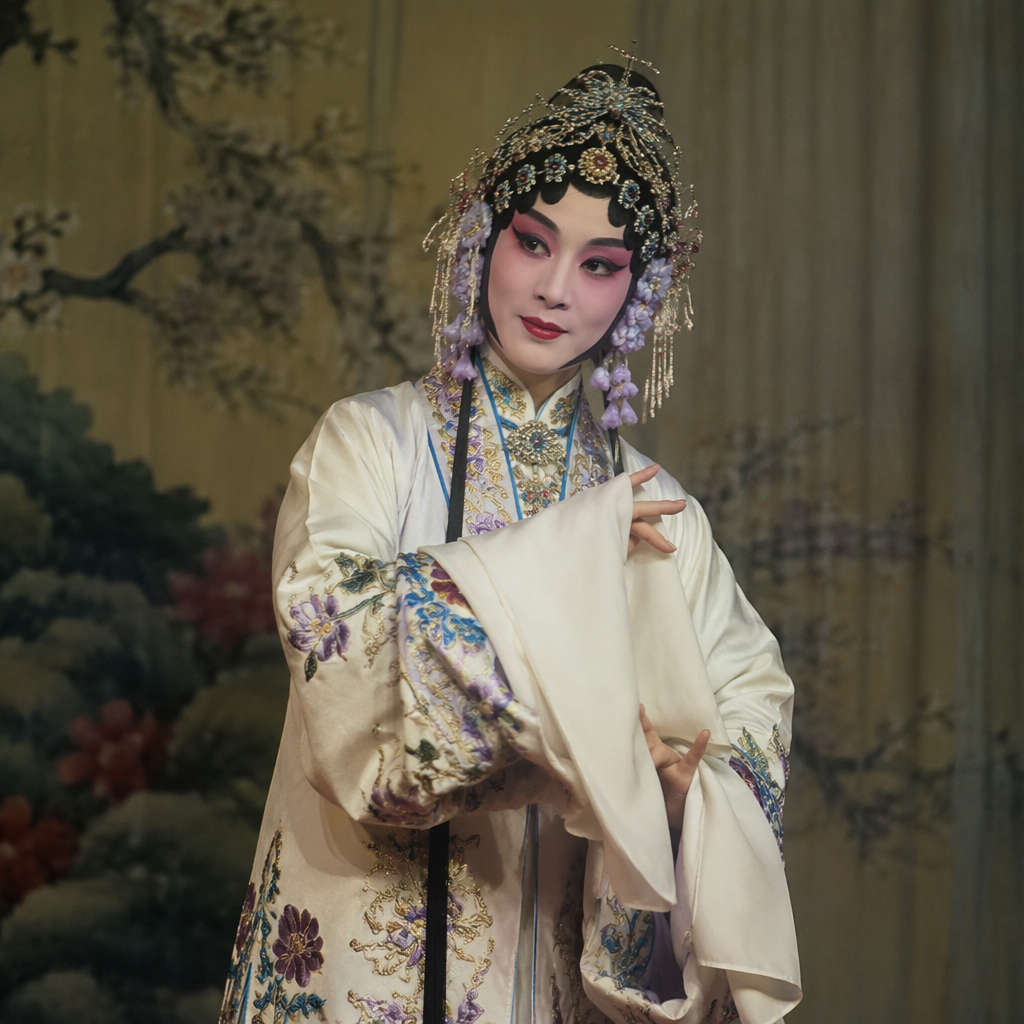
"Dan" (旦) are female roles—general term for positive female roles. Dan makeup is the most beautiful in Peking Opera, with steps including applying makeup, raising eyebrows, sticking hair pieces, doing hair, and wearing headpieces. Dan is divided into zhengdan (qingyi—dignified women, wearing imperial robes or formal attire), huadan (lively young women, in colorful clothes or skirts), guimendan (young ladies from noble families, in embroidered robes or xizi), wudan (martial women, in short costumes or armor), daomadan (horse-riding martial women), laodan (elderly women), and caidan (female clown roles).
"Jing" (净) are "painted face" roles, commonly called "dahua lian"—mostly male characters with distinctive personalities or appearances. Jing uses elaborate facial makeup, with powerful voices and rough style. Jing is divided into zhengjing (copper-hammer face, focusing on singing), fujing (stage face, focusing on acting), wujing (martial face, focusing on martial arts), and others. Facial makeup is the most iconic visual element of Peking Opera—every painted face role has its unique pattern, and even the same character's pattern varies by school.
"Chou" (丑) are comedy roles, commonly called "xiaohua lian" or "san hua lian"—generally playing comic and witty characters who add humor to the drama. Chou is the atmosphere holder of the Peking Opera world. Chou is divided into wenchou (comedy through acting) and wuchou (comedy through martial arts).
"Xingtou" (行头) is the general term for Peking Opera costumes, including mang (imperial robes), kao (armor), pei (robes), xie (folded robes), helmets, footwear, and all accessories. They're categorized and stored in costume boxes—first costume box, second costume box, third costume box, and helmet box—and worn according to the character's identity and role type, without being restricted by era, region, or season. Peking Opera costumes are extremely magnificent, with rich national characteristics. Different costumes represent different identities and statuses, providing rich visual enjoyment for the audience.
"Mang" (蟒) is the formal attire for emperors, generals, and high-ranking officials. The main patterns are dragons and sea waves. Colors are divided into "upper five colors" (red, green, yellow, white, black) and "lower five colors" (purple, pink, blue, turquoise, fragrance). You see the emperor wearing yellow mang robes and ministers wearing red—that's how it works.
"Kao" (靠) is military attire for generals, also called "jia" (armor). The armor consists of front and back pieces, connected at the top and bottom, with armor patterns—but it doesn't cling to the body—it's a "separated" costume. Still, it gives the character a majestic presence; moving, it facilitates exaggerated dance movements. When a long-costume wusheng appears in kao, that's the bearing of a great general.
Peking Opera music follows the "banqiang" system. "Ban" is rhythm, "qiang" is melody. Through changes in rhythm and melody, the entire play's music is constructed. Peking Opera's vocal music mainly consists of two major tune systems: Xipi and Erhuang.
"Xipi" has a higher overall register, with bright, ornate, and sharp melodies. When handled with moderate rhythm, it often expresses bright, lyrical comedic scenes and pleasant character emotions. "Princess Yang Gui Fei" is a typical Xipi piece—so graceful and melodious.
"Erhuang" has a lower register, with darker, more solemn and calm melodies. When the tempo is slow, it's often used to express suppressed tragic scenes and melancholic character emotions. "The Injustice of Dou E" is Erhuang—listening to it makes your heart feel choked, and tears come without you realizing.
Can't understand the lyrics? My suggestion: start with "Xipi liushui" (西皮流水)—fast tempo, catchy lyrics, very enjoyable to listen to. Peking Opera has many "elevated pronunciations" for metrical purposes—for example, "白" isn't pronounced "bai" but "bo." That's why there's a saying: "New book, familiar opera—never-gets-old tunes." Listen to the same opera several times with the script, and you'll not only understand but find yourself singing along!
After all this, you might be wondering: where can I watch it?
If you're in Beijing, the most convenient option is Chang'an Grand Theatre. Located just east of Tiananmen Square, it's easy to get to and has shows every night. Tickets start from 80 yuan—about ten US dollars. For that price to watch an international-quality performance in Beijing, it's practically free. Most importantly, this venue is very tourist-friendly—every show comes with Chinese and English subtitles, so you won't miss the plot. Classic works like "Princess Yang Gui Fei," "The Empty City Strategy," and "White Snake" are regularly performed here.
If you want to feel the "master's aura," head to Mei Lanfang Grand Theatre. Named after the great master himself, it's on the western Second Ring Road, with world-class acoustics and elegant classical architecture. Tickets start from 100 yuan. If your budget allows, I recommend seats in the orchestra—you can see the performers' facial expressions clearly, and that's where the true essence of Peking Opera lies. Famous performers from the National Peking Opera Company often perform here.
Liyuan Theatre is another good choice. This is a tea-house style theater—audience members drink tea while watching the show, with a relaxed and lively atmosphere. Tickets from 120 yuan include tea and snacks. Most thoughtfully, there are Chinese and English subtitles—very friendly for foreign tourists.
If you want to experience old Beijing's flavor, Zhengyici Opera House is the choice. This opera house is over three hundred years old—one of China's oldest wooden opera theaters, called the "living fossil" of Chinese opera. The moment you walk through the door, you'll feel time rewinding a hundred years—carved wooden windows, vermilion columns, an old stage—everything preserved in its old Beijing form. Show tickets here are around 200-300 yuan, and advance booking is required.
If you're in Shanghai, don't miss Tianchan Yifu Stage. This theater is known as the "First Theater of the Far East," built in 1926. Mei Lanfang, Cheng Yanqiu, and Xun Huisheng all performed here. Tickets start from 120 yuan, and there's a great show every night. Shanghai Peking Opera House performers frequently stage shows here.
💡 Tips
• Aim for center seats—the stage isn't high, so back rows obscure the performers' expressions
• Arriving 30 minutes before the show is perfect—no need to come earlier
• Bring binoculars for a closer look at performers' expressions
• For first-timers, martial arts or lively plays are easier to get into
You walk out of the theater. The autumn evening breeze brushes against your face. Those painted eyes from the painted face still linger in your mind—that raised eyebrow, those exaggerated features, as if carrying six hundred years of history in their gaze. The gongs and drums still echo in your ears—"Clang! Clang! Clang!"—each beat changing the rhythm of your heart. You can't help but glance back—the theater lights are still on, like history is waving at you.
You didn't understand that line of singing—but it doesn't matter. You understood an emotion—the anger of betrayed loyalty, the sorrow of a hero at the end of their rope, the tenderness between lovers. You don't need to understand Chinese, because beauty is universal. Those gestures, glances, movements, tunes—they're all speaking, telling the most universal feelings of human experience.
Throughout history, life is opera, and opera reflects life. A few people, a small space, showing great stories. From galloping horses to battlefield warfare, from garden pavilions to palace halls—the charm of Peking Opera must be experienced on stage. Some things can only be truly understood when you see them with your own eyes and hear them with your own ears. Peking Opera is one such experience—it's not a "must-know cultural feast," but an encounter that will make your heart skip a beat.
Next time you visit China, remember to add "watch a Peking Opera show" to your travel itinerary. You won't regret it.
Some things can only be
truly understood when
you see and hear them yourself.
Practical Information
• Beijing: Chang'an Grand Theatre (from 80 yuan, nightly), Mei Lanfang Grand Theatre (from 100 yuan), Liyuan Theatre (tea house + subtitles, from 120 yuan), Zhengyici Opera House (300 years old, 200-300 yuan, advance booking required)
• Shanghai: Tianchan Yifu Stage (from 120 yuan, "First Theater of the Far East")
• Tip: Center front seats recommended, comfortable shoes
— Written for National Geographic China —