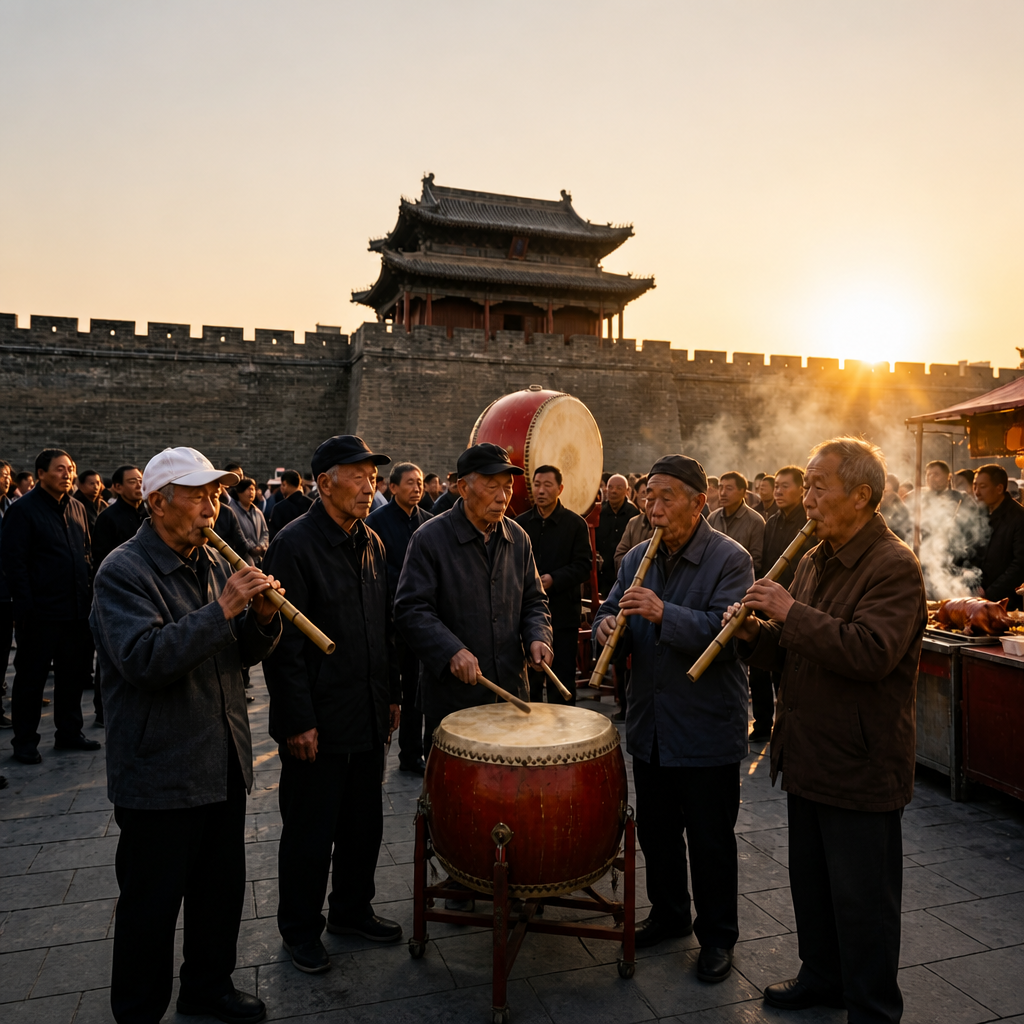
Xi'an Drum Music
A Thousand-Year Symphony of the Tang Dynasty
"Of ten thousand songs and countless dances, my favorite is the Rainbow Skirt Dance." — Bai Juyi
In a narrow alley near Xi'an's City God Temple, the scent of lamb stewed in flatbread drifts through the dusk. Suddenly, a sound spills out from a courtyard — not pop music, not a radio broadcast, but a kind of music you have never heard before. The drumbeats are heavy; each strike makes the air of the entire alley tremble. A flute cuts through, sharp and bright, piercing the drumming like a blade of light splitting through thick clouds. Beneath it all, a low humming drone holds everything up. It is vast, solemn — as if an invisible palace were slowly rising from the ground.
An old man at the alley entrance stops walking, a half-head of cabbage still in his hand. A young man on an electric scooter hits the brakes, plants one foot on the ground, listens for a dozen seconds, then rides off. No one speaks. The feeling is strange — hearing this sound for the first time, yet feeling as though you have heard it somewhere before.
It is called Xi'an Drum Music. More than 1,300 years ago, it was born in the imperial palace of the Tang Dynasty — court music played when the emperor banqueted foreign dignitaries. Later, war came. Musicians fled the palace with their instruments, scattered into the countryside, and passed the melodies down from generation to generation. Today, people in Xi'an still play these tunes — using the same musical scores handed down from the Tang Dynasty, playing the same instruments. In 2009, UNESCO inscribed it on the Representative List of the Intangible Cultural Heritage of Humanity. But standing in that alley, none of these titles matter. What matters is the sound itself — it makes you want to stay and listen to the end.
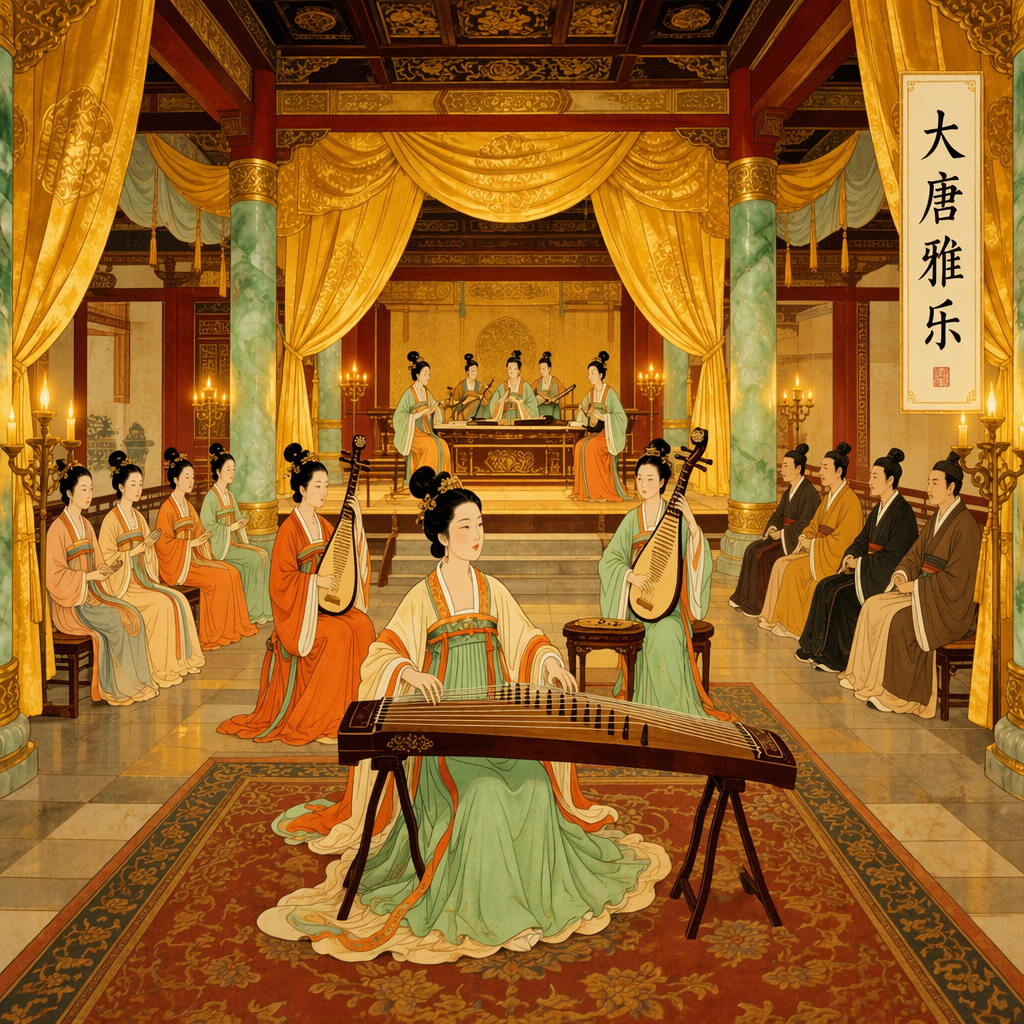
△ The grandeur of Tang Dynasty court banquet music (artistic rendering)
In 618 CE, Li Yuan declared himself emperor in Chang'an and founded the Tang Dynasty. For nearly three centuries afterward, Chang'an was the largest city on Earth — with a population exceeding one million, more bustling than Constantinople and Baghdad combined. The city was not just a political and commercial hub; it was a "capital of music." The imperial court maintained thousands of musicians who performed what was called "Yanyue" — banquet music — used for court assemblies, celebrations, diplomatic banquets, and festivals. Instruments and melodies from Central Asia, India, and the Korean Peninsula converged in Chang'an, fusing into a vast and refined musical system.
How spectacular was Tang Dynasty Yanyue? According to the "New Book of Tang," the imperial court employed up to ten thousand musicians, divided into "standing" and "seated" sections — the standing section performed outside the hall with hundreds of players, while the seated section played inside, more intimate and refined. During major court assemblies and visits by foreign envoys, this grand music would sound before the Hanyuan Hall of the Daming Palace, carrying for miles. Japanese envoys brought the repertoire and organization back to Nara, and traces of Tang music can still be found in Japanese gagaku today. The same is true of Korean court music. In every sense, Tang-era Chang'an was the center of the entire East Asian musical world.
Then, all of it nearly vanished.
In 755 CE, a general named An Lushan launched a rebellion. War tore through more than half the empire. The emperor fled in panic to Sichuan, and Chang'an fell. The palace musicians scattered — they took nothing with them except the instruments in their arms and the melodies in their heads. These sounds, once heard only at imperial banquets, flowed into the countryside with the fleeing musicians, settled into temples, and sank into folk life. From then on, they no longer belonged to the court — they belonged to ordinary people who set up canopies at temple fairs, arranged chairs in ancestral halls, and gathered to play during the hottest days of summer.
This is a miraculous story. Sound is the most fragile thing of all — a painting can hang on a wall for a thousand years, a building can stand for centuries, but music, once the last person who can play it dies, is gone forever. What songs did the priests of ancient Egypt sing? What melodies accompanied the tragedies of ancient Greece? No one knows. But Tang Dynasty music survived. It lives in the unremarkable villages around Xi'an, in the humming passed from master to apprentice, in handwritten scores that read from right to left in vertical columns.
755 CE An Lushan Rebellion; musicians scatter into the countryside
Song-Yuan-Ming-Qing Takes root in temple fairs; three traditions form — Buddhist, Daoist, and folk
1953 Scholars Li Shigen and He Jun systematically collect and document the music, formally naming it "Xi'an Drum Music"
2006 Inscribed on China's first national intangible cultural heritage list
2009 Inscribed on UNESCO's Representative List of the Intangible Cultural Heritage of Humanity
In 1953, two music scholars — Li Shigen and He Jun — found this music in villages around Xi'an. They were astonished to discover that the musicians were using "su-zi-pu," a notation system from the Tang and Song dynasties — a method of writing music using components of Chinese characters, almost identical to Tang Dynasty scores unearthed at the Mogao Caves in Dunhuang and the notation in Jiang Kui's "Songs of the White Stone Daoist" from the Southern Song. In other words, the tunes these farmers and craftsmen were playing could well be the same melodies that once rang through the Hanyuan Hall of Daming Palace over a thousand years ago.
This sounds incredible. It is not a "reconstruction" or "restoration" — not a museum's computer-synthesized approximation of "what Tang music might have sounded like." It is a living river of sound that has never been broken, flowing from the palaces of the Tang to the streets of Xi'an today. It is like walking into a small church in Rome and hearing a choir sing a sixth-century chant in Latin — and they have been singing it for generations, without ever stopping.
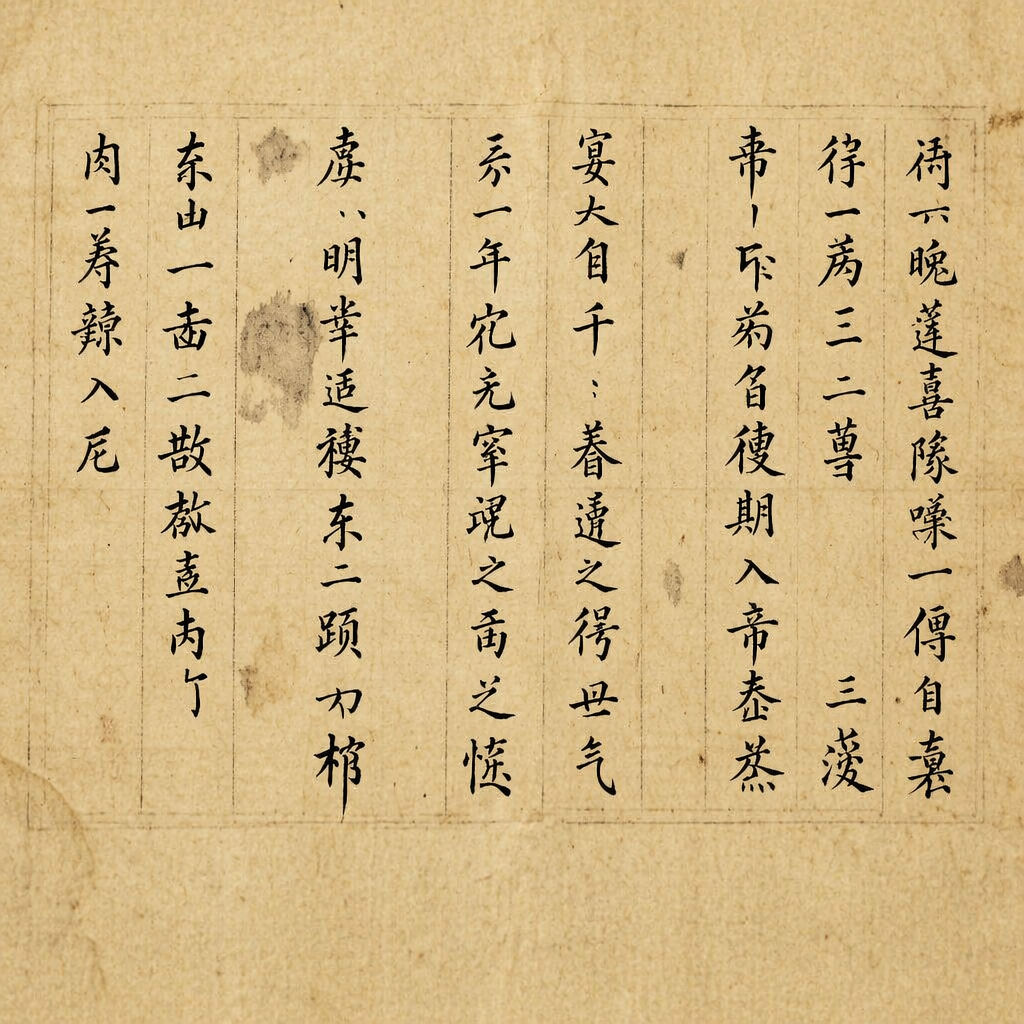
△ Gongche notation — one of the world's oldest musical notation systems
When Westerners hear the word "symphony," they think of Beethoven, Mahler, a conductor standing before a hundred-piece orchestra waving a baton. Xi'an Drum Music has no conductor — its conductor is the drum. A large drum sits at the center, and the drummer is the soul of the entire ensemble, using drumbeats to control rhythm, guide transitions between sections, and decide when to surge and when to pull back. But it is equally vast, equally intricate, equally overwhelming.
Xi'an Drum Music has two performance forms. "Seated Music" (Zuo Yue) — musicians sit in a circle in a courtyard or hall, performing a structure so grand that a single piece can last over an hour, like a multi-movement symphony. It opens with a slow introduction: the flute drifts in from afar, like the first lantern lit in the fog. Then the drums join, the rhythm tightens, the sheng and the guanzi layer on top of each other, the sound growing denser and thicker, like a tide filling the room. Suddenly — all melodic instruments stop at once, leaving only the large drum solo. The drummer unleashes the most intense barrage of beats, the climax of the entire piece, called "Tui Gu." Then everything falls into silence, and the flute sounds again — like a ray of sunlight after a storm.
The other form is "Processional Music" (Xing Yue) — musicians line up in a row and play while walking. It can be seen at temple fairs, pilgrimages, and rain-praying ceremonies. The flute leads the way, the drums follow behind, and the procession winds through streets and lanes, music flowing like a river through the entire village. Red cloth strips hang on the doors of houses on both sides. Children chase after the procession. Old people stand at their doorways with palms pressed together. This is not a "concert" — this is life itself.
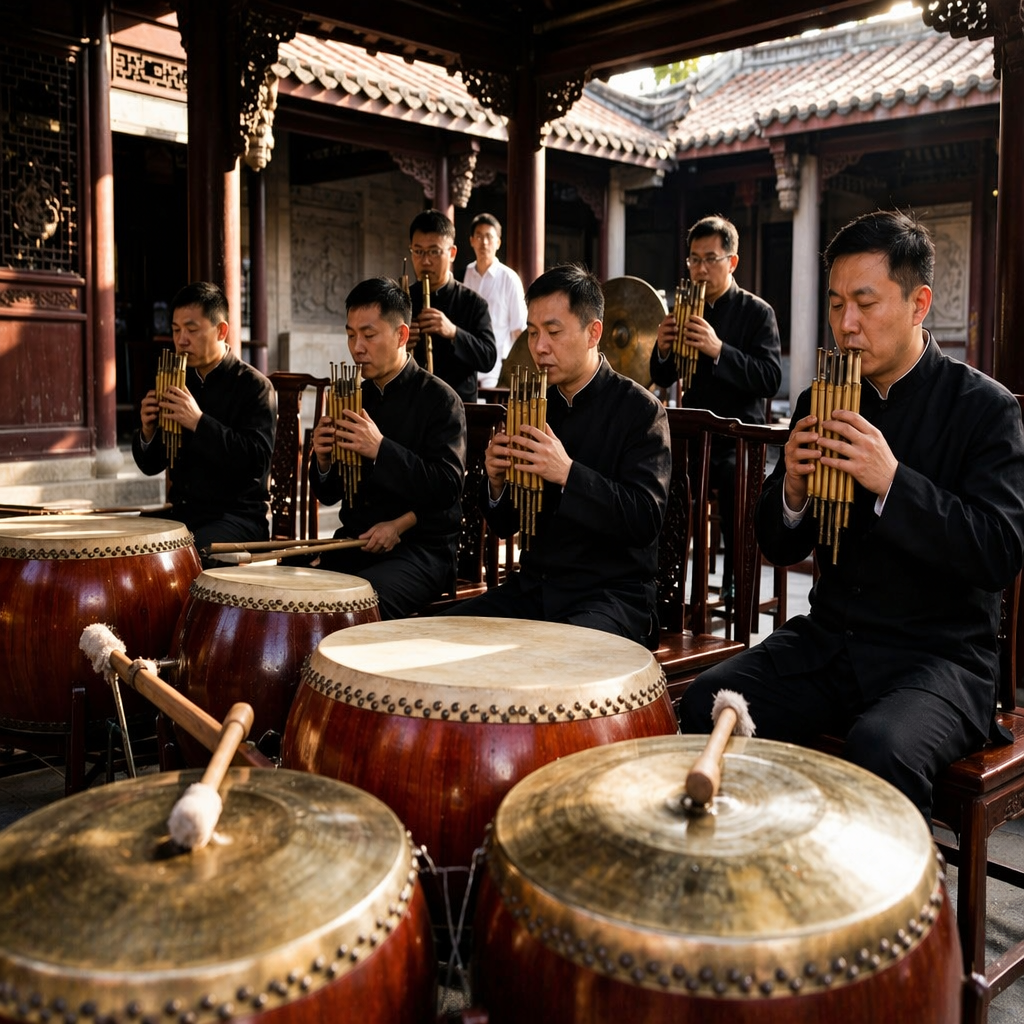
△ "Seated Music" — musicians sit in a circle, with a structure as grand as a multi-movement symphony
There are nearly twenty types of instruments, divided into two camps. The melodic instruments are led by the bamboo flute — note, not the suona, not the erhu, but the flute. The flute's tone is clear and penetrating, always at the forefront amid the roar of all instruments, like a silver thread running through brocade. The sheng is one of the world's earliest free-reed instruments — a row of bamboo pipes inserted into a copper base, producing several notes simultaneously with a single breath. The Western harmonica and accordion are its "descendants." The guanzi, a double-reed wind instrument, has a raspy, desolate sound, like a person calling out in the wind.
The percussion section is an entire "wall": large drums, seated drums, battle drums, music drums, twin cloud-gongs, large gongs, small gongs, cymbals, clash cymbals... They are not accompaniment — they are the skeleton. The drum is the heartbeat, the gong is the pulse, the cymbals are the breath. When all the percussion instruments erupt at once, the air itself vibrates.
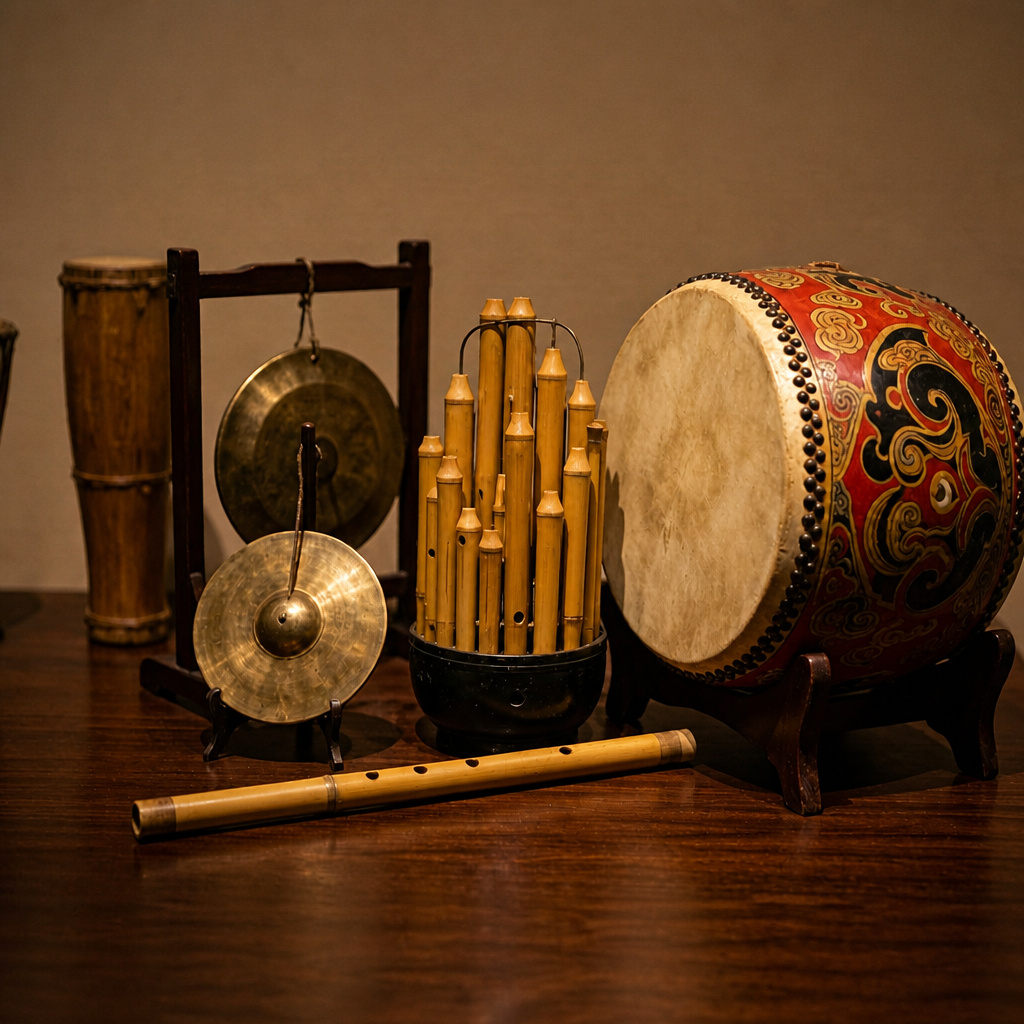
△ Flute, sheng, guanzi, drums, gongs, cymbals — nearly twenty instruments forming an "ancient symphony orchestra"
Clear and piercing, the soul's melodic line of the ensemble
Multi-pipe harmony, ancestor of the Western harmonica
Double-reed, raspy and desolate, like a voice calling in the wind
The ensemble's conductor, commanding all through drumbeats
Dozens of small gongs in a set, crisp as wind chimes
Bronze percussion, thunderous at the climax
Full ensemble: nearly 20 instrument types, over 3,000 pieces, 1,200+ titled melodies, 40+ complete suites
Close your eyes and listen, and it feels not like a group of people performing, but like a mountain speaking. The flute is the wind at the summit, the drums are the mountain's trembling, the sheng is the echo in the valley, the gongs and cymbals are the instant lightning splits the clouds. It has something you will never hear in any Western symphony — a sense of "earth." It does not grow from sheet music; it grows from the soil, from the incense smoke of temple fairs, from a thousand years of time.
One more detail worth noting: Xi'an Drum Music uses a seven-tone scale, not the Chinese traditional pentatonic scale (gong, shang, jue, zhi, yu) that many people assume. This means its melodies are richer and more intricate than typical Chinese folk songs, with a tonal coloring reminiscent of West Asian and Central Asian music. This is no coincidence — Tang Dynasty Yanyue absorbed a great deal of Western Regions musical elements. Those semitones and key changes may be the very melodies a Sogdian merchant caravan hummed all the way from Samarkand to Chang'an, which court musicians then notated and wove into the bloodstream of Tang music.
Chinese scholars call this music "the symphony of ancient China." But anyone who has heard it in person will find that comparison insufficient — it is older than the symphony, rawer, closer to sound itself. The symphony is written on paper; Xi'an Drum Music is carved in bone.
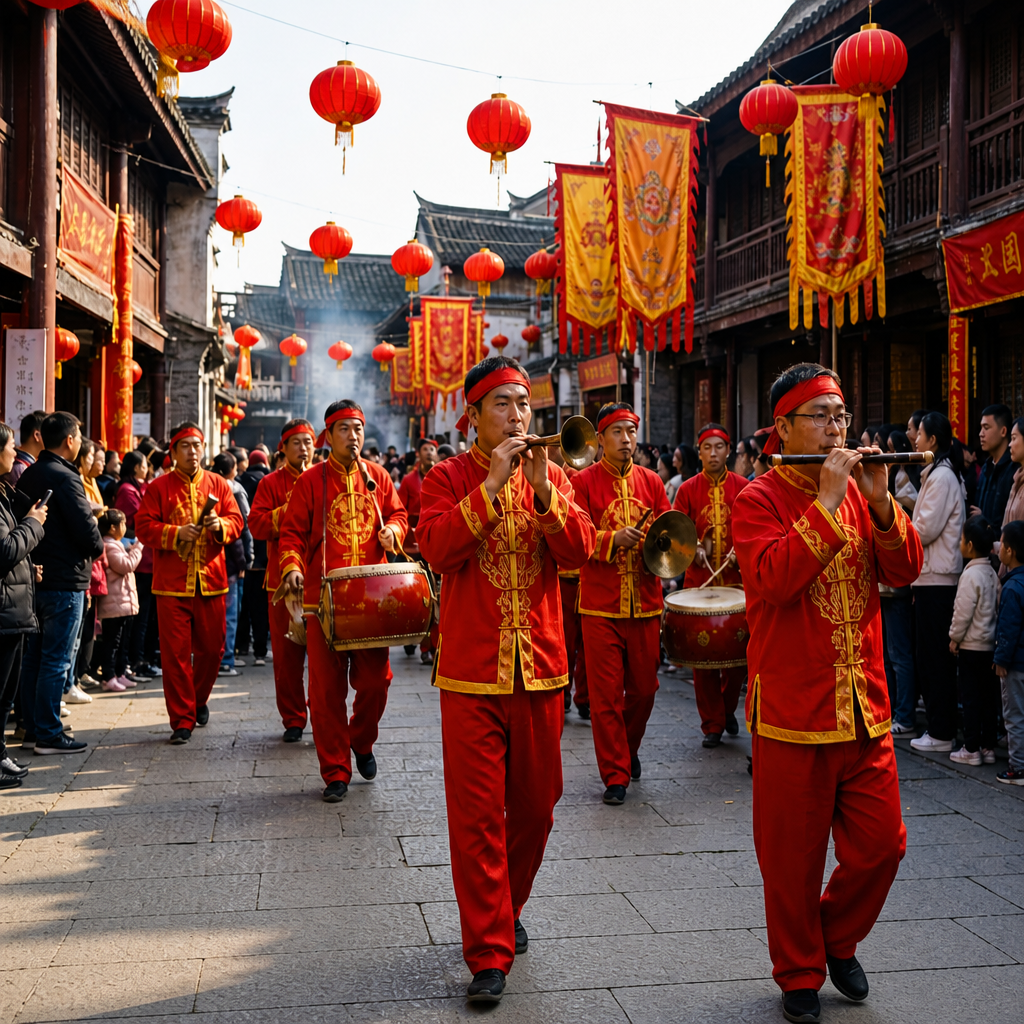
△ "Processional Music" — the drum ensemble at a temple fair, winding through streets, music flowing like a river
The story nearly ended in tragedy. In 2006, when Xi'an Drum Music was inscribed on the national intangible heritage list, only 13 folk drum societies remained in all of Xi'an, with just over 200 musicians in total. There were only 6 nationally recognized heritage bearers. The oldest musician was over ninety; the youngest had passed fifty. The old men passed away one by one, taking with them the melodies that had never been written down. Young people did not want to learn — it did not pay, it was not fashionable, and there was not even a proper rehearsal space.
The method of transmission was also extraordinarily "ancient" — oral and physical instruction. The master does not simply hand over the score; he sings a phrase, and the apprentice repeats it. Scores do exist — those brush-penned Gongche notation manuscripts — but Gongche only records pitch and a rhythmic framework. The true "flavor" — which note should tremble, which should slide, where to hold a beat longer — all of that lives in the master's mouth and hands. It takes ten years of study with a master to learn a single piece well enough to "take the stage." It is like locking the full score of a symphony inside one person's brain and hoping he lives long enough to pass it on.
But the story did not end in tragedy.
The Dongcang Drum Music Society — one of Xi'an's most renowned ensembles — made a bold decision: to take up residence at the Tang Paradise (Datang Furongyuan). Built on the site of the Tang Dynasty's Furong Garden, the Tang Paradise features the resplendent Ziyun Tower, ablaze with lights every evening. The ensemble created an immersive musical drama called "Drum." They brought traditional seated music onto the stage, incorporating dance, holographic projections, and lighting design. The ancient titled melodies, wrapped in new technology, radiated unprecedented brilliance. On Douyin (TikTok China), topics related to "Dongcang Drum Music" surpassed 120 million views. Young netizens gave them a nickname — "the Tang Dynasty's hottest band."
In the summer of 2026, the Tang Paradise launched the "Chang'an Dance · Music Season" summer series, transforming drum music from something you "watch on stage" to something that "rings beside you." Every morning at 10 AM, a "Drum Music Workshop" opens in the Ziyun Tower — heritage bearers personally teach visitors to read Gongche notation, practice basic rhythms, and even lay hands on instruments passed down for generations. No knowledge of music theory needed, no ability to read numbered notation required — in 45 minutes, even children can hum along to a Tang Dynasty melody. In the afternoon, musicians carrying sheng, flutes, and cloud-gongs step out of the theater and wander among the lotus ponds and covered bridges — this is called "Celestial Sounds Drifting," where music follows your footsteps; turn a corner, and suddenly you collide with a flute melody. By evening, "Drum" takes the stage on the third floor of Ziyun Tower — six shows a day, drums and music resounding, lights blazing, fully recreating the grandeur of Tang court banquet music. The park also offers over a hundred free hanfu (traditional Chinese clothing) outfits for visitors — wearing a Tang-style ruqun dress, carrying a lantern across a winding bridge, with drum music chasing you from behind, you might just feel as though you have truly returned to Chang'an.
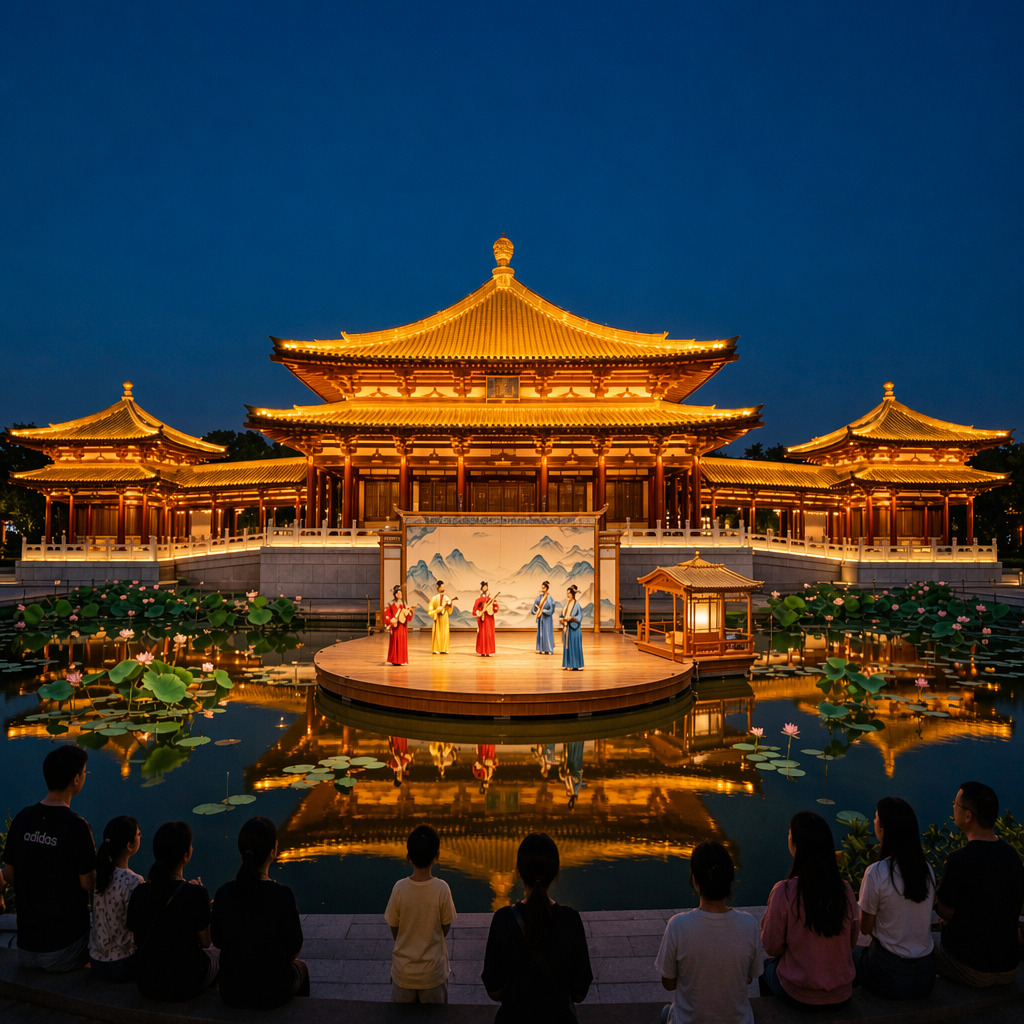
△ Tang Paradise — home of the Dongcang Drum Music Society's immersive show "Drum"
More cutting-edge experiments are also underway. In 2026, Qujiang Cultural Tourism launched the "Chang'an Music Archaeology Center" concept at the Tang Paradise. The Dongcang Drum Music Society restored four grand suites and 46 works, and turned these ancient pieces into AI music story short dramas — "Chao Tian Zi," "Feng Jin Bei," "De Sheng Ling" — garnering a large following of young fans on short-video platforms. Dongcang Drum Music even collaborated with virtual singer Luo Tianyi on a single called "Breaking the Dawn," where Tang melodies met electronic music — surprisingly, it sounded wonderful. At the Grand Tang Mall, part of the same Tang Paradise district, a "Magic Art MR Experience Pavilion" opened — put on mixed-reality glasses and watch virtual Tang Dynasty musicians perform right before your eyes. The sounds of 1,300 years ago are speaking again, through the most cutting-edge means of this era.
Another force has come from universities. Xi'an International Studies University formed the Xi'an International Studies Drum Music Troupe, creating a themed concert series called "Elegance of the Great Tang · Bells and Drums," which fuses classical instruments — bianzhong (bronze chime bells), bianqing (stone chimes), xun (ocarina), pipa — with drum music, performing over 220 shows. They have taken this program abroad — Germany, France, Japan, Singapore, Malaysia, Australia, the Netherlands, South Korea, Uzbekistan... Audiences in more than twenty countries have sat in theaters, listening to music from China's Tang Dynasty, rising to their feet in applause. In 2023, at the China-Central Asia Summit, they performed "Po Zhen Yue" — a military march that Tang Emperor Taizong (Li Shimin) himself helped create — for heads of state. When the drums sounded, it was as if the iron cavalry of 1,300 years ago appeared before the audience.
The immersive musical drama "Drum" runs six shows daily; the evening shows are the most spectacular. 2026 Summer (Jun 30 – Aug 31) adds a "Drum Music Workshop": every morning at 10 AM, heritage bearers teach Gongche notation reading and basic rhythm — hands-on experience with traditional instruments, 45 minutes, free with reservation. "Celestial Sounds Drifting" performances wander through the gardens in the afternoon. The park also offers over 100 free hanfu outfits.
② Xi'an Museum (Small Wild Goose Pagoda) · Jianfu Temple Abbot's Hall
"Chang'an Ancient Music Silk Road Heritage Concert" — a resident show for visitors, with an intimate, warm atmosphere. After the show, stroll beneath thousand-year-old cypress trees.
③ Hejiaying Drum Music Society Exhibition Hall
Located in Chang'an District, with regular weekly performances. Accepts study tour groups. See ancient instruments and handwritten scores up close — the most authentic, grassroots experience.
④ Grand Tang Mall · Magic Art MR Experience Pavilion ★New
Opened May 2026. Mixed-reality technology brings Tang Dynasty musicians to life before your eyes. A collision of technology and intangible heritage — great for families with children.
⑤ Xi'an Drum Music Festival
Held annually. The 18th edition in 2025 took place at Hejiaying Drum Music Plaza, where six major ensembles "battled" — essentially an ancient music competition, with a thrilling atmosphere.
In 2024, China's first specialized drum music research institute — the Xi'an Drum Music Research Institute — was established at Xi'an International Studies University. Scholars began using modern technology to record, organize, and study these thousand-year-old pieces, publishing over 200 academic papers and dozens of monographs. The Xi'an Conservatory of Music opened drum music courses, training a new generation of performers and researchers. "Drum Music in Schools" programs have reached dozens of schools across Shaanxi, Beijing, Shanghai, Fujian, and even Taiwan. Those melodies that once lived only in a master's pocket, in an old man's memory, are now being written down, recorded, and sent out into the world.
Mr. Zhao Gengchen, a nationally recognized heritage bearer, studied drum music for over fifty years. His disciple Zhao Xiaomin is now the bearer of the Dongcang Drum Music Society and the core figure behind the immersive musical drama "Drum." Zhao Xiaomin once said, in essence: we are not "protecting" something that is about to die — we are keeping it alive. It was always alive — it has lived for 1,300 years. Why shouldn't it live for another thousand?
The story is told now: a sound heard suddenly in a dusk alley, which set out from the palaces of the Tang, passed through the fires of the An Lushan Rebellion, sank into rural temple fairs, hid in the handwritten scores of old men, and was then lifted up again by a group of people who refused to let it go, and placed on the world stage. It was not reconstructed, not rebuilt — it has been alive all along.
Xi'an is a city where you can measure history with your footsteps. Standing on the ancient bricks of the city wall and looking west, you can see the silhouette of the Qinling Mountains — the direction from which Zhang Qian set out on the Silk Road. Walking into the Tang Paradise, lantern light reflects off the flying eaves of Ziyun Tower — and drum music is ringing inside. Standing in Jianfu Temple beneath the Small Wild Goose Pagoda, thousand-year-old cypress trees shade half the sky — and the flute melody drifting from the Abbot's Hall is the same tune that sounded here a thousand years ago.
You do not need to read Gongche notation. You do not need to know the difference between the "Buddhist school," the "Daoist school," and the "folk school." You do not need to distinguish the timbre of the flute from the guanzi. Just find a chair, sit down, close your eyes, and let the drumbeats vibrate from the soles of your feet to the top of your head. Then you will understand one thing: the sound that the people of Chang'an heard 1,300 years ago, and the sound ringing in this city at this very moment, are the same sound.
Some sounds can only be understood when you stand on that piece of land. Come to Chang'an — the drumbeats of 1,300 years are waiting for someone to listen.
Recommended Route: City Wall cycling → Tang Paradise Drum Music Workshop → "Drum" evening show → Small Wild Goose Pagoda ancient music concert → Hejiaying for authentic folk performance
Special Notes: The Drum Music Workshop starts at 10 AM daily — free but requires advance reservation. "Drum" runs six shows daily; evening tickets sell out fastest, so book 1–2 days ahead. The park offers over 100 free hanfu outfits — change into one before the show to double the experience.
Hidden Gem: During the hottest days of lunar June, villages like Nanjixian and Hejiaying hold traditional temple fair drum performances — free admission, with the most authentic atmosphere. The Grand Tang Mall "Magic Art MR Experience Pavilion" opened May 2026 — great for families.
"The drums do not stop; Chang'an is not far away."
— Follow the drums and flute melodies, into the Chang'an of 1,300 years ago —