Dong Grand Song
Polyphonic Choir of the Mountain Tribes
The First Note in the Drum Tower
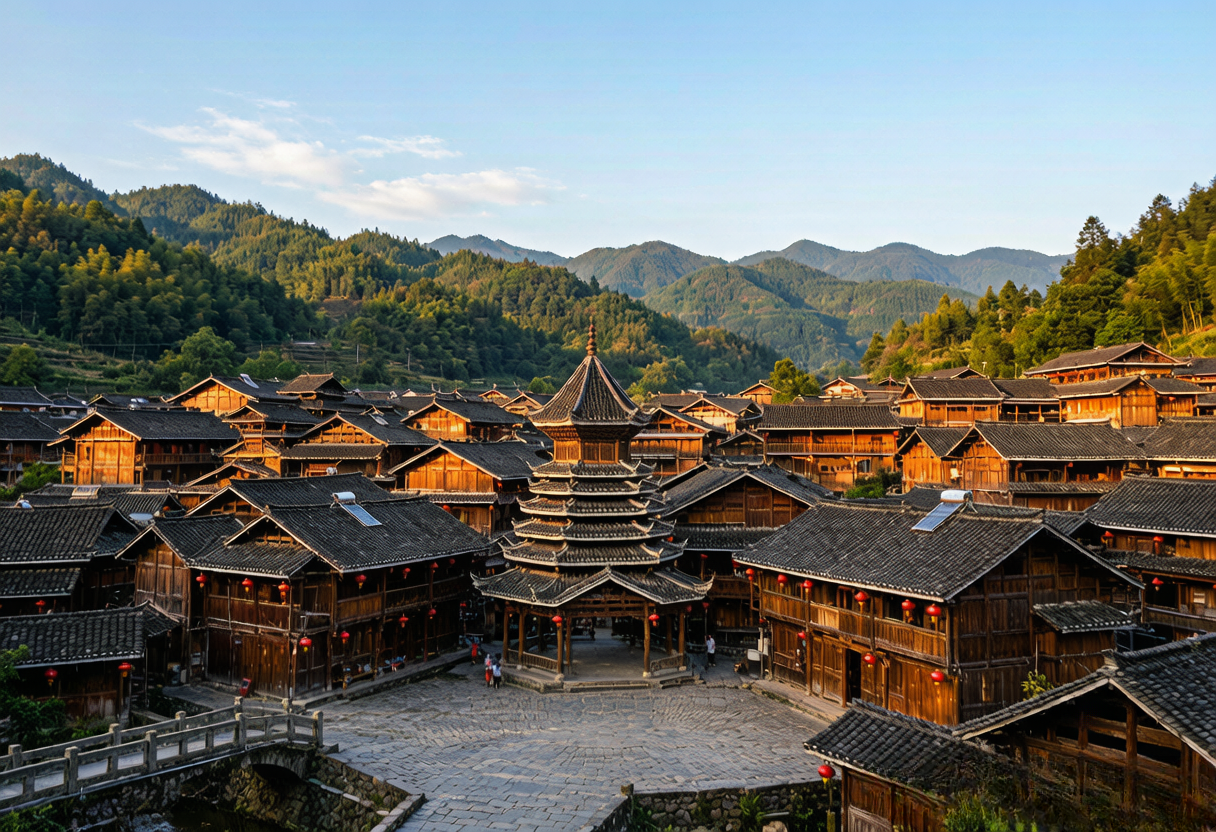
You sit inside the Drum Tower of Zhaoxing Dong Village. The light is dim, about twenty people stand in a circle. No instruments, no conductor, no sheet music. The first person opens their mouth — a long note, like the first cicada song on a summer evening.
Then a second voice joins, a third, a fourth… You can hardly tell who is singing high and who is singing low, but all the voices flow together like streams joining a river. The sound echoes through the wooden Drum Tower, carrying a hint of moisture — that special dampness of deep Guizhou mountains. You don't understand the lyrics, but you understand the feeling.
This singing has been going on in these mountains for over two thousand years. But the world only learned about it 60 years ago.
Dong people often say: "Rice nourishes the body, songs nourish the soul." They consider "songs" as important as "rice." In a Dong village, nobody is "unable to sing."
What is Dong Grand Song
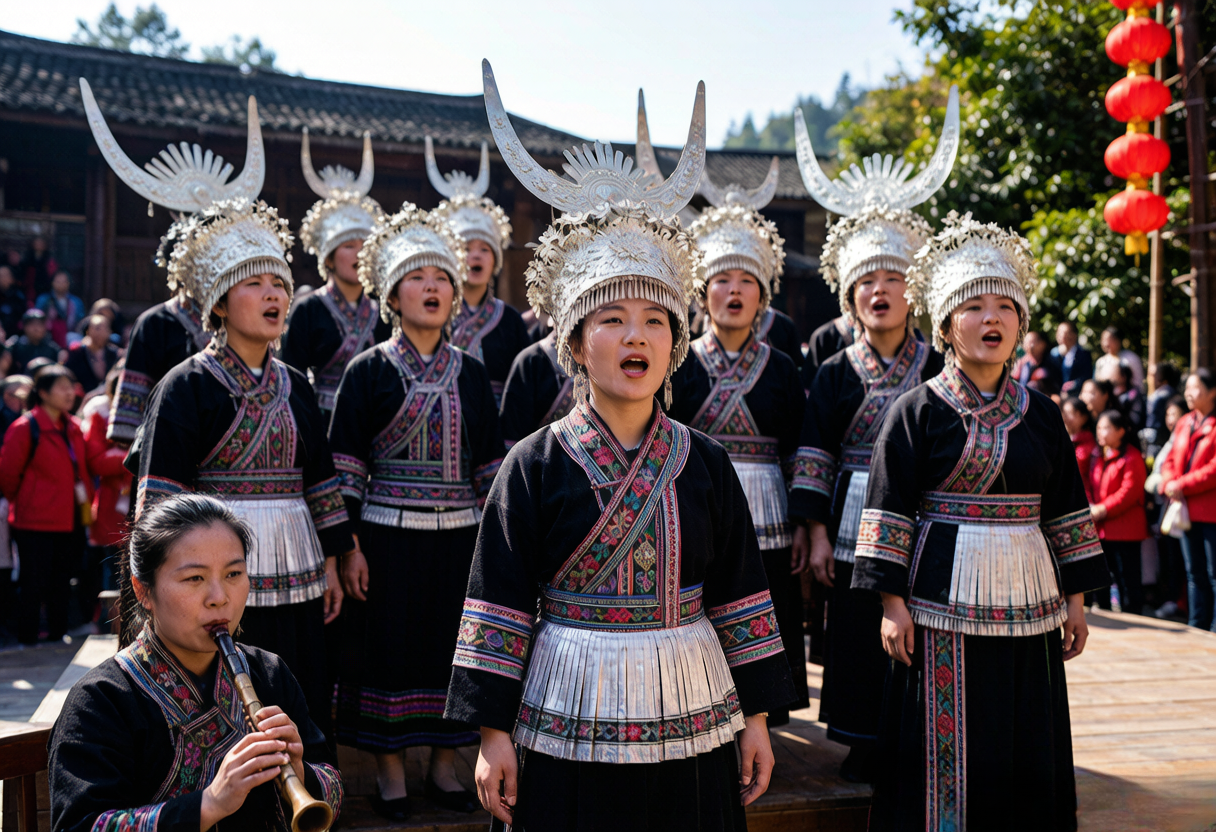
Simply put, Dong Grand Song is a form of "polyphonic, conductorless, a cappella, naturally harmonized" folk choral music. A dozen or even several dozen people stand in a circle — some singing high, some low, some middle — but nobody conducts, no instruments accompany. Through strict training and unspoken understanding, each voice finds its own position, flowing seamlessly.
The traditional approach is called "zhong di du gao" (many low, one high) — most people sing low, with only one person singing the high melody when needed. This arrangement isn't about "sounding good" — it's a tradition passed down through generations of Dong people.
Even more interesting: many melodies of Dong Grand Song imitate sounds of nature — cicada chirps, bird calls, flowing water, pine winds. You'll find yourself wondering: are these people singing, or imitating nature? The answer is: they don't distinguish, and they don't intend to.
The Dong people have no written language. For thousands of years, they've sung their history, stories, customs, and knowledge into their songs. Dong Grand Song is their encyclopedia — singing is how Dong people record their lives. UNESCO put it simply: "The voice of a people, a culture of humanity."
"Rice nourishes the body, songs nourish the soul."
The Moment That Rewrote Music Textbooks
Western musicology has long had a "common knowledge": polyphonic music (multipart chorus) is unique to Europe. This "rational" achievement is something Western civilization has been proud of.
But in 1959, a composer named Zheng Lvcheng "accidentally encountered" Dong Grand Song in southeastern Guizhou. When he heard these a cappella polyphonic harmonies, he was completely stunned. He said: "It seems the world's music textbooks will have to be rewritten."
In 1956, a book called "Dong Grand Song" was published. It was like a bomb — shattering the prejudice that "the East has no polyphonic music." Western musicologists had always believed polyphonic chorus could only emerge in European churches. But Dong Grand Song proved: deep in the mountains of the East, farmers who never studied music had been singing polyphonic harmony for over two thousand years. No conductor, no sheet music, no accompaniment — yet their precision rivals Western rigorous harmonies.
In 1986, nine Dong women took the stage at the Paris Autumn Arts Festival. They sang "Song of the Cicada" — the audience went wild. The song was performed 5 times, with over 30 curtain calls, and applause lasting more than 10 minutes. French audiences exclaimed: "This is the most charming polyphonic music we've ever heard!"
That's the magical part of the story: a group of Chinese farmers, with two thousand years of singing, made Western musicology admit they were wrong.
"It seems the world's music textbooks will have to be rewritten."
— Composer Zheng Lvcheng, 1959
From Paris to the World
After the 1986 Paris performance, Dong Grand Song began its journey around the world. Italy, Hungary, Austria, Singapore, Japan, Russia, Norway, Belgium, the United States… more and more countries heard this sound from Chinese mountains.
On September 30, 2009, at a UNESCO meeting in Abu Dhabi, Dong Grand Song was inscribed on the Representative List of the Intangible Cultural Heritage of Humanity, alongside 76 other outstanding projects worldwide. The judges said: "The voice of a people, a culture of humanity."
In 2025, Dong Grand Song "Song of Farewell" performed at the Global Women's Summit as the only artistic program. That same year, at London's Royal Academy of Music, Dong Grand Song was fused with Western modern music, praised as "a deep-level dialogue of souls." Even in the film "Nezha: The Dark Soul," elements of Dong Grand Song were used, letting this ancient sound surprise the world once more.
From Guizhou mountains to Paris stages to UNESCO intangible heritage — Dong Grand Song has traveled over 70 years. But where it truly belongs is still those Dong villages scattered across southeastern Guizhou.
Go to Zhaoxing — Hear It Live
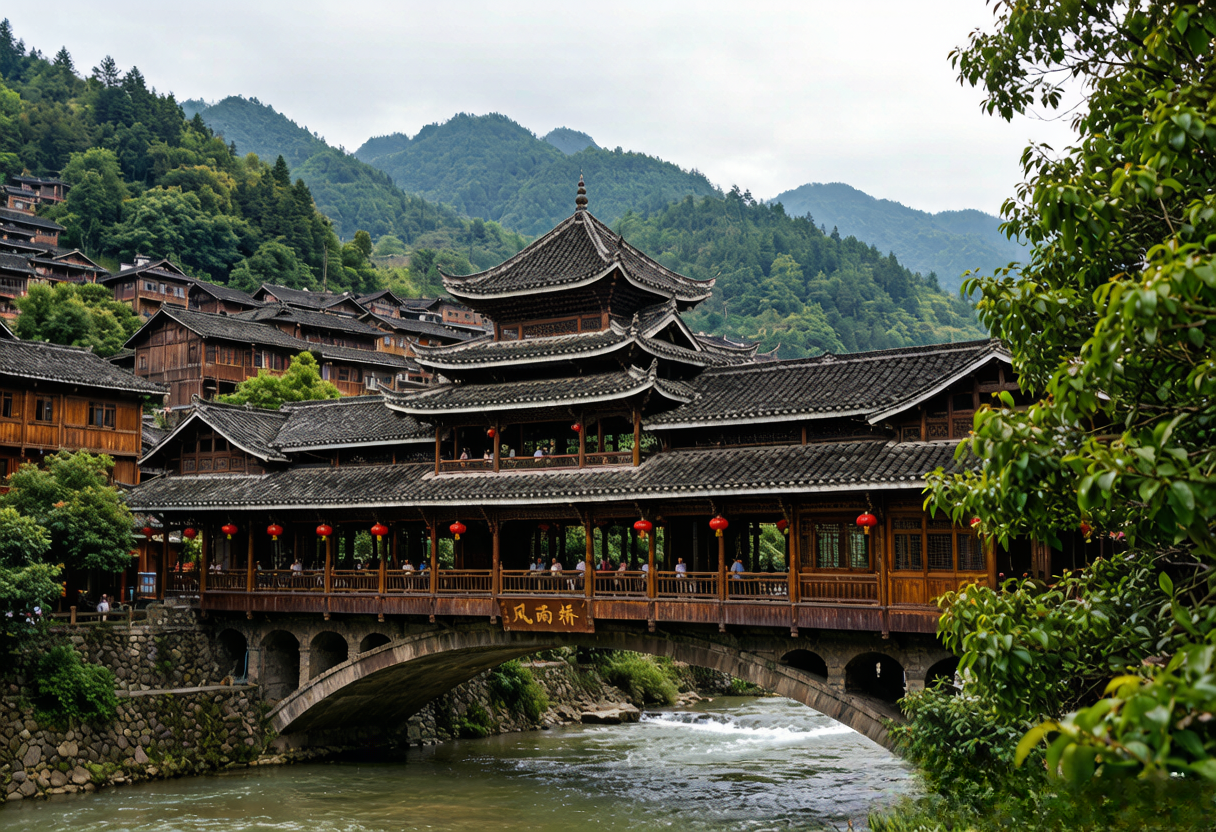
Zhaoxing Dong Village is located in Liping County, Qiandongnan Miao and Dong Autonomous Prefecture, Guizhou Province. It is one of the largest Dong villages in China and a national 4A tourist attraction. National Geographic called it "a thousand-year-old village you must visit in this lifetime." The Dong people have three treasures — Drum Towers, Grand Songs, and Wind-Rain Bridges. Here, Drum Towers are landmarks and the core venues for Grand Song performances.
What can you experience?
Village Gate Welcome — Dong girls and boys line up in long rows, singing Dong Grand Song, holding rice wine, welcoming guests with the highest礼仪. That sound passes through the village gate, echoes in the valley — you'll feel wrapped in ancient, sincere warmth.
Drum Tower Grand Song — This is the most authentic experience. Walk into the Drum Tower, listen to a dozen or twenty Dong people standing in a circle, no instruments, no conductor, opening their mouths to produce heavenly sounds. The sound echoes through the wooden structure — you'll hear your own heartbeat following the rhythm.
If you catch the Guyu Festival or Dong New Year, you can see grand parades and "Sa" worship ceremonies. At the long-table feast, warm Dong people will invite you to sit, serve homemade rice wine, sing toast songs. When you leave, they'll hand you hand-pounded sticky rice cakes — glutinous rice pounded in a stone trough, dipped in sugar, unbelievably delicious.
How to get there? Take a high-speed rail to Congjiang Station, then turn right to the bus station for the direct shuttle to the village — 10 yuan. About 4 hours from Guangzhou or Shenzhen. Most homestays include station pickup. Ticket is 80 yuan, valid for 3 days, can enter and exit multiple times.
French tourist Roand brought his family to Zhaoxing for the first time. After listening to Dong Grand Song, he excitedly said: "This is the most beautiful sound we've ever heard." Foreign tourist Konstantin wrote after experiencing Dong New Year in the village: "The grand parade and Sa worship ceremony were eye-opening. After the immersive experience, the emotion is impossible to put into words."
Zhaoxing Dong Village: 80 RMB (75 RMB online), valid for 3 days
Transport: High-speed rail to Congjiang Station, shuttle bus 10 RMB
The Song Continues
2,500 years ago, Dong ancestors sang their first note in these mountains. Today, you can still hear that same singing in the Drum Tower of Zhaoxing — the same polyphony, the same a cappella, the same natural harmony.
UNESCO said it best: "The voice of a people, a culture of humanity." — Perhaps this is the most accurate definition of Dong Grand Song.
Some sounds can only be truly understood when you stand where they were born. Next time you visit Guizhou, go to Zhaoxing and sit for a while — listen to what human singing sounded like over two thousand years ago.
"The voice of a people, a culture of humanity."
"Rice nourishes the body, songs nourish the soul"
— Zhaoxing Dong Village, Guizhou —