Yang Guifei
The Imperial Concubine Who Brought Down a Dynasty
How a Wise Emperor Became a Foolish One
Emperor Xuanzong Li Longji was the grandson of Wu Zetian, and the longest-reigning emperor of the Tang dynasty—forty-four years in total. In the first half of his reign, he governed diligently, appointing capable ministers like Yao Chong and Song Jing, reforming the administration and developing the economy. He created the "Flourishing Kaiyuan Era"—Tang at its zenith. At that time, Tang was the most powerful empire in the world, with merchants, envoys, and students from around the world in Chang'an.
But emperors are human too. When power reaches its peak, human weaknesses emerge. The Old Tang Annals records that in his later years, Emperor Xuanzong became "tired of rising early and staying up late"—he grew weary of governing, immersed himself in pleasure, and handed state affairs entirely to his prime minister Yang Guozhong.
Du Mu wrote in his poem "Passing Huaqing Pool": "A rider raises red dust as the lady smiles; none knows it's fresh lychees arriving from afar." Just to make Yang Guifei smile, fresh lychees were rushed from Lingnan—it was the "express delivery" of over a thousand years ago.
The once most diligent emperor became the most foolish one. And the turning point all happened at Huaqing Pool. When Emperor Xuanzong was holding Yang Guifei in the warm waters of Huaqing Pool, the seeds of the An Lushan Rebellion were already quietly being sown.
"A rider raises red dust as the lady smiles; none knows it's fresh lychees arriving from afar."
— Du Mu, "Passing Huaqing Pool"
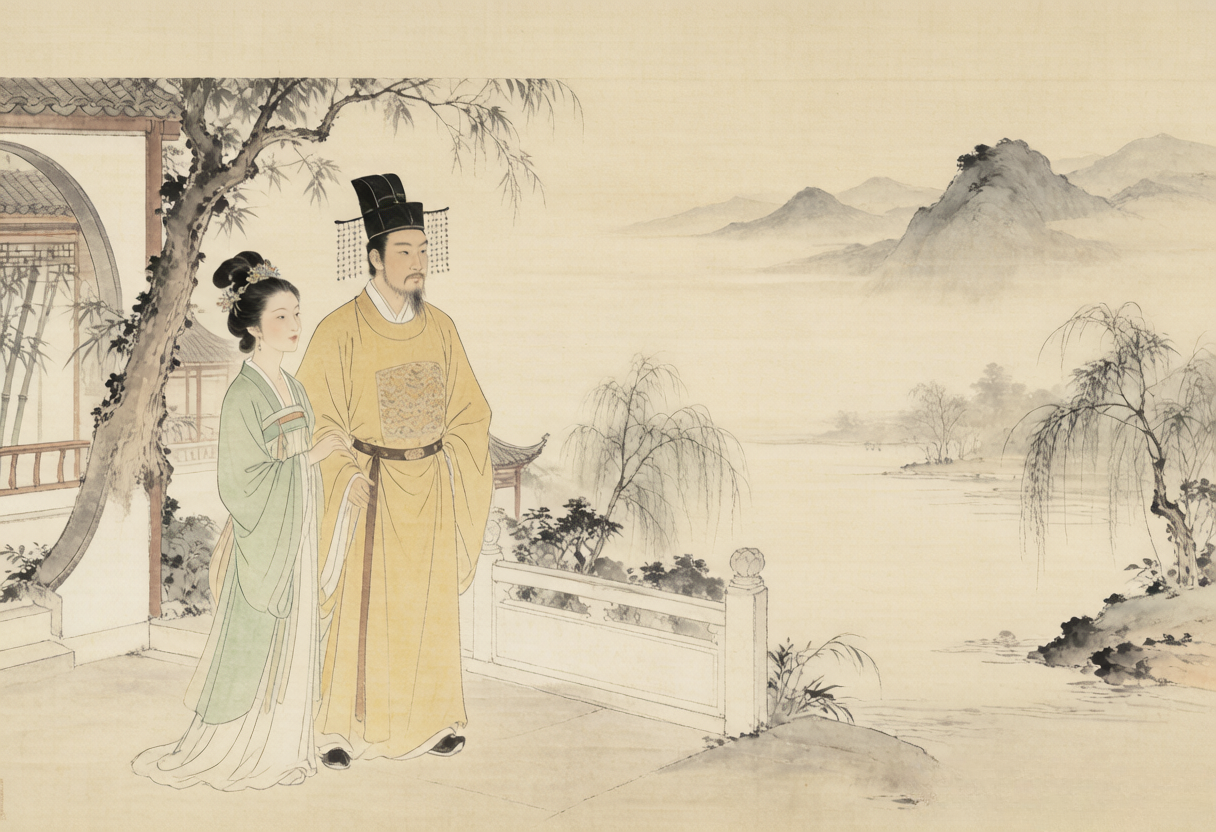
Huaqing Pool — Warm Waters Smoothing Her Creamy Skin
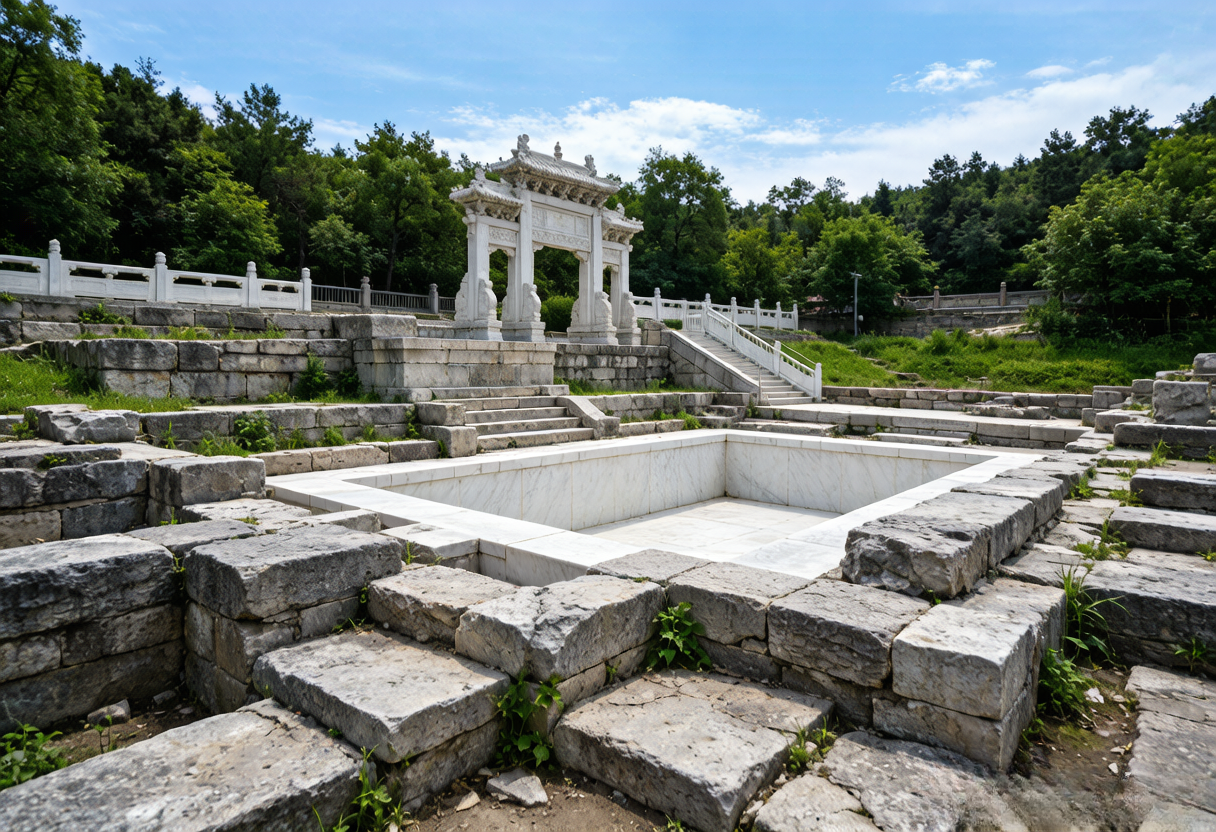
Huaqing Pool lies at the northern foot of Mount Li in Lintong District, twenty-three kilometers east of Xi'an. With over two thousand years of history, emperors from the Zhou, Qin, Han, Sui, and Tang dynasties all built palaces here. The place is most famous for its hot springs—water temperature stays at around forty-three degrees year-round, rich in minerals, rumored to beautify skin.
Bai Juyi wrote in "The Everlasting Regret": "In the cold spring, she was granted a bath in the Huaqing Pool; the warm waters smoothed her creamy skin." Yang Guifei's personal Begonia Pool—a small bath pool made of white jade, with a character reportedly carved at the bottom. You can still see this pool when you visit Huaqing Pool today.
Emperor Xuanzong's Lotus Pool was even larger—over ten meters in diameter, showcasing imperial grandeur. The two pools stood side by side—his and hers. You can imagine the scene: the emperor and his beloved, in their respective pools, whispering sweet nothings across a few steps.
Today's visitors, standing before these ruins, can see what the imperial hot springs looked like over a thousand years ago. The stones you touch—Yang Guifei once stepped on them; the warm mist you feel—she once bathed in it. History isn't just written in books—it's also carved in stones and flows in the waters.
The An Lushan Rebellion — The Collapse of a Flourishing Era
In 755 CE, An Lushan rose in rebellion at Fanyang—the event known in history as the "An Lushan Rebellion." This once most powerful empire instantly fell into war flames. Emperor Xuanzong fled with Yang Guifei and his court officials, heading westward toward Sichuan.
When they reached Maweiyi—a small post station west of Chang'an—the imperial guards mutinied. They demanded that Emperor Xuanzong hand over Yang Guozhong and Yang Guifei—Yang Guozhong was Yang Guifei's cousin, and the soldiers blamed the Yang family for corrupting the court.
"The six armies would not march—helplessly, her graceful brows died before the horse." Flower hairpins fell to the无人收—gold phoenixes and jade hair ornaments scattered on the ground. The greatest beauty of her era, perished.
Emperor Xuanzong was forced to grant Yang Guifei three feet of white silk. At forty-five years old, Yang Guifei ended her life at that small post station. Yang Guifei, who had "all the emperor's love concentrated on one person," ultimately became a political sacrifice.
The ending of "The Everlasting Regret" reads: "Heaven and earth may endure for ages long, but this sorrow shall forever last." This was Emperor Xuanzong's reality after returning to Chang'an—spending his remaining years in endless melancholy and longing.
"Heaven and earth may endure for ages long, but this sorrow shall forever last."
— Bai Juyi, "The Everlasting Regret"
Bai Juyi and "The Everlasting Regret" — A Poem That Made Love Immortal
Forty years after the An Lushan Rebellion ended, Bai Juyi wrote this 840-character narrative poem "The Everlasting Regret." By then, over forty years had passed since Yang Guifei's death, and the Tang's flourishing era was long behind. Yet Bai Juyi, with his pen, made this love story last forever.
But the most moving part isn't the historical account—it's the ending: A Luoyang Taoist visited the emperor's palace, able to summon spirits through his sincerity. Touched by the monarch's endless longing, he traveled diligently to find her... Ascending to the heavens, searching the earth—nowhere could she be found.
In the poem's finale, the Taoist finally finds Yang Guifei on the fairy island—she lives in a palace of white jade beds and pearl curtains, as beautiful as ever. The two reunite in the仙境, fulfilling their vow of "two birds flying wing to wing" and "two trees with branches intertwined."
A poet used beautiful imagination to makeup for history's cruelty. The love of Yang Guifei and Emperor Xuanzong transformed from real history into a cultural symbol, a forever-circulating poem, and a performance watched by seven hundred thousand visitors annually at Huaqing Pool.
Today's Huaqing Pool — Ruins by Day, Spectacle by Night
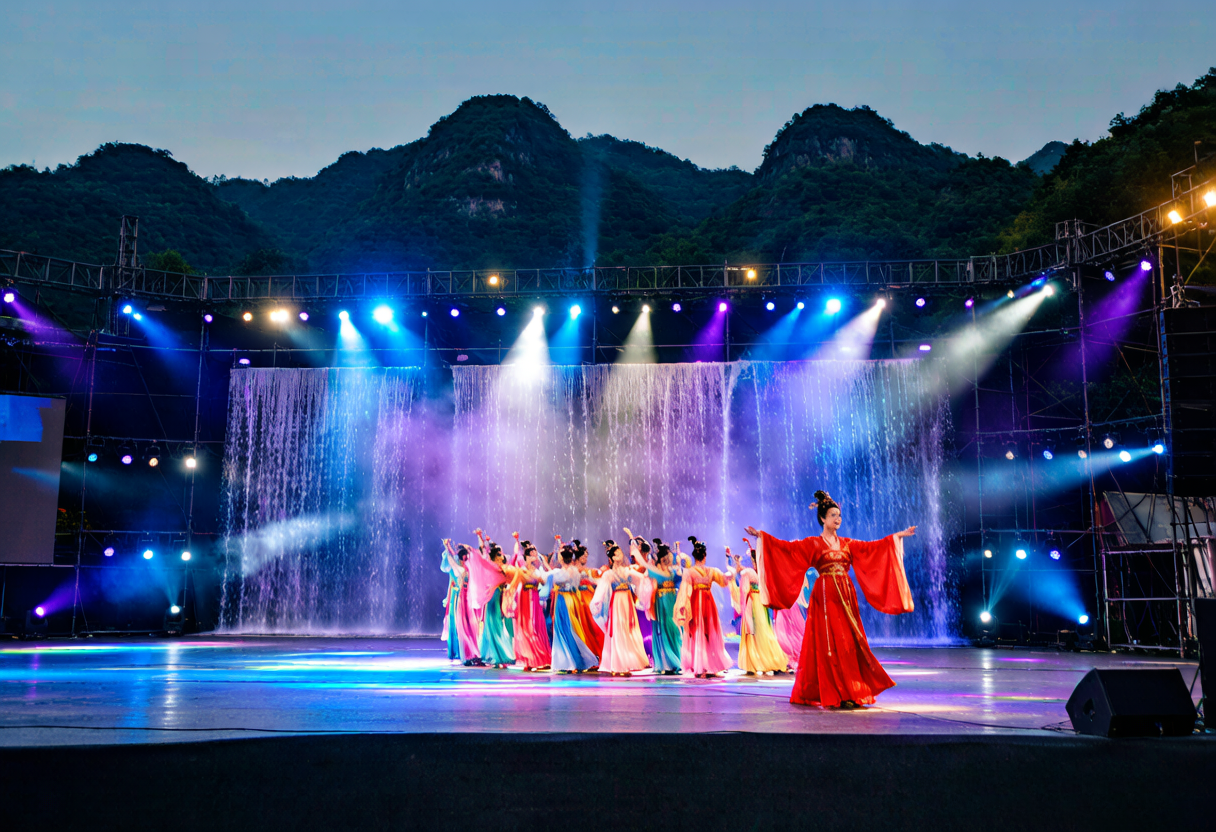
Huaqing Pool is a museum of ruins by day, and the world's most stunning live theater by night. In the same place, day and night are two completely different worlds.
Must-see by day: the Tang Imperial Bath Ruins Museum—Yang Guifei's Begonia Pool and Emperor Xuanzong's Lotus Pool; Five Rooms Hall—the site of the Xi'an Incident, with bullet holes still preserved on the walls; Nine Dragon Lake and Lotus Lake—Tang-style architecture combined with garden scenery, perfect for photos; Mount Li—take the cable car up for a panoramic view of the Guanzhong Plain.
Must-see by night—"The Everlasting Regret" live performance: with Mount Li as the backdrop and Huaqing Pool as the stage, over seven hundred professional performers in gorgeous Tang costumes, high-tech lighting, water curtain effects, and real fire effects. Must-see highlights include the water curtain spectacle of "She was granted a bath in Huaqing Pool," the tender moonlight of "Whispering secretly at midnight," the war drums of "The war drums rumble from Yuzhou," and the star-filled ending of "Meeting in the Heavenly Realm."
A Xiaohongshu user wrote after watching: "The nighttime Huaqing Pool, with drooping willows and brilliant lights, Tang-style architecture reflected in the lake—beautifully moving to tears! This is absolutely the most stunning live performance I've ever seen!"
Address: No.38 Huaqing Road, Lintong District, Xi'an
Transport: Metro Line 9 to Huaqing Pool Station, Exit B/C, 5-minute walk
Admission: 120 RMB adults, students half price
Performance: 20:10/21:35/23:00, Center 338 RMB, book 7-10 days ahead in peak season
This Sorrow Shall Forever Last
Over a thousand years have passed. Mount Li still stands. The warm spring water still flows. Every night, over seven hundred performers at Huaqing Pool reenact this story.
From the Kaiyuan Flourishing Era to the An Lushan Rebellion, from Mawei Slope to the fairy island—an emperor and a woman's love became an 840-character poem, a seventy-minute performance, and a Huaqing Pool forever etched in Chinese memory.
Some stories can only be truly understood when you stand where they happened.
Next time, come to Xi'an. Come to Huaqing Pool. Touch the stones where Yang Guifei bathed by day, watch a performance that transcends a thousand years by night.
"On high, we'd be two birds flying wing to wing; on earth, two trees with branches intertwined."
— Bai Juyi, "The Everlasting Regret"
"This sorrow shall forever last"
— Huaqing Pool · Xi'an · China —