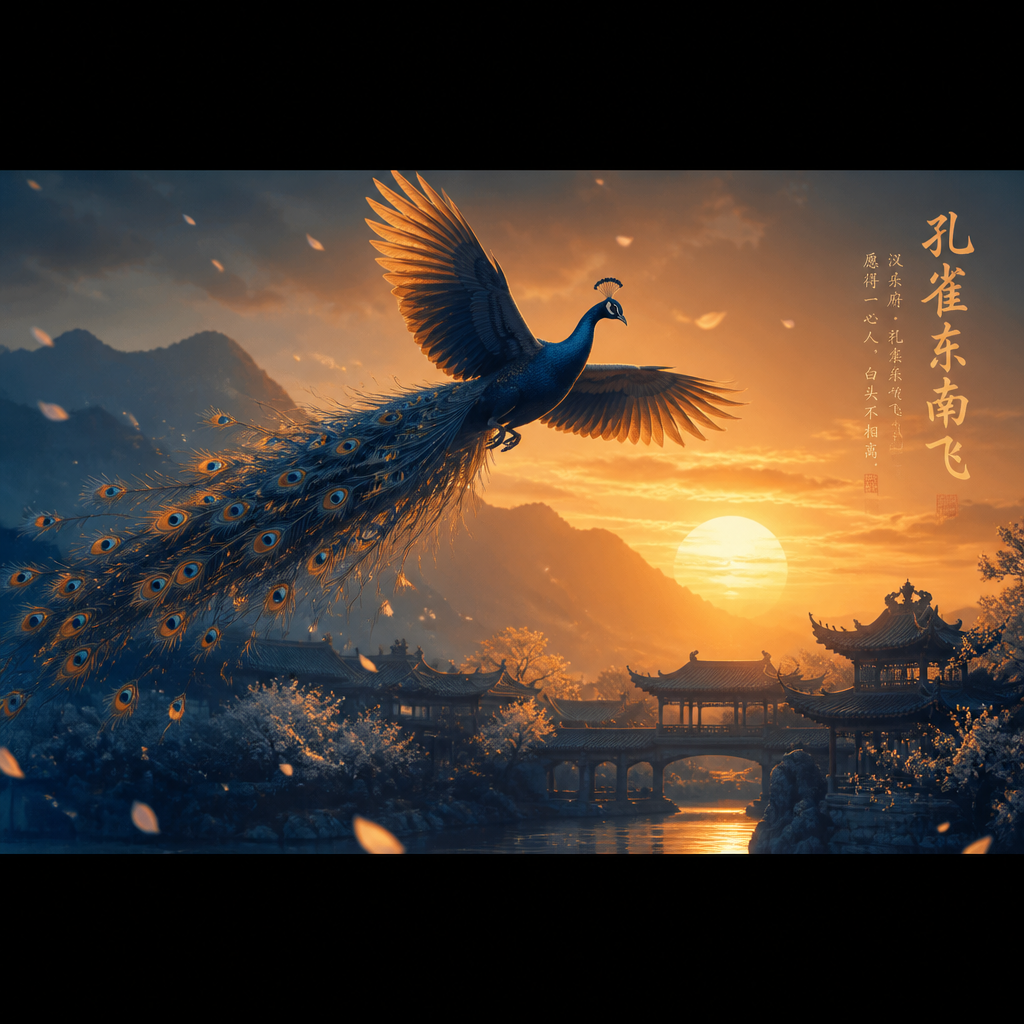
Peacock Flies Southeast
— China's Romeo and Juliet, 1,200 Years Older
"Her slender steps were exquisitely unmatched in all the world." — The Peacock Flies Southeast
During the Eastern Han Dynasty, in a small town of Huaining, Anhui, Liu Lanzhi sat before her loom, her fingers flying between the shuttles. Beyond the window, the faint sound of the Wan River trickled past; distant mountains loomed in the twilight, their ridges shrouded in mist. At thirteen, she could weave silk. At fourteen, she learned to cut fabric. At fifteen, she played the konghou. At sixteen, she recited poetry. Her slender fingers, her graceful gait—she was renowned for miles around as a woman of exceptional talent.
Then, without warning, the loom fell silent. She had received a letter—a letter of divorce from her husband, Jiao Zhongqing. In those days, not bearing children was enough reason for a husband to send his wife away.
Eighteen centuries later, in that same land of Anhui, a country road awaits you. You cycle through rice paddies and bamboo groves. Afternoon sunlight dapples your white shirt through bamboo leaves; frogs croak in the irrigation channels beside the road, and the air carries the earthy scent of soil and straw. At the end of the road lies a place called "Xiaoshi Town"—ancient times knew it as "Xiaosigang," the very place where Liu Lanzhi and Jiao Zhongqing's love story unfolded.
You park your bike beneath an old locust tree at the village entrance and look up to see an ancient opera stage, its beams carved with two peacocks—one flying east, the other gazing west. A breeze stirs, and wind bells at the stage's four corners chime softly. You stand before the Peacock Stage, where afternoon sun has warmed the stone foundation. Press your palm against it—you can feel the same warmth that woman felt eighteen hundred years ago.
This poem has only about 1,700 characters, yet it has survived for 1,800 years. It tells a love story 1,200 years older than Romeo and Juliet. And now, you can step into this story yourself—just by riding a bike.
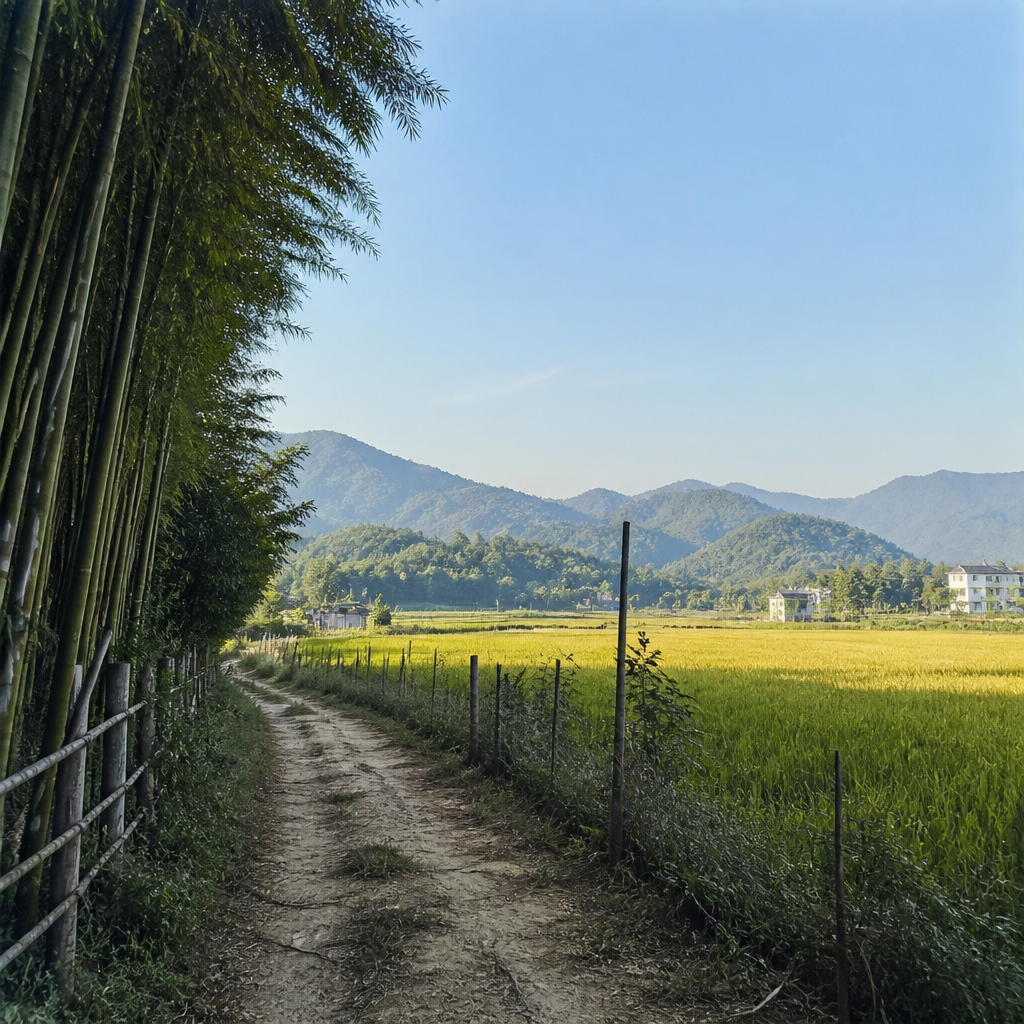
△ The rural road in Huaining, Anhui—leading to where a love story unfolded 1,800 years ago
The story begins beautifully. At seventeen, Liu Lanzhi married Jiao Zhongqing. They were devoted to each other—he served as a minor clerk in the local magistrate's office, while she wove cloth and cooked at home. Every evening, as Zhongqing returned from work, he would first walk to the window to catch a glimpse of her. The poem records: "Cockcrow sends her to the loom, night after night without rest." Not a complaint—a simple chronicle. Every night, she wove, because her husband needed new clothes.
But his mother despised this daughter-in-law. The reason was as cruel as it was absurd: Lanzhi bore no children. In that era, childlessness was one of the "seven grounds for divorce"—enough reason to send a wife away. Day and night, Mother Jiao nagged until, finally, she forced Zhongqing to write a dismissal letter. As Lanzhi returned to her parental home, she looked back again and again, tears streaming down her face. She said to Zhongqing: "You shall be the rock, I shall be the reed. The reed is as soft as silk, the rock stands unshaken." Love crumbled before worldly pressures, but the vow endured.
"You shall be the rock, I shall be the reed.
The reed is as soft as silk, the rock stands unshaken."
Her tragedy truly began after returning to her parents' home. The county magistrate, hearing of her beauty and talent, sent a proposal. The prefect, too, sent envoys—with extraordinarily generous betrothal gifts: "golden and silver ornamented boxes," "thirty bolts of colorful silk," "forty to fifty attendants." However, her brother, eyes glinting at the wealth, forced her to remarry.
On the night before her wedding, Lanzhi sat alone by the window. Moonlight fell on her pale face. She sent a letter to Zhongqing: "Calamity has descended from heaven—I can no longer be your wife. Let us not burden each other anymore."
On the day of the wedding, tears flowed freely inside the bridal sedan. When they reached a pond not far from the Jiao family, she suddenly called for a stop. "She lifted her skirts and removed her silk shoes, then threw herself into the clear pond." The water splashed high, shocking the wedding procession.
When the news reached Zhongqing—who was at the magistrate's office—he stood in silence for a long time. Then he walked slowly out of the office, into the courtyard, to the old locust tree. "He lingered beneath the courtyard tree, then hanged himself on the eastern branch."
"She lifted her skirts and removed her silk shoes,
Then threw herself into the clear pond.
He lingered beneath the courtyard tree,
Then hanged himself on the eastern branch."
Their families buried them together beside Mount Hua. On their shared grave grew a parasol tree; in the tree lived a pair of peacocks. "East and west they planted pine and cypress, left and right they grew phoenix trees. Branch upon branch they cover each other, leaf upon leaf they intertwine."—at last, they could be together forever. Later generations turned their story into a narrative poem of over 1,700 characters, included in New Songs from the Jade Terrace, making it the longest narrative poem in Chinese literary history. The Ming Dynasty literary master Wang Shizhen called it "the saint of long poems"—the greatest long narrative poem ever written.
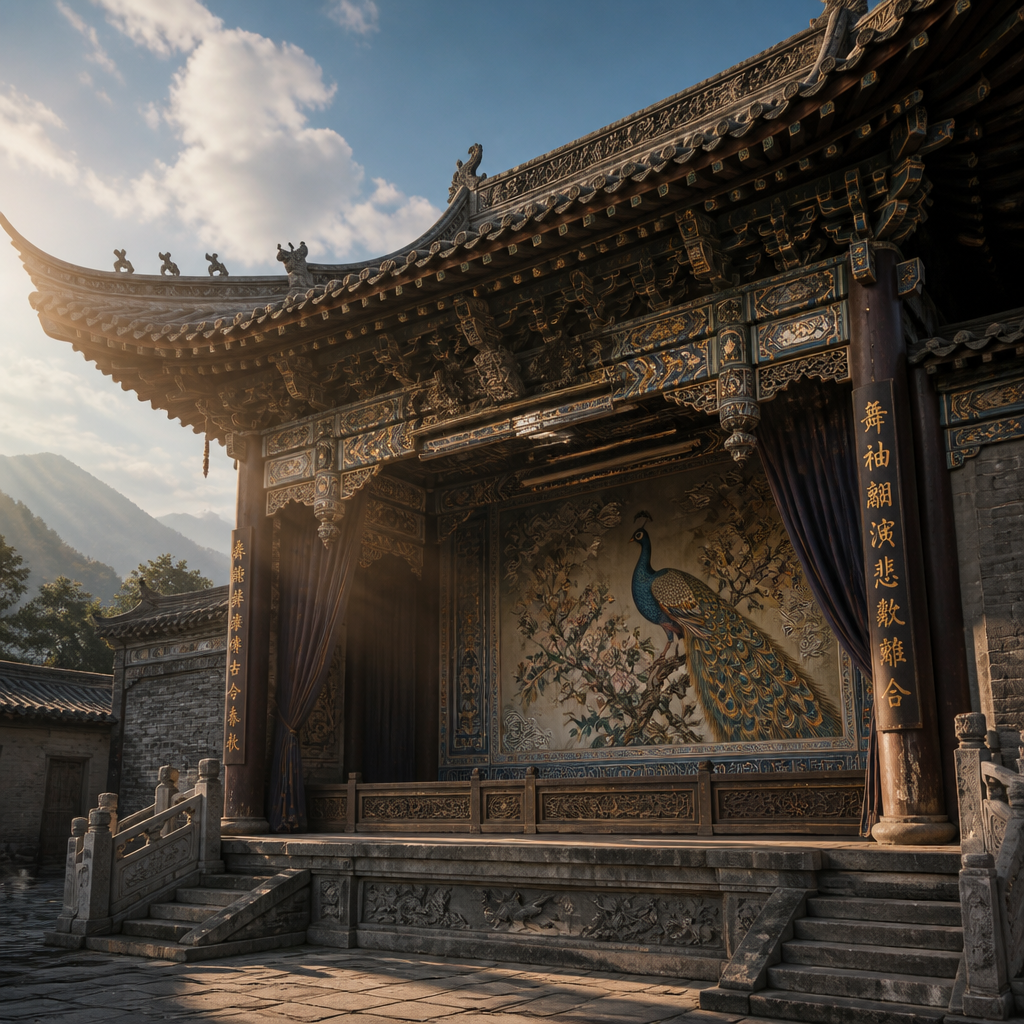
△ The Peacock Stage—where Liu Lanzhi and Jiao Zhongqing first pledged their love
Shakespeare's Romeo and Juliet was written around 1595. The Peacock Flies Southeast is dated to approximately 200 CE—1,200 years earlier. Two lovers die because their families oppose their union, then are buried together—this story structure is not uncommon in world literature. But The Peacock Flies Southeast predates Romeo and Juliet by a full twelve centuries. When Shakespeare was still in his cradle, a Chinese couple had already transformed into peacocks, together forever.
When people mention Liu Lanzhi, many think of her as a "victim"—a weak woman persecuted by feudal ethics. But read the poem carefully, and you'll find she was far more than a victim. She was a true woman of talent—"At thirteen she could weave silk, at fourteen she learned to cut fabric, at fifteen she played the konghou, at sixteen she recited poetry." At thirteen she could weave; at fourteen she could tailor; at fifteen she could play the harp; at sixteen she could recite classic texts. In rural China two millennia ago, this level of education was extraordinary.
After her dismissal, her brilliance was not forgotten. The county magistrate, hearing of her reputation, sent a proposal. The prefect did the same, with lavish gifts: "golden and silver ornamented boxes," "thirty bolts of colorful silk," "forty to fifty attendants." A divorced woman, yet both the magistrate and prefect vied to marry her—this speaks to recognized brilliance that no worldly prejudice could obscure.
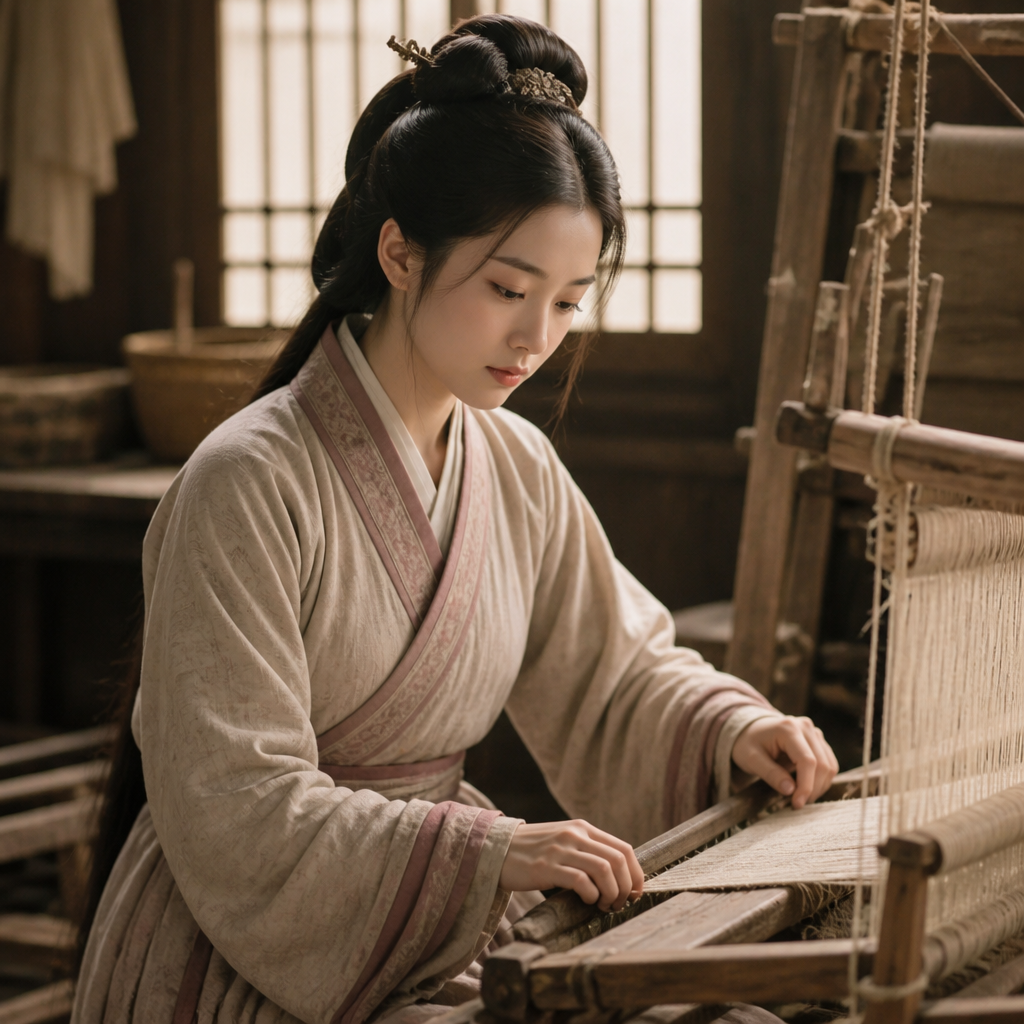
△ Liu Lanzhi—"At thirteen she could weave silk, at fourteen she learned to cut fabric, at fifteen she played the konghou, at sixteen she recited poetry"
But what moves us most is not her talent—it is her choice. When her brother pressured her to remarry, she did not simply submit. On the night before her wedding, she chose to jump into the water. Not from weakness, not from resignation, but because she wanted to master her own fate. "She lifted her skirts and removed her silk shoes, then threw herself into the clear pond"—this act was deliberate, absolute, the final dignity of a human being. Through death, she completed her fidelity to love and her mastery of herself.
And what of Jiao Zhongqing? He was no "mama's boy." When his mother dismissed Lanzhi, he had resisted: "I respectfully beg Mother—if you send this woman away, I shall never marry again!" Filial piety ultimately conquered love, and he wrote the dismissal letter. When he heard of Lanzhi's death, he chose to hang himself. "He lingered beneath the courtyard tree, then hanged himself on the eastern branch"—through death, he completed his penance for love and his accusation of that era.
This is not a story of "woman suffers, man fails." It is a story of mutual destruction before feudal ethics—a couple who conquered the world through death, only to lose to their era. Standing before their shared grave eighteen centuries later, we should see not merely "tragedy," but two real people—a talented woman, a loving but weak man—who made the bravest choices possible in a world that permitted no love.
The story unfolds in Huaining, Anhui—a small county easy to overlook on any map. But set foot on this land, and you'll find eighteen centuries have not passed here in vain. Huaining was anciently called "Xiaosigang" because Jiao Zhongqing once served as a minor clerk here. Today it is a national AAAA-level tourist attraction—the Peacock Flies Southeast Cultural Park.
Entering the park, the first thing you see is the Peacock Tomb—the shared burial site of Liu Lanzhi and Jiao Zhongqing. This is a municipal cultural relic protection site; the inscriptions on the tombstone have faded, yet every Qingming Festival, newlyweds still come to pay their respects. An ancient parasol tree grows atop the tomb, and beneath it lies a bitter well—legend says the water turned bitter after Lanzhi drowned. You crouch by the well; cool air rises from it, and moss covers the walls.
The Peacock Stage is the park's most central site. This ancient opera stage was first built during the Tang Dynasty and has undergone renovations through the ages. It is where Lanzhi and Zhongqing pledged their love. The stage features flying eaves, carved beams, and wind bells at each corner. When wind blows, the bells chime across the entire square, as if recounting an ancient tale. Together with Yellow Crane Tower and Phoenix Tower, it is known as one of the "three legendary structures along the Yangtze River"—not an official title, but word-of-mouth folk reputation.
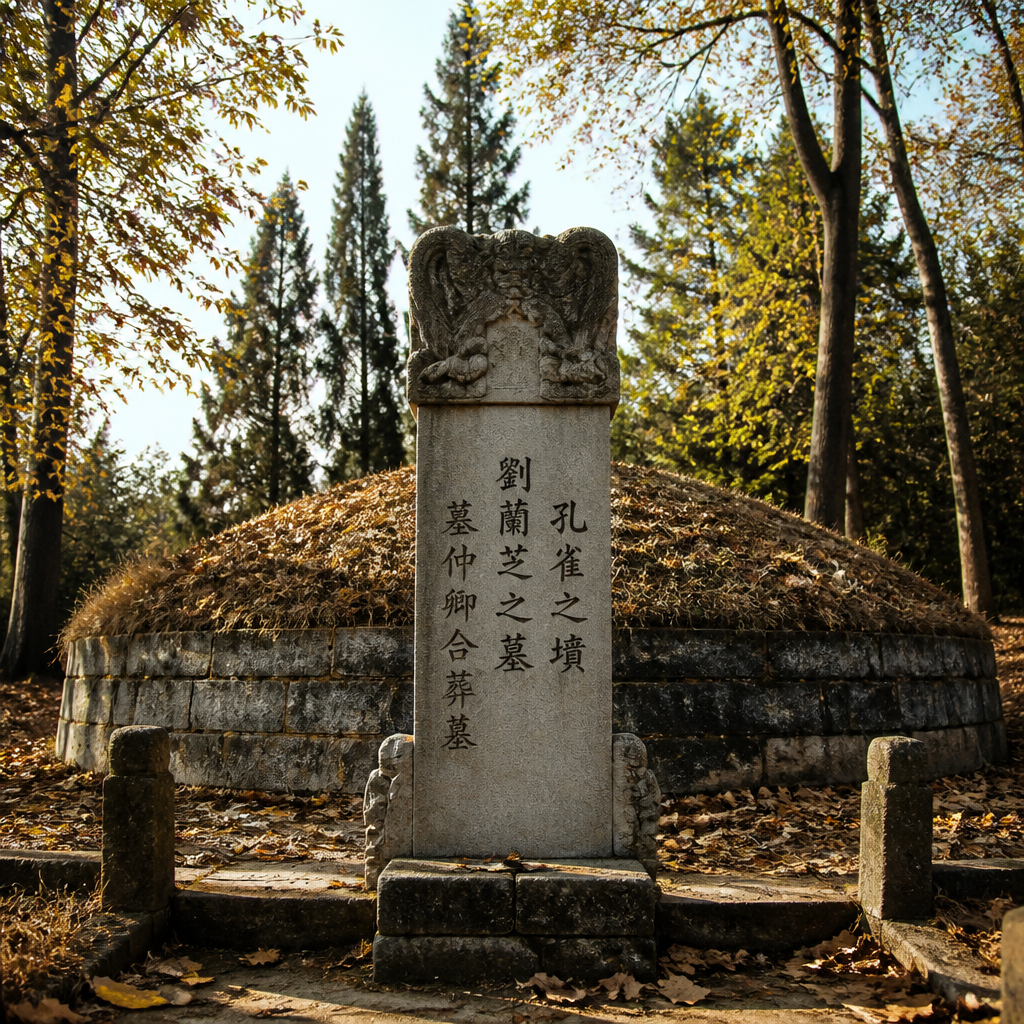
△ The Peacock Tomb—the shared grave of Jiao and Liu, a municipal cultural relic protection site
Li Bai wrote in his "White-Haired Song": "The turtle swims in the boiling pool, upon seeing this the spirit grieves." He specially traveled to Huaining to mourn this love, penning lines: "The peacock flies southeast, where shall it rest?" The park still preserves Li Bai's poetry stele; the characters soar like dragons and phoenixes. You can trace the strokes with your fingers, feeling the poet's sigh from 1,300 years ago.
In 2014, The Peacock Flies Southeast was inscribed on the National Intangible Cultural Heritage list. The story is no longer mere text in literary history—it is a living cultural symbol. Every year on the seventh day of the seventh lunar month—the legendary day when the Cowherd and Weaver Girl meet—Huaining hosts the Peacock Flies Southeast Cultural Festival, and the entire town empties onto the streets.
Getting to Huaining
· High-speed rail: Only 1.2 km from Qianshan South Station; 2-3 hours from Hefei/Wuhan/Nanjing
· Self-drive: Exit at Huaining on the Shanghai-Chongqing Expressway; ~5 km to the park
· Nearby: Adjacent to Tianzhu Mountain scenic area—combine visits
Today's Peacock Flies Southeast Cultural Park covers over 300 mu (about 50 acres) with 118 Han-style buildings. Walk into the park, and you'll feel time has rolled back 1,800 years. The blue brick paths beneath your feet were walked by ancients; the carved window patterns were carved by ancients; even the scent in the air—soil, grass, pond—is identical to what it was 1,800 years ago.
In the park, you can experience "ball-throwing matchmaking"—the ancient custom where women selected husbands by throwing embroidered balls. You can take an embroidered ball, throw it high into the air, and watch it arc through the crowd—of course, it's a game now. But in that era, this might have been how Lanzhi and Zhongqing met. You can don Hanfu and photograph yourself before the Peacock Stage—rental costs just a few dollars, and rental points are everywhere in the park. The moment you put on the garments, you suddenly understand why ancient love was so heavy—because wearing this clothing meant bearing an era's weight.
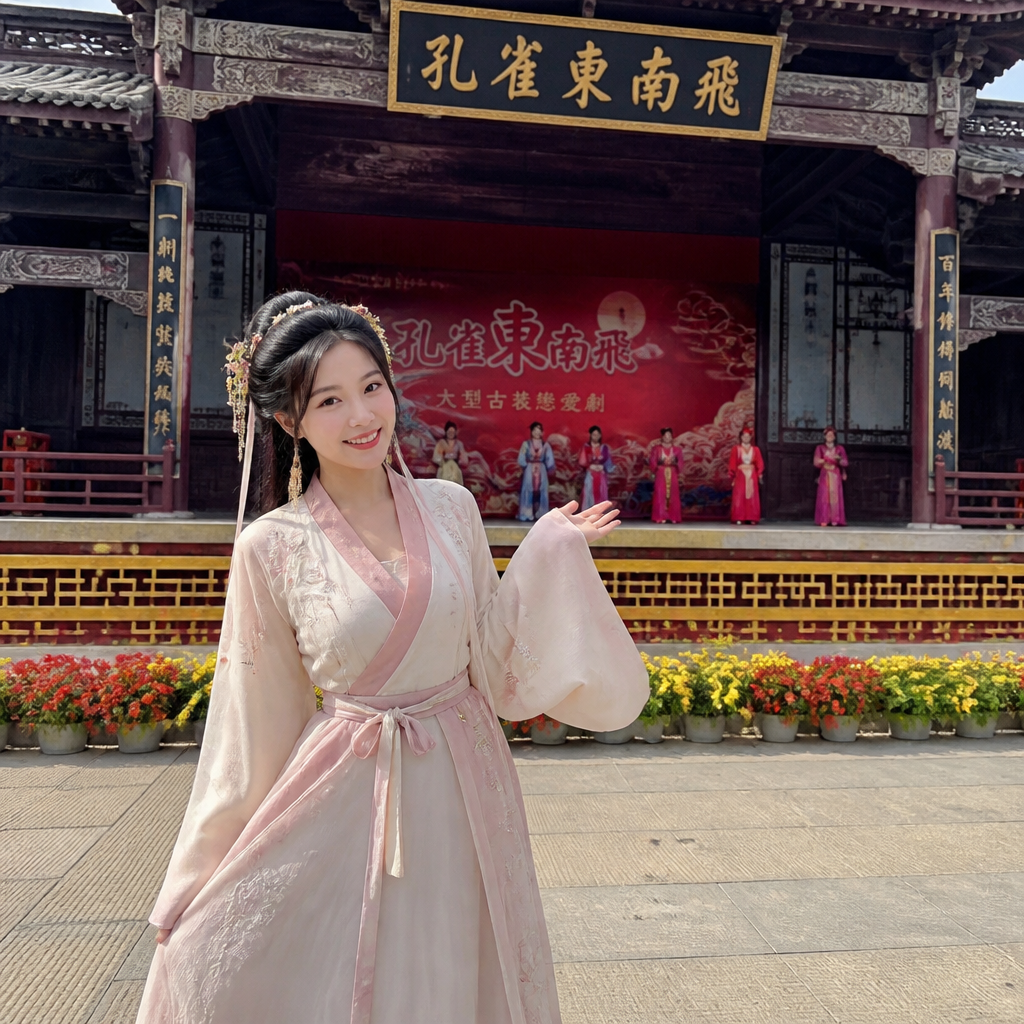
△ Try Hanfu and embroidered-ball matchmaking—experience love from 1,800 years ago at the Peacock Stage
In the Oath Pavilion, you can see Lanzhi and Zhongqing's vows carved on the wall; in the Peacock-Gazing Pavilion, you can read the poets' verses describing the peacock; in the Film City, 84 Han-style building replicas recreate the Eastern Han marketplace—you can walk into the inn, the tavern, the silk shop, imagining yourself an ordinary person living here 1,800 years ago. The Peacock Flies Southeast is no longer a poem to memorize from textbooks—it is something you can touch, somewhere you can walk into.
Park Information
· Tickets: ~70-120 CNY (off-peak vs. peak)
· Hours: 9:00 AM - 6:00 PM
· Address: Xiaoshi Town, Huaining County, Anqing City, Anhui Province
· Recommended visit: 2-3 hours
· Best season: Spring and autumn
A German tourist wrote on Trip.com: "Walking through the Peacock Southeast Flying heritage park feels like stepping back in time. The story of Lan Zhi and Zhong Qing is incredibly touching—it's China's Romeo and Juliet, but written 1,200 years earlier."
Eighteen centuries have passed. The peacock still flies—not a real peacock, but the carvings on the opera stage, the parasol tree on the shared grave, and the crowded streets during the Qixi Cultural Festival each year. Romeo and Juliet came 1,200 years after The Peacock Flies Southeast, but the story of love never grows old.
Next time you see a copy of Romeo and Juliet in an overseas bookstore, or watch Shakespeare's play in a theater—remember this: in a small Chinese town in Anhui, a couple loved 1,200 years before them. They had no Shakespeare's pen, but they had truer lives. Their love, completed through death, is more stirring than any drama.
Next time you plan a trip to China, put Huaining on your list. You don't need to first understand that 1,700-character poem, and you don't need to study Eastern Han marriage customs. All you need is to cycle down a country road, through rice paddies and bamboo groves, to the Peacock Stage. The wind bells will tell you the story; the parasol tree will show you the way.
Because some loves can only truly be understood standing on that land.