Folktale · Celestial Romance
The Goddess Marriage
A Heavenly Weaver Falls for a Mortal
When the Huangmei opera melody starts, you can almost see the scene — a young farmer working in the fields; his wife sitting at the loom, singing. "Birds in the trees fly pair by pair, green mountains and clear waters smile with joy..."
The voice is not flashy or complicated — like wind blowing through the fields, like a stream flowing through the mountains. This is China's simplest and most touching love story — not about emperors or generals, but about a farmer and his wife working together.
This melody has been sung across China for exactly 2,000 years. From farm fields to the Huangmei opera stage, from old radios to short videos on phones — everyone knows "Birds in the trees fly pair by pair."
This is the power of "The Marriage of the Fairy." A story about "the Seventh Fairy and Dong Yong," a melody about "you plow the fields and I weave cloth" — why has it been sung for 2,000 years?
"Birds in the trees fly pair by pair, green mountains and clear waters smile with joy. No more suffering from servitude, husband and wife return home together."
— Classic lyrics from Huangmei opera "The Marriage of the Fairy"
More than 2,000 years ago, there was a young man named Dong Yong, living at the foot of Tianzhu Mountain. When his father died, he had no money for a burial, so he sold himself to a landlord to pay for his father's funeral.
His filial piety moved the Seventh Fairy in heaven. She secretly descended to earth, met Dong Yong under a locust tree, and they fell in love at first sight — getting married.
Their married life was "you plow the fields and I weave cloth, I fetch water and you water the garden." The Seventh Fairy was no longer a fairy in heaven — she became a farmer's wife on earth. Dong Yong was no longer a lonely hired hand — he had someone to accompany him.
The happiness didn't last long. The Jade Emperor learned that the Seventh Fairy had secretly descended to earth. He was furious and ordered her to return. The Seventh Fairy had to leave Dong Yong. They bid farewell under the locust tree — this is how "parting at the locust tree" came to be.
This story was first recorded in "Stories of Filial Children" by Liu Xiang in the Western Han dynasty. In 2006, "The Legend of Dong Yong" was listed among the first batch of National Intangible Cultural Heritage items. A story about "filial piety" and "love" has been sung for 2,000 years.
"The Legend of Dong Yong"
— Listed in 2006 as National Intangible Cultural Heritage (Item No. I-9)
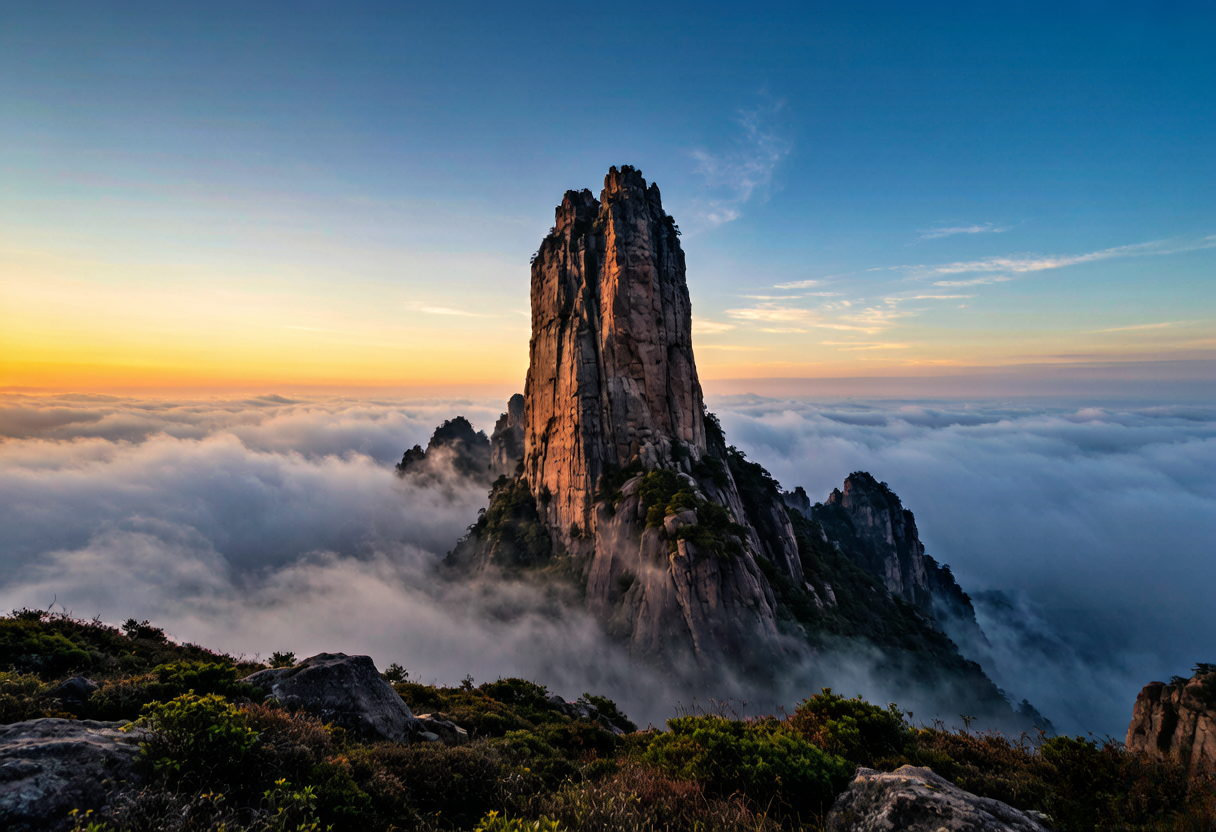
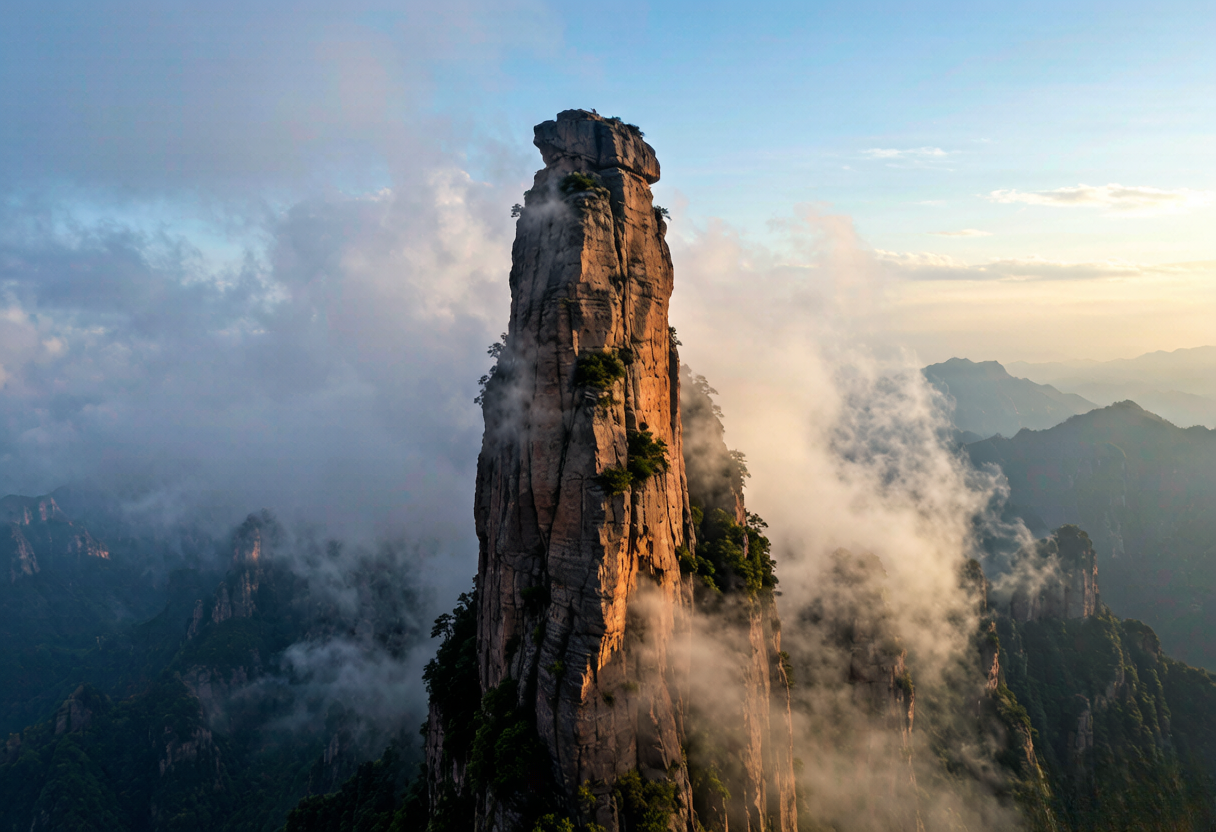
In Anqing, Anhui, there's a mountain called Tianzhu Mountain. Its main peak looks like a pillar reaching into the clouds, giving it the name "one pillar supports the sky." Li Bai wrote: "Strange peaks give birth to strange clouds; graceful trees hold graceful spirit."
This is "the hometown of the Seventh Fairy." Legend says the Seventh Fairy descended to Tianzhu Mountain because she was curious about the "central pillar" supporting the southern heaven — Tianzhu Peak.
Tianzhu Mountain is 1,489.9 meters high, a national 5A scenic spot and World Geopark. In 106 BC, Emperor Wu of Han toured south and climbed Tianzhu Mountain, conferring upon it the title "Southern Sacred Mountain."
Tianzhu Mountain is also called "Wan Mountain." During the Spring and Autumn period, it belonged to the Kingdom of Wan — that's how Anhui got its abbreviation "Wan." One mountain, half of Anhui's history.
"Climb Tianzhu Mountain, receive heaven's blessing" — this is Tianzhu Mountain's slogan. A mountain, because of a legend, became a "holy mountain of love."
"Climb Tianzhu Mountain, receive heaven's blessing"
— Tianzhu Mountain tourism slogan

On Tianzhu Mountain, every step you take is along the same path the Seventh Fairy and Dong Yong walked 2,000 years ago.
Tianchi Peak — the place where the Seventh Fairy bathed after descending to earth. Standing at the top of Tianchi Peak, looking closely at Tianzhu Peak, with clouds floating between the peaks — you'll understand why the Seventh Fairy fell in love with this place.
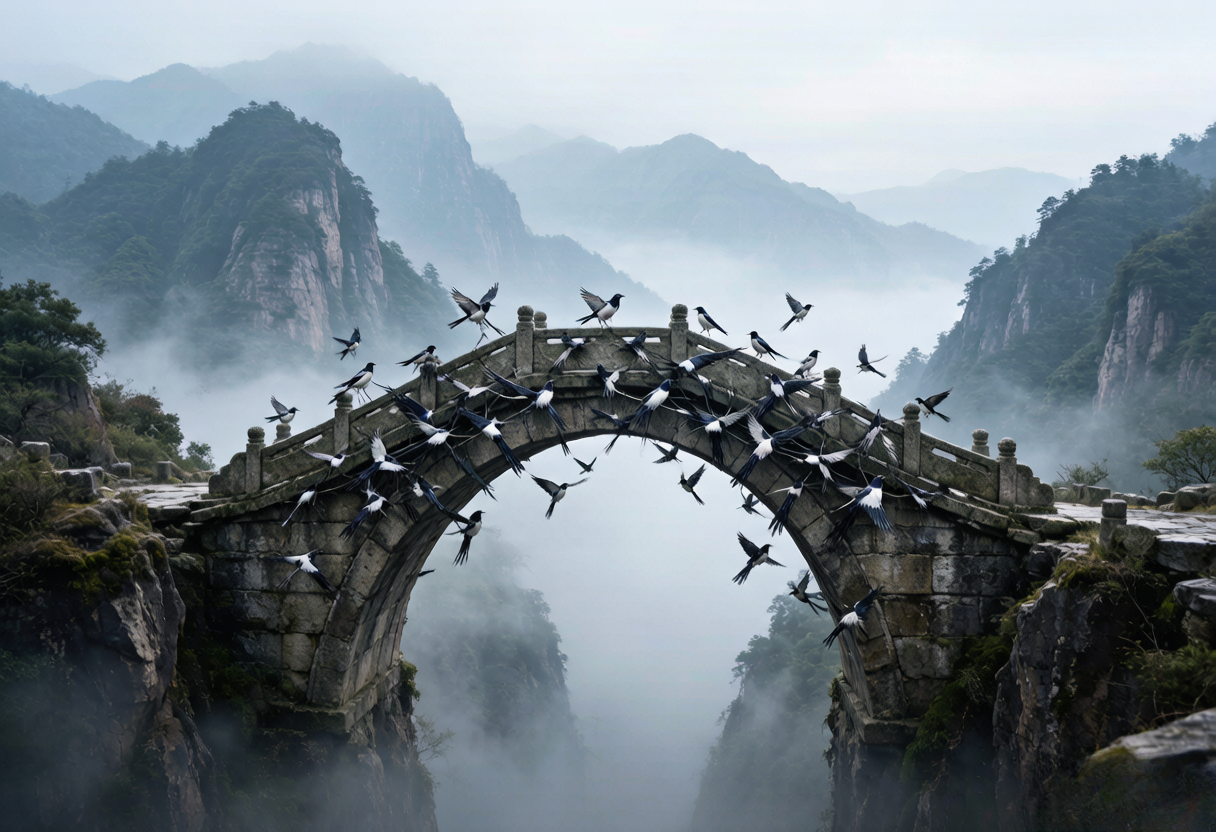
Magpie Bridge — a large rock extending from the eastern cliff, hanging in the air like a bridge. Legend says this is where the Cowherd and Weaver Girl meet on Qixi Festival. "It's said that lovers who are truly in love can hear the Cowherd and Weaver Girl whispering on this bridge every Qixi."
Foguang Temple — where the Seventh Fairy and Dong Yong got married under the locust tree beside the temple. Is that locust tree still there? You'll find out when you go.
Tianlongguan · Dongjia Bay — Dong Yong's birthplace. "The Seventh Fairy descended here, and Dong Yong's former residence is also located here."
One tourist said: "Tianzhu Mountain is known as the 'hometown of the Seventh Fairy.' You can see the Seventh Fairy's footprints everywhere. During Qixi, you can follow Dong Yong and the Seventh Fairy's love trail and visit those ancient love sites."

You might think "The Seventh Fairy and Dong Yong" is just an old folk story, long forgotten. But the opposite is true — this story not only hasn't disappeared, it's become even more popular.
On November 11, 2024, Anqing launched a satellite called "Tianxianpei." A 2,000-year legend was sent into space by a city. "Building a bridge to the heavens for the protagonists of this romantic love story."
Starting in 2025, Tianzhu Mountain deeply connected with the "Seventh Fairy" IP: launched the "Seventh Fairy" tourist train; held the "Heavenly Pool Festival" in the scenic area, with "fairies" inviting tourists to interact; every weekend presented "The Story of Seven Women and One Man" — "Li Bai" leading the "Seventh Fairy" in immersive live streaming with games and group broadcasts.
The results were stunning: from January to July 2025, Tianzhu Mountain's online tourists increased 40% year-on-year; July saw 77% growth; Ctrip platform alone saw 120% growth in July. In August 2025, Tianzhu Mountain's official Douyin (TikTok) livestream room "Seventh Fairy" launched, gathering over 100 tourists in the square, with likes surpassing 10,000 in no time.
"A 2,000-year legend is being retold by a mountain, a city, and a new generation."
"January-July 2025: 40% YoY growth in online tourists; July: 77% growth; Ctrip alone: 120% growth in July."
— Tianzhu Mountain tourism data
How to get there? Take a high-speed rail to Qianshan Station, then take the scenic area bus — 10 yuan per person, about 40 minutes to the scenic area.
Tickets: 130 yuan in peak season (March 16 - November 15), 110 yuan in off-season. Students and seniors aged 60-69 get half price. Scenic area shuttle bus round-trip is 30 yuan; cable car (Dalongwo) is 80 yuan up, 60 yuan down.
Opening hours: 7:30-17:00 on weekdays, 7:30-17:30 on weekends. Ticket sales stop at 14:30 each day. Remember to book tickets one day in advance on the "Tianzhu Mountain Tourism Official Platform" WeChat mini-program or on Ctrip, Meituan.
Recommended route: Take the Dalongwo cable car up → Tianchi Peak (view Tianzhu Peak) → Magpie Bridge → Foguang Temple → Tianlongguan Dongjia Bay. This route covers most of the love-related attractions.
Don't forget to visit Tianxianxia Scenic Area! Just 2 kilometers straight-line distance from Tianzhu Mountain's main peak, it's a national 4A scenic area themed around the "Marriage of the Fairy" love story. You can experience: water slide aerial drift (188 yuan, 1,800 meters), love shouting spring, promising love on the Magpie Bridge, locust tree wedding ceremony, and farmer-weaver folk experiences.
One tourist said: "Tianzhu Mountain's unique positioning as a 'love shrine,' with its spectacular scenery and gentle cultural atmosphere, creates a dreamlike experience for participants like walking into a TV drama."
Best time to visit: April-May for rhododendrons, September-November for autumn scenery. Foreign tourists say: "The spectacular scenery and gentle cultural atmosphere create a dreamlike experience like walking into a TV drama."
Tickets: 130 RMB peak, 110 RMB off-season; students/seniors half price
Transport: High-speed rail to Qianshan Station → bus 10 RMB (40 mins)
Open: 7:30-17:00/17:30
Booking: Reserve one day ahead on official mini-program or Ctrip/Meituan
2,000 years ago, Dong Yong sold himself to pay for his father's burial at the foot of Tianzhu Mountain; the Seventh Fairy saw him from heaven. Today, you can still stand in the same place and hear the same melody.
"Climb Tianzhu Mountain, receive heaven's blessing." Some legends aren't just written in books — they're sung in songs, walked on mountains, and carved in stones.
Next time you visit Anhui, don't just go to Huangshan. Go to Tianzhu Mountain — walk into the hometown of the Seventh Fairy and hear the song that has been sung for 2,000 years with your own ears.
"You plow the fields, I weave the cloth; I fetch water, you water the garden. Though our cottage is humble, it shelters us from wind and rain; with love, even hardship tastes sweet."
— Huangmei opera "The Marriage of the Fairy"
"Birds in the trees fly pair by pair"
— Tianzhu Mountain, Anhui —