The Butterfly Lovers
China's Romeo and Juliet
A Melody, A Story
When the violin begins to play, you feel something gently tug at your heart — it is not sorrow, but something indescribably soft, like spring rain falling on the surface of West Lake, rippling outward in concentric circles. You close your eyes, and you can almost see a girl dressed as a young man walking on the road to Hangzhou, meeting a earnest scholar, and the two of them swearing brotherhood at the Grass Bridge. Music needs no language — it makes you believe that some things, even in death, do not disappear.
This piece is called "The Butterfly Lovers" — the Butterfly Lovers Violin Concerto. On May 27, 1959, it premiered at the Lyceum Theatre in Shanghai, with Yu Lina as the violin soloist. When the bow drew the first note from the strings, the audience fell silent — no one could have predicted that a folk tale passed down for 1,600 years would, on that day, be transformed into a melody that would captivate the world. It has been hailed as "a classic of Chinese folk music, the pride of all Eastern music".
If you are a foreign visitor, you may have felt something of the East in the melody of the Butterfly Lovers Concerto, or you may have heard the phrase "the Romeo and Juliet of the East" — but you probably do not know where this story comes from or why it is so deeply moving. What you do not know is that this story is not merely "the Eastern Romeo and Juliet" — it predates Shakespeare's star-crossed lovers by more than a full millennium. Shakespeare wrote Romeo and Juliet in 1597, while the story of the Butterfly Lovers originated in the 4th century CE, during the Eastern Jin dynasty.
Even more remarkably, this story may not be pure fiction — it may have actually happened. A legendary figure who has his own tomb, his own stele, and his own county records, who may have truly lived, loved, and died. And in 2026, you can hear the echoes of their reading at Wansong Academy in Hangzhou, imagine their reluctant farewell in the sunset at West Lake's Long Bridge, and feel the true weight of this love standing before the ancient tomb at the Liangzhu Cultural Park in Ningbo.
That Spring, 1,600 Years Ago
Sixteen hundred years ago, a girl named Zhu Yingtai put on men's clothing and set out on the road to study in Hangzhou. She was from Shangyu County in Kuaiji Commandery — present-day Shangyu, Shaoxing, Zhejiang — and she was clever and beautiful. She could embroider phoenixes and cut intricate patterns, but what she loved most was reading and writing. In an era when the prevailing belief was that "a woman without talent is virtuous," the idea of a girl wanting to study was almost unthinkable. But Zhu Yingtai was determined, and her father, unable to sway her, finally relented.
Disguised as a young scholar with her maid dressed as a page boy, she traveled until they reached a ferry crossing, where they stopped to rest in a roadside pavilion. It was there that she met a sincere young scholar named Liang Shanbo, from Mao County in Kuaiji Commandery — present-day Yinzhou District, Ningbo. The two hit it off immediately and, at the Grass Bridge, swore an oath of brotherhood. Liang Shanbo was two years older, so Zhu Yingtai called him "brother," and he called her "younger brother" — he had no idea, of course, that this "younger brother" was actually a girl.
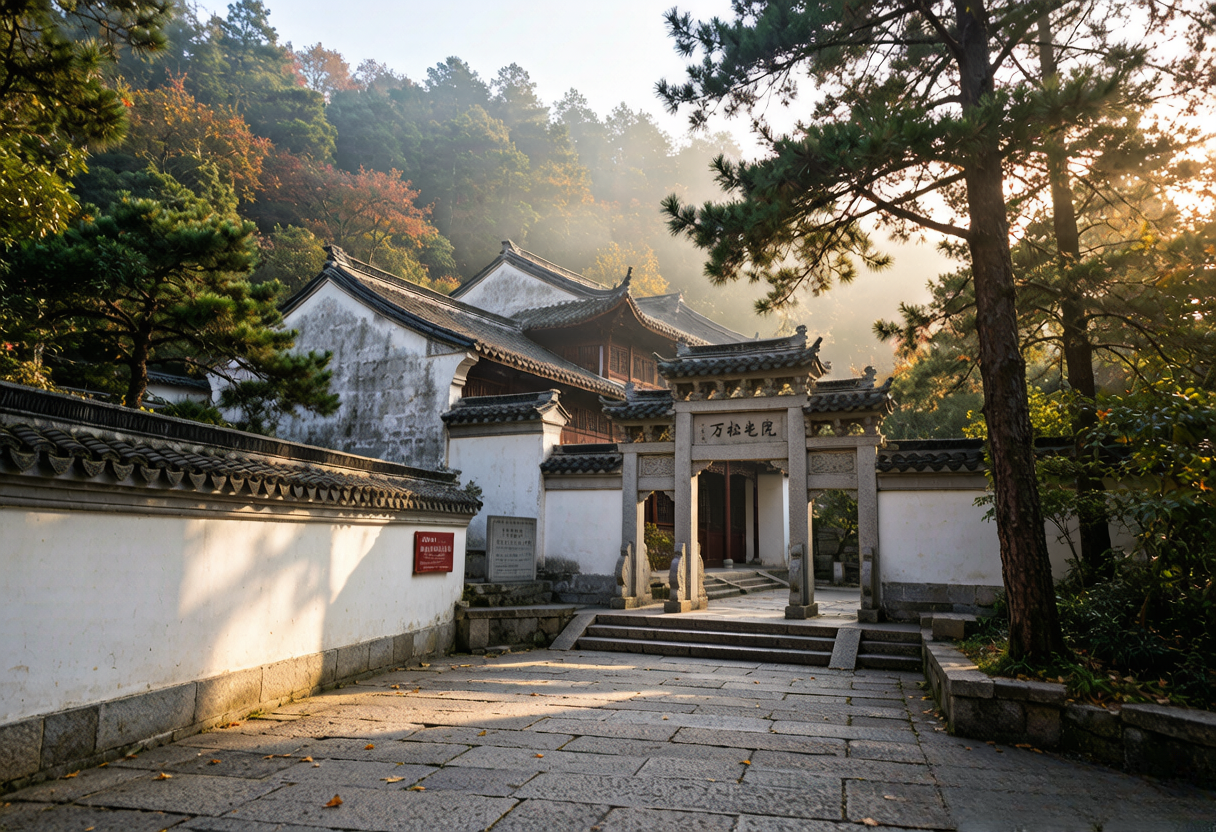
During their three years of studying together at Wansong Academy, they were inseparable from dawn to dusk, becoming the closest of friends. To keep Liang Shanbo from discovering her true identity, Zhu Yingtai placed a basin of water between their beds and warned him not to move in his sleep — Liang Shanbo, ever proper, stayed perfectly still and never discovered her secret for three whole years. But in Zhu Yingtai's heart, feelings had quietly taken root. She could hear the sound of recitation drifting through the pine forest, smell the faint fragrance of ink spreading on rice paper, and see the earnest profile of Liang Shanbo bent over his writing — in those days, even the patches of sunlight falling through the window lattice onto the desk felt warm.
Three years later, her father summoned her home. On the eighteen-mile journey of farewell, Zhu Yingtai used metaphor after metaphor to hint at her feelings — seeing mandarin ducks, she said "they come in pairs"; seeing a woodcutter, she asked "for whom do you toil so?"; seeing peonies, she said "pluck the flower while it can be plucked." But Liang Shanbo, that "blockhead," never understood. The Yue opera version contains a classic lyric: "A rainbow spans ten thousand miles as flowers bloom; butterflies come in pairs. Through heaven's ruin and earth's decay, our hearts remain unchanged — Liang Shanbo and Zhu Yingtai."
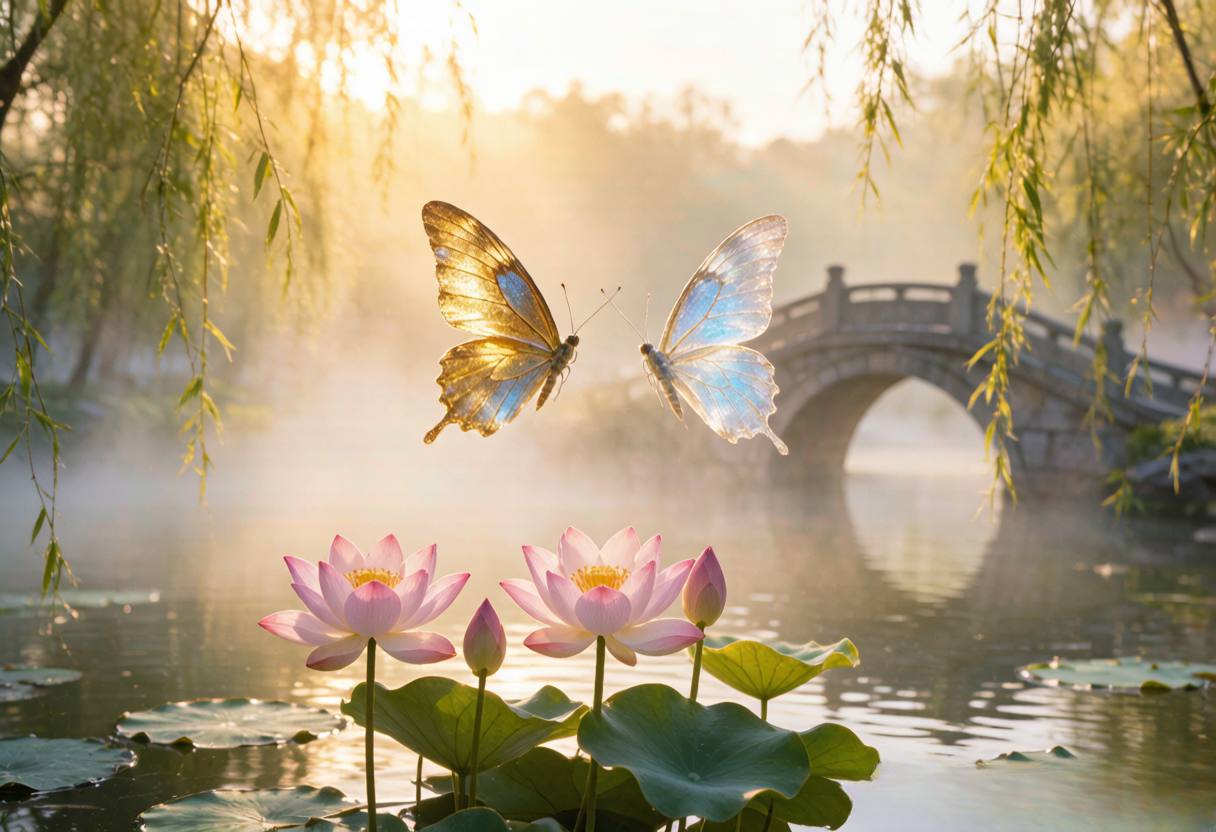
By the time Liang Shanbo finally learned the truth and rushed to propose, he discovered that Zhu Yingtai had already been betrothed by her father to Ma Wencai, the son of a prefect. The two met at the pavilion for one final, heartbreaking reunion, where Zhu Yingtai wept: "If we cannot share a bed in life, then let us share a grave in death." Not long after, Liang Shanbo died of grief and longing. On her wedding day, as Zhu Yingtai's bridal procession passed his tomb, a great storm arose and the tomb split open — she threw herself inside, and the two were buried together. According to legend, at that moment, they transformed into a pair of butterflies and flew away, never to be separated again.
In 2006, the Legend of the Butterfly Lovers was inscribed on the first batch of China's National Intangible Cultural Heritage List. The official citation reads: "The Legend of Liang Shanbo and Zhu Yingtai is one of China's four great folk legends and a treasure of Chinese culture. For over a thousand years, it has deeply moved people's hearts with its vivid themes of advocating learning, celebrating love, and praising the endless vitality of life."
"A rainbow spans ten thousand miles as flowers bloom; butterflies come in pairs. Through heaven's ruin and earth's decay, our hearts remain unchanged — Liang Shanbo and Zhu Yingtai."
— Classic lyric from the Yue opera "The Butterfly Lovers"
He May Have Really Existed
If you assume Liang Shanbo was purely a fictional character, you would be deeply mistaken. The most astonishing fact is this: Liang Shanbo may have been a real historical figure — he served as a county magistrate, died of exhaustion while managing flood control, and had his own tomb and epitaph. According to historical records, Liang Shanbo once served as the magistrate of Yin County in Ningbo, Zhejiang, and died of illness from overwork while managing the Yao River. His dying wish was to be buried at Jiulong Xu in Gaoqiao. The Northern Song dynasty text "Record of the Temple of the Righteous King" records that Liang Shanbo was born in 352 CE and died in 373 CE, and that Zhu Yingtai died and was buried with him in 374 CE — these dates are specific to the year, which is unusual for a purely fictional character.
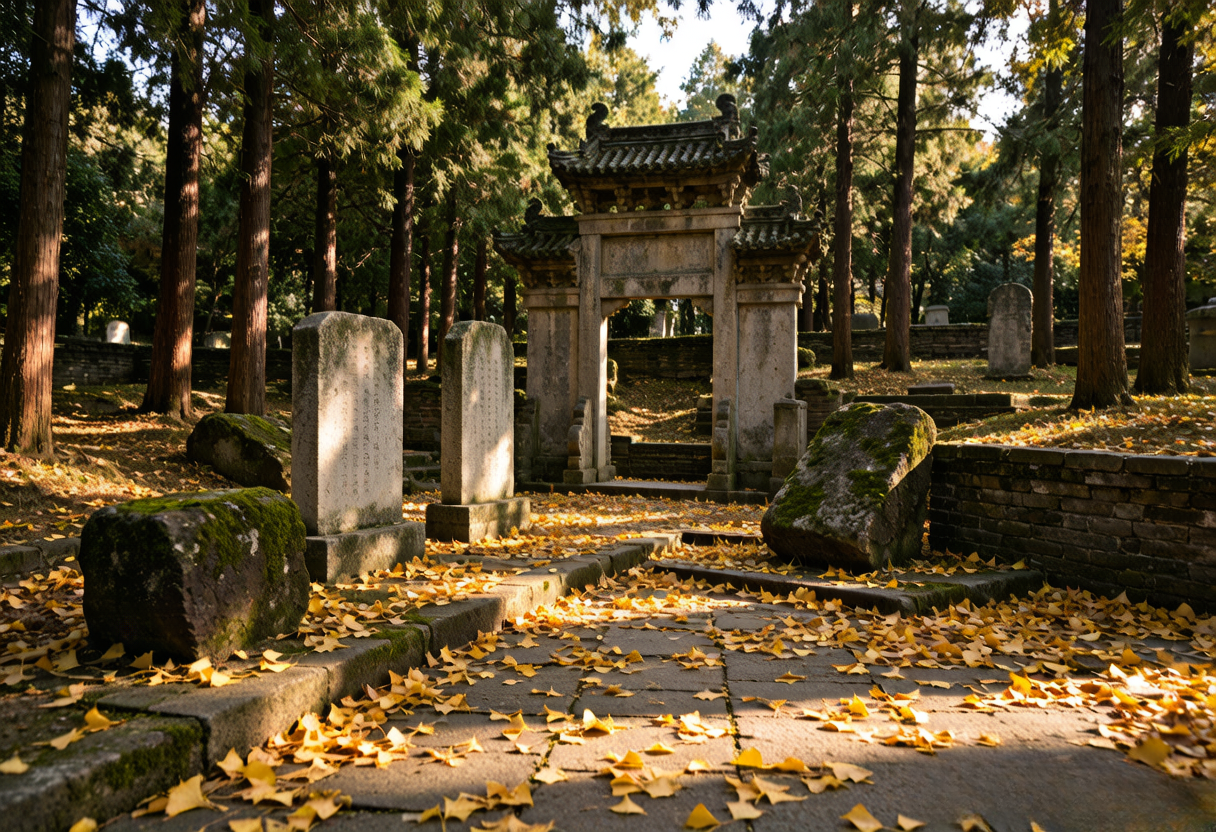
In 1997, archaeologists excavated the ancient tomb of Liang Shanbo in Gaoqiao Town, Ningbo, and unearthed an epitaph identifying the tomb's occupant as "Liang Shanbo, magistrate of Yin County in the Jin dynasty." Standing before the tomb pit, looking at bricks stained by sixteen centuries of earth, you can almost feel the residual warmth in the soil — this is not a prop from a story, it is a real tomb. The map of Yin County appended to the Southern Song dynasty text "Chronicle of Baoqing Siming" already clearly marks the "Tomb of the Righteous Woman, Liang Shanbo and Zhu Yingtai" — meaning that eight hundred years ago, this tomb was already officially documented.
In 2003, a stele inscribed with "Record of the Tomb of Liang Shanbo and Zhu Yingtai" was unearthed in Weishan County, Jining, Shandong. A legendary figure with his own tomb, his own stele, and his own county records — he may have truly lived, loved, and died. This intertwining of legend and history is something you would be hard-pressed to find anywhere else in the world. Romeo and Juliet are fictional characters created by Shakespeare, but Liang Shanbo may have truly walked this earth, breathed its air, and finally rested in the soil of Ningbo.
There is another touching detail: after the deaths of Liang Shanbo and Zhu Yingtai, the Jin dynasty prime minister Xie An reportedly petitioned the court to bestow upon their tomb the title of "Tomb of the Righteous Woman". A sitting prime minister petitioning for a folk love story — evidence that this tale had already moved countless people in its own time, spreading from the fields and villages all the way to the imperial court.
Another counterintuitive fact is that the earliest ending of the story may not have included the butterfly transformation. The oldest surviving written source — the Tang dynasty text "Records of the Mysterious Room" by Zhang Du — only records that the two lovers died and were buried together, with no mention of butterflies at all. The "transformation into butterflies" ending did not appear until the Southern Song dynasty, centuries later. An ending that took hundreds of years to "grow" — like a tree slowly putting forth its most beautiful blossom, it was not written by any one person but co-created by countless generations of storytellers.
"The Legend of Liang Shanbo and Zhu Yingtai is one of China's four great folk legends and a treasure of Chinese culture. For over a thousand years, it has deeply moved people's hearts with its vivid themes of advocating learning, celebrating love, and praising the endless vitality of life."
— National Intangible Cultural Heritage citation
From Folk Legend to World Classic
The Butterfly Lovers legend did not achieve its current influence overnight. It began as a story passed down by word of mouth, traveling from the Eastern Jin dynasty through the Tang and Song, from the Jiangsu-Zhejiang region across the entire country, and even reaching Korea, Vietnam, Myanmar, Japan, Singapore, and Indonesia. The earliest surviving written records are the "Treatise on Ten Provinces" by Liang Zaiyan of the early Tang dynasty and the "Records of the Mysterious Room" by Zhang Du of the late Tang — the journey from oral tradition to written record alone took hundreds of years.
The story was later adapted for the Yue opera stage, and the Yue opera "The Butterfly Lovers" became one of the most famous theatrical works in China. The singing from the "Eighteen-Mile Farewell" scene still echoes in Chinese ears today: "A plum tree stands before the study door; birds on its branches call to each other. Magpies chatter all over the tree — bringing good news to you, Brother Liang." — Listen, how it sounds like birdsong in spring, carrying a young girl's unspoken feelings.
But what truly brought the Butterfly Lovers to the world stage were two young men. In 1959, two students at the Shanghai Conservatory of Music — He Zhanhao, 26, and Chen Gang, 24 — composed the Butterfly Lovers Violin Concerto using Yue opera melodies as raw material. They took the soul of Chinese traditional opera and placed it inside the shell of a Western orchestral work, letting a single violin sing the melodies of Yue opera. When the bow glided across the strings, what you heard was neither Western classical music nor pure Chinese opera — it was an entirely new sound, a sound that belonged to the Chinese people. Two young men, with one melody, gave a thousand-year-old legend eternal life.
This concerto later traveled the entire world. Whether in a concert hall in New York or the Golden Hall in Vienna, whenever the melody of the Butterfly Lovers rises, there are always audience members quietly wiping away tears. Music needs no translation — it leaps over the walls of language and touches the softest place in the human heart. As one评价 has it: "Since its birth, 'The Butterfly Lovers' has captivated the world and touched the hearts of countless music lovers. It is hailed as a classic of Chinese folk music, the pride of China, and the pride of all Eastern music."
"A plum tree stands before the study door; birds on its branches call to each other. Magpies chatter all over the tree — bringing good news to you, Brother Liang."
— Yue opera "The Butterfly Lovers"
Hangzhou — Where They Studied Together
If you come to Hangzhou and walk southeast along West Lake, passing through the tree-lined path of Wansong Ridge on Phoenix Hill, you will find an ancient academy — Wansong Academy. Founded in the eleventh year of the Hongzhi reign of the Ming dynasty (1498), it has a history of over five hundred years and was the largest, longest-lasting, and most influential academy in Hangzhou during the Ming and Qing dynasties. Standing at the entrance, you can smell the woody fragrance of old cypress trees and hear the rustling of wind through the pine branches — over five hundred years ago, countless scholars listened to these same sounds while studying in this very academy.
The Ming-Qing transition playwright Li Yu was the first to link the Butterfly Lovers story with Wansong Academy. In his play "Studying Together," Wansong Academy became the place where Liang Shanbo and Zhu Yingtai studied side by side for three years, discussing poetry and philosophy, and the academy has been known among the people as the "Butterfly Lovers Academy" ever since. Walking through the grounds, you will see three stone archways in sequence — a popular photo spot for visitors, their carved patterns casting delicate shadows in the sunlight. Further in, the Gate of Reverence bears the inscription "Look up to the high mountain" on its lintel, the Hall of Illuminating the Way displays exhibits on China's imperial examination culture, and the Hall of Great Achievement houses a statue of Confucius — everything carries a quiet, scholarly atmosphere.
The most worthwhile stop is the Butterfly Lovers Study Room — located on the first floor of Yuxiu Pavilion, opened as a scenic spot in 2002. It uses Dongyang woodcarving, murals, and multimedia to recreate scenes of the Grass Bridge oath, three years of studying together, and the eighteen-mile farewell. The carved figures are so lifelike that you can see the folds in Liang Shanbo's sleeve as he bends over his writing, and Zhu Yingtai's slightly turned face as she stands by the window — as if she might turn around and smile at you at any moment. One tourist on Xiaohongshu wrote: "I was surprised to discover that this was where Liang Shanbo and Zhu Yingtai studied together. The entire scenic area is very quiet, perfect for spending a leisurely half day here."
Interestingly, Wansong Academy is not only a legendary site of love but has also become an important matchmaking venue in Hangzhou. From a "holy land of love" in the Butterfly Lovers legend to a "place of good fortune for marriage" for modern people — for over a thousand years, people have been coming here looking for love. One Xiaohongshu visitor wrote: "Some say Wansong Academy is a matchmaking corner, but for me, what's more attractive is the story behind it — the love legend of Liang Shanbo and Zhu Yingtai, and the days when countless scholars buried themselves in their studies. You feel that these stories and buildings are not just decoration — they are living things."
From Wansong Academy, walking toward the southeast corner of West Lake, you will come to Long Bridge — one of the "Three Lovers' Bridges" of West Lake. Legend has it that when Liang Shanbo escorted Zhu Yingtai home, they walked back and forth for eighteen miles here, with Zhu Yingtai using eighteen metaphors to hint at her feelings. The saying "the road is long but the bridge is not" was born from this. The people of Hangzhou have a phrase for the "Three Oddities of West Lake" — "Long Bridge is not long, Broken Bridge is not broken, and Solitary Hill is not solitary." Long Bridge earned its name from the eighteen-mile farewell: the bridge may not be long, but the feelings it carries are. Strolling on Long Bridge at dusk, watching the sunset turn West Lake into a sheet of golden red, with Leifeng Pagoda silhouetted against the water, you can imagine the backs of those two lovers bidding each other farewell over a thousand years ago — the wind blows off the lake, carrying the scent of water plants and lotus blossoms, gently brushing your cheeks.
Wansong Academy costs only 10 RMB to enter, open from 7:30 AM to 5:00 PM, accessible by taking Metro Line 5 to Houchao Men station and transferring to Bus 102. Plan to spend about two to two and a half hours here — some stories can only be heard when you slow down.
Ningbo — Where They Rest
The high-speed train from Hangzhou to Ningbo takes only about an hour. In Gaoqiao Town, Haishu District, Ningbo, there is a Liangzhu Cultural Park — the site of the ancient Jin dynasty tomb and temple of the Butterfly Lovers, and the place where Liang Shanbo truly rests. Liang Shanbo served as the magistrate of Yin County and died of exhaustion while managing the Yao River, with his dying wish to be buried here. The park covers over 300 mu (about 50 acres), with a themed route following the story's plot: "Grass Bridge Oath," "Three Years of Study," "Eighteen-Mile Farewell," "Pavilion Reunion," and "Eternal Companionship as Butterflies."
The most striking sight is the ancient tomb site of Liang Shanbo — excavated in 1997, yielding an epitaph identifying the occupant as "Liang Shanbo, magistrate of Yin County in the Jin dynasty." Standing before the tomb pit, you can smell the mixture of moss and ancient brick in the earth, and see bricks from sixteen hundred years ago gleaming with a dark red hue in the sunlight — this is not a prop from a scenic area, it is a real tomb. Nearby stands the Temple of the Sage King — the only temple dedicated to the Butterfly Lovers in all of China — and the "Tomb of the Righteous Woman," the shared burial site of Liang Shanbo and Zhu Yingtai. The story of the Jin dynasty prime minister Xie An petitioning for the title "Tomb of the Righteous Woman" took place on this very ground.
The Liangzhu Cultural Park costs 50 RMB to enter, accessible by taking Metro Line 1 to "Liangzhu Station" Exit A2 and walking about 1.5 kilometers, open from 8:00 AM to 5:00 PM. Autumn is the best time to visit — ginkgo leaves carpet the stone paths, and when the breeze blows, golden leaves spiral down with a rustling sound, as if you are walking through the final notes of a thousand-year-old melody. If you want to trace the Butterfly Lovers' footsteps more completely, you can also visit Shangyu, Shaoxing — the hometown of Zhu Yingtai, where the Yu River beside the Zhu family estate flows to the Cao'e River and the Yao River, and cultural relics related to Zhu Yingtai are still preserved.
Wansong Academy, Hangzhou: 10 RMB, 7:30 AM - 5:00 PM (last entry 4:30 PM), Metro Line 5 to Houchao Men, transfer to Bus 102
Long Bridge, West Lake: Free, southeast corner of West Lake, east of Jingci Temple on Nanshan Road
Liangzhu Cultural Park, Ningbo: 50 RMB, 8:00 AM - 5:00 PM, Metro Line 1 to Liangzhu Station Exit A2, walk 1.5 km
Recommended Route: Hangzhou (Wansong Academy → Long Bridge) → Ningbo (Liangzhu Cultural Park) → Shaoxing Shangyu (Hometown of Zhu Yingtai)
The Butterflies Are Still Flying
The violin is still playing, and the butterflies are still flying. For 1,600 years, this story has been told, sung, and performed by generation after generation — from the oral traditions of the Eastern Jin dynasty, to the written records of the Tang dynasty, to the birth of the "butterfly transformation" ending in the Southern Song, to its theatrical debut on the Yue opera stage, and finally to that day in 1959 when two young men let it take flight to the world through a single violin. Each time it is told, the story "lives" once more.
Some stories can only be truly understood when you stand on the land where they happened and where their protagonists rest. When you sit in the Butterfly Lovers Study Room at Wansong Academy and listen to the wind threading through the pines; when you stand on Long Bridge and watch the sunset paint West Lake gold and red; when you lean over the ancient bricks of the Liang Shanbo tomb in Ningbo, laid sixteen hundred years ago — you will understand that this is not merely "the Romeo and Juliet of the East." It is a love story that happened on Chinese soil, has been sung by the Chinese people for 1,600 years, and is still very much alive today.
The next time you visit China, take a trip to Hangzhou and Ningbo. Listen to a passage of the Butterfly Lovers Violin Concerto, see the desk where those two scholars once sat at Wansong Academy, and feel the same breeze on Long Bridge that brushed across those two lovers 1,600 years ago. You will find that the butterflies are still flying, the story is still being told — and you, too, have become one of its storytellers.
"From the folk legend of the Eastern Jin to today's violin concerto, from the sound of reading at Wansong Academy to the footsteps on Long Bridge — Liang Shanbo and Zhu Yingtai is the most moving love story China has given the world."
— National Intangible Cultural Heritage
"Through heaven's ruin and earth's decay, our hearts remain unchanged"
— Wansong Academy, Hangzhou · Long Bridge, West Lake · Liangzhu Cultural Park, Ningbo · Shangyu, Shaoxing —