Qilin
The Gentle Mythical Beast of Benevolence
What Is a Qilin — China's "Benevolent Beast"
If this is your first time hearing about the Qilin, you might think of it as simply "China's unicorn" — but the Qilin is far more complex and meaningful than its Western counterpart. It is known as the "Benevolent Beast": it has a horn on its head, yet the tip of the horn is covered with a piece of flesh, symbolizing that it possesses a weapon but chooses never to use it to harm any living creature. It has hooves, yet it never tramples flowers or insects beneath its feet. China's earliest dictionary, the Shuowen Jiezi, describes it as "a benevolent beast with the body of a deer, the tail of an ox, and a single horn" — a gentle creature that embodies the very idea of compassion.
The Qilin's form is a fusion of multiple animals, combining the head of a dragon, antlers of a deer, eyes of a lion, back of a tiger, waist of a bear, scales of a snake, hooves of a horse, and tail of an ox, and it is said to live for two thousand years. The ancient Chinese believed that the Qilin was an auspicious beast that would only appear during times of peace and prosperity or when a great sage was born, making it a powerful symbol of harmony and virtue in Chinese culture. The Book of Rites ranks the Qilin alongside the dragon, phoenix, and tortoise as the "Four Spiritual Creatures," and ancient texts say that if a ruler governed with benevolence, a Qilin would appear in the wild — which is why the phrase "the Qilin roams in the garden, and the phoenix comes to dance" was used to praise a golden age.
China's oldest collection of poetry, the Classic of Poetry, contains a verse dedicated to the Qilin: "The feet of the Qilin, the noble princes, alas, the Qilin!" — praising the feet of the Qilin and the virtue of noble leaders. In Confucius's time, people used the Qilin as a metaphor for the benevolence of the aristocracy, showing just how highly this creature was regarded in ancient Chinese society.
"The feet of the Qilin, the noble princes, alas, the Qilin!"
— Classic of Poetry, "Odes of Zhou and the South"
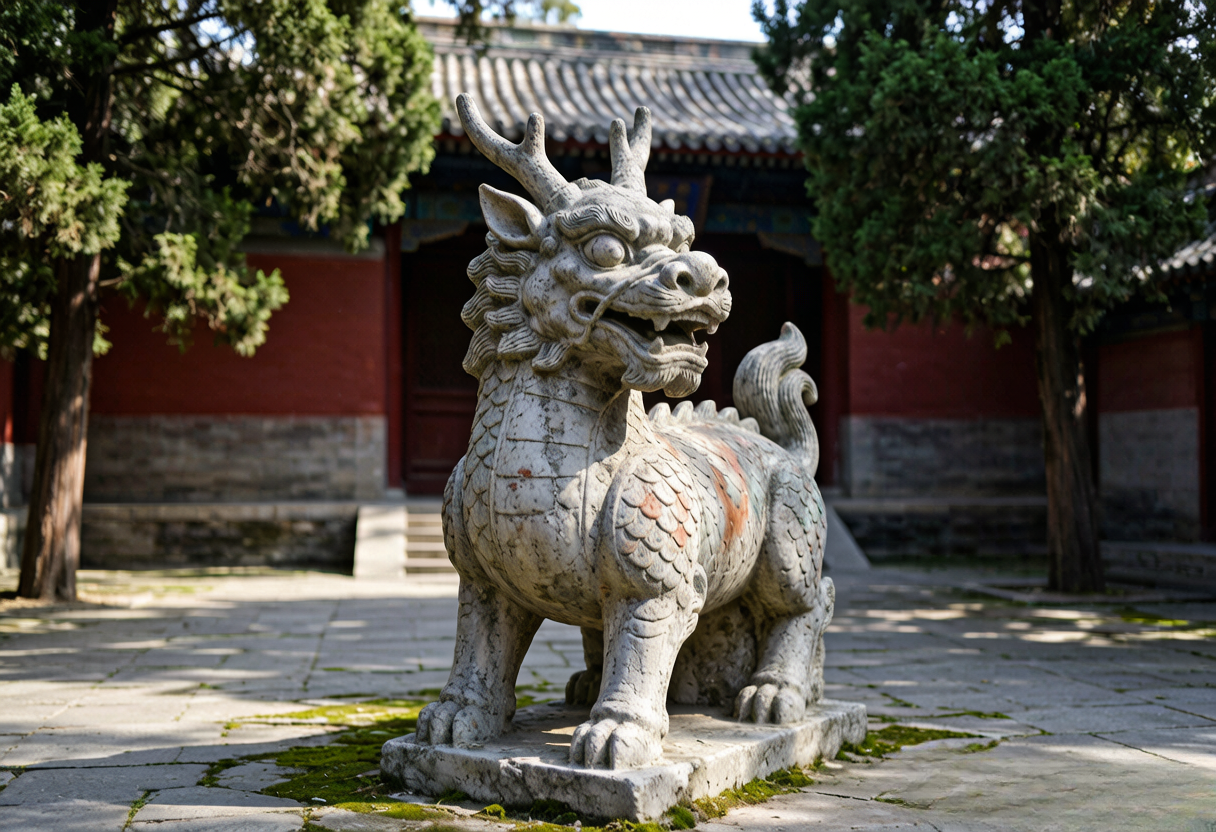
Confucius and the Qilin — A Beast That Stilled a Sage's Brush
In the spring of 481 BCE, Confucius was already a seventy-year-old man who had spent years traveling from state to state, hoping to find a ruler willing to adopt his philosophy of benevolent governance — but his efforts had been in vain. When he heard the news that a Qilin had been captured in the State of Lu, he made his way to the scene with a heavy heart. What he saw was an auspicious beast that should have appeared in an age of prosperity, but instead it had appeared in a chaotic and troubled time, and worse still, this sacred creature that should never have been harmed had been hunted by those who had no right to kill it.
In his historical work, the Spring and Autumn Annals, Confucius recorded only seven words: "In the fourteenth year, in spring, hunting in the west, a Qilin was captured." Then he set down his brush and never wrote again. He passed away two years later. This event came to be known as "the brush stilled by the captured Qilin," and it became one of the most iconic moments in Chinese cultural history.
The book Kongcongzi records the elegy that Confucius sang upon seeing the dying Qilin: "In the age of Yao and Shun, the Qilin and phoenix roamed free; now is not that time, what do I seek? Qilin, oh Qilin, my heart grieves for you." — In the golden age of the legendary sage-kings Yao and Shun, the Qilin and phoenix could wander freely, but now the world had fallen into chaos and that era was gone forever. What was he still hoping for? Qilin, oh Qilin, his heart was filled with sorrow. For a man who "never spoke of strange things, supernatural powers, disorder, or spiritual beings" — a rationalist through and through — to be moved to such grief by the death of a mythical beast was extraordinarily rare in Confucius's life.
Confucius felt that the appearance and death of the Qilin symbolized the end of his lifelong ideals — a creature that should only appear in times of peace had been killed in a world of chaos, a fate that mirrored his own. The great Tang dynasty poet Li Bai later wrote: "If I could achieve the deeds of a sage, I would stop my brush at the capture of the Qilin." The death of the Qilin was not only the endpoint of Confucius's life but also the turning point of his thought.
"In the age of Yao and Shun, the Qilin and phoenix roamed free; now is not that time, what do I seek? Qilin, oh Qilin, my heart grieves for you."
— Confucius, "Elegy for the Captured Qilin"
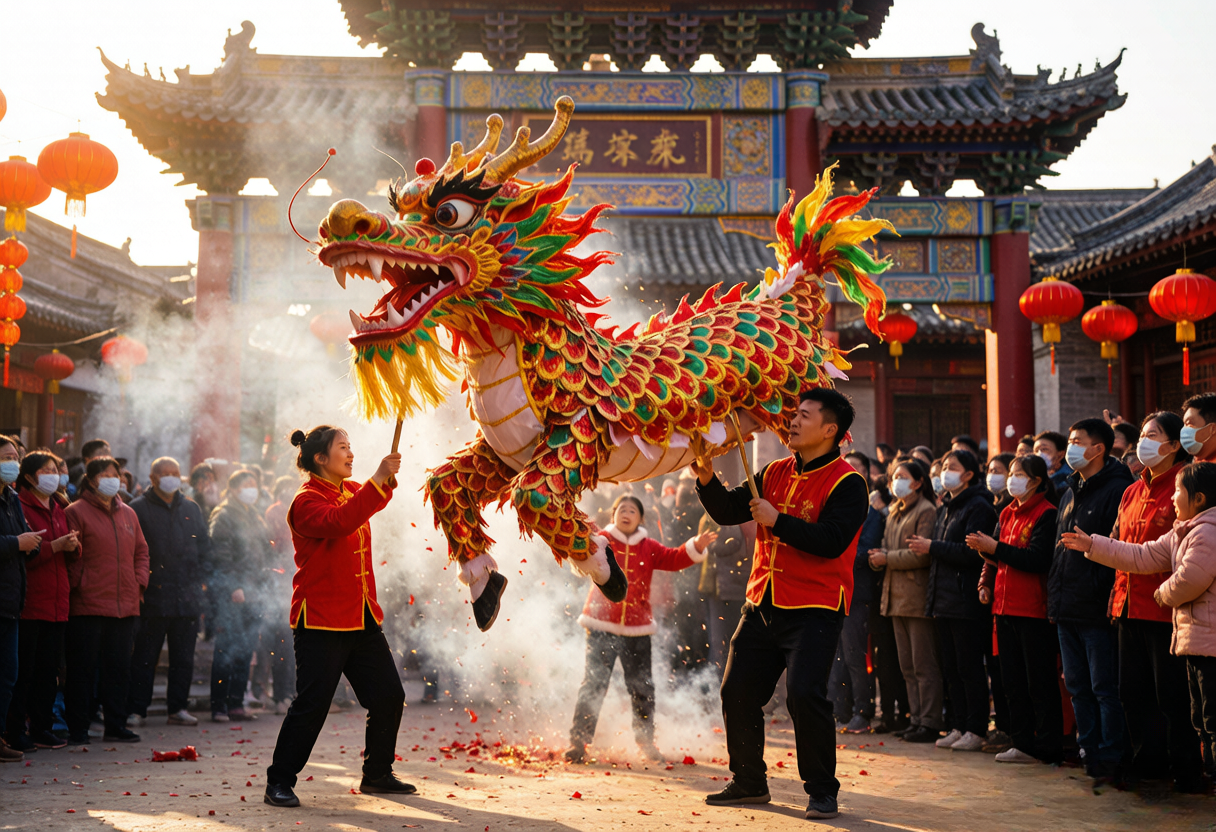
From "the Qilin Spits the Jade Book" to "the Qilin Delivers Children"
The bond between the Qilin and Confucius extends beyond the story of the captured beast. Before Confucius was even born, another legend circulated among the people: a Qilin came to Queli — Confucius's hometown — and spat out a jade book from its mouth, inscribed with the prophecy "A child of water's essence, who shall inherit the declining Zhou and become a king without a throne" — foretelling that the child about to be born would carry on the legacy of the fading Zhou dynasty, possessing the virtue of a true king but never the political power. This legend, known as "the Qilin Spits the Jade Book," means that the Qilin not only heralded Confucius's birth but also foretold his destiny as a "king without a throne" — a man of great virtue who would never hold political power.
From this legend, the folk custom of "the Qilin Delivers Children" was born — people believed that the Qilin would gift intelligent and healthy children to kind and virtuous families. Even today, when Chinese people congratulate a friend on the birth of a child, they still say "May the Qilin deliver you a child." A single mythical creature foretold Confucius's arrival at his birth and witnessed the shattering of his ideals in his final years — the bond between the Qilin and Confucius is undoubtedly one of the most profound spiritual metaphors in all of Chinese culture.
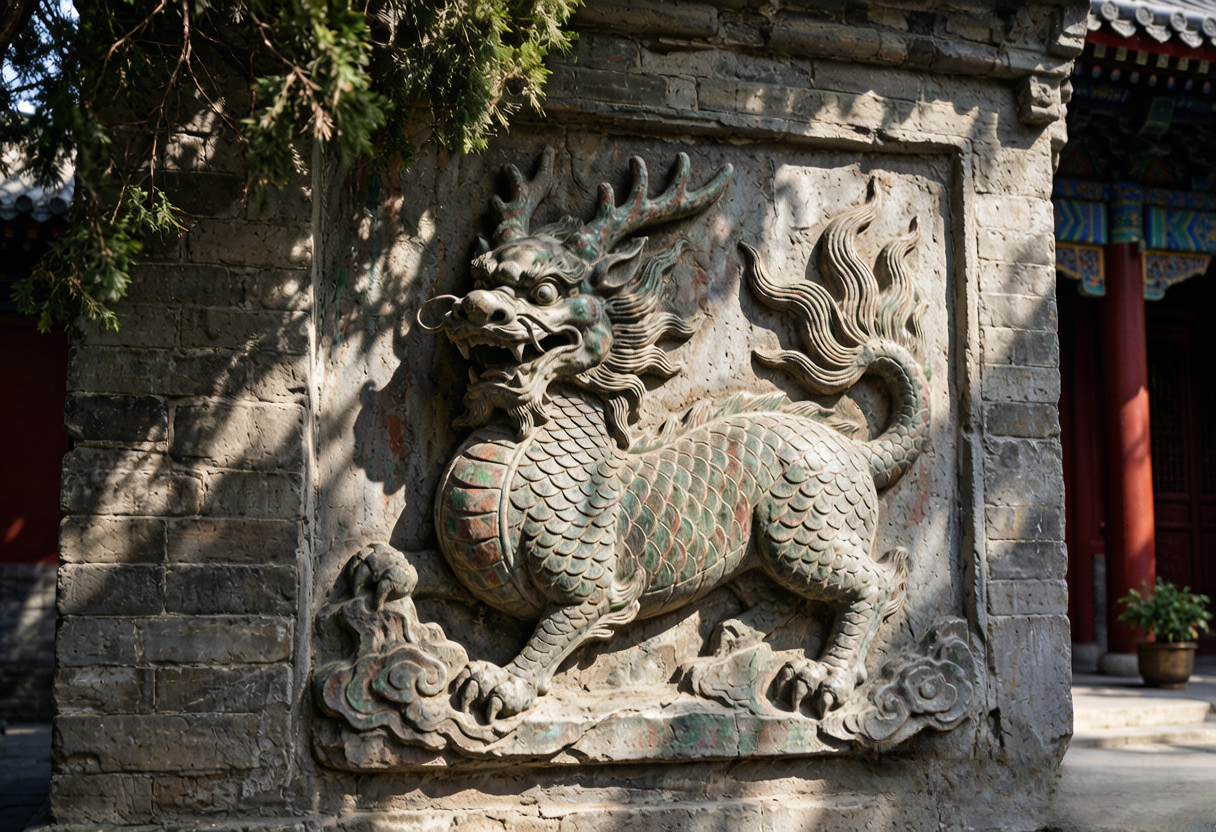
The Qilin Today — From Ancient Legend to Living Heritage
You might think the Qilin is nothing more than an ancient legend, but the reality is quite different — in 2026, the Qilin is still very much alive in the daily lives of the Chinese people. In 2008, the "Qilin Legend" was officially inscribed on China's National Intangible Cultural Heritage List, and from Guangdong to Shandong, from Shenzhen to Guizhou, people continue to perform the Qilin dance during festivals, praying for favorable weather and good fortune.
At the Shenzhen Qilin Museum — located in Longhua District with free admission — you can see authentic Qilin dance props up close and even learn a few basic Qilin dance steps from the instructors. A city dedicating an entire museum to a "legendary creature" is something you would be hard-pressed to find anywhere else in the world. In Qingxi, Guangdong, the craft of Qilin-making has been passed down for over 150 years, and a complete Qilin is divided into three parts — head, body, and tail — requiring vivid expression, exquisite painting, and a lightweight yet sturdy construction, because it has to dance through the crowd to the rhythm of drums and gongs.
When the drums and gongs thunder and a golden-red Qilin bursts forth from the crowd, its scales glittering in the sunlight, the entire atmosphere ignites with energy. A tourist on social media wrote: "Intangible heritage is not something gathering dust in a museum — it is still 'dancing.'" This sentence perfectly captures the essence of the Qilin's "living inheritance" — it is not a specimen sealed behind glass, but a story that each generation continues to tell.
"Intangible heritage is not something gathering dust in a museum — it is still 'dancing.'"
— A tourist on Xiaohongshu
Where to Find the Qilin — Three Travel Routes
Juye, Shandong is the actual site where the legendary "Western Hunt captured the Qilin" took place, and in 2008 it was officially designated as the "Hometown of the Chinese Qilin." The Qilin Garden here features a massive stone sculpture group depicting the scene, measuring 21.6 meters long and carved from Jiashiang blue stone, portraying Confucius, Chu Shang, and other historical figures along with the Qilin, chariots, and horses. The ruins of the Huilin Terrace and the Qilin Tomb are also located here, allowing you to stand on the very ground where the story is said to have unfolded.
The Confucius Temple in Qufu, Shandong is the sacred site where Confucius is worshipped, and Qilin carvings can be found throughout the temple grounds. The tour guides will tell you the story of "the Qilin Spits the Jade Book," and one foreign visitor on Ctrip remarked after their visit: "I never knew Confucius and the Qilin had such a deep connection — Chinese culture is truly fascinating."
The Shenzhen Qilin Museum offers free admission and spans five floors with nearly 500 square meters of exhibition space, systematically presenting the origins of Qilin culture, the creation and spread of the Qilin dance, and the deep connection between the Hakka people and the Qilin dance tradition. The Dalang Qilin Dance has a history of over 400 years and was listed as a national intangible cultural heritage in 2011.
If you want to connect these three destinations into a single journey, here is the recommended route: Juye (visit the Qilin Garden and Huilin Terrace ruins) → Qufu (visit the Confucius Temple and experience Confucian culture) → Shenzhen (visit the Qilin Museum and learn the Qilin dance) — a complete journey that takes you from the historical source to contemporary inheritance, allowing you to truly understand what the Qilin means in Chinese culture.
Juye Qilin Garden, Shandong: Located east of Juye County town; take high-speed rail to Heze and transfer
Shenzhen Qilin Museum: Longhua District, Shenzhen; free admission; closed on Mondays
Confucius Temple, Qufu: Open 8:00 AM - 5:30 PM; admission 110 RMB
The Qilin Is Still Here
Two and a half thousand years ago, Confucius saw the Qilin and set down his brush; two and a half thousand years later, the Qilin is still alive in the lives of the Chinese people — it appears on the streets during Spring Festival, on the stages of intangible cultural heritage performances, and in the exhibition halls of museums. Some legends survive not because people truly believe in them, but because generation after generation is willing to keep telling the story, and so the legend never truly fades away.
The next time you visit China, take the time to seek out this mythical beast that stilled Confucius's brush 2,500 years ago — it is still dancing, still smiling, and still very much alive in the stories of the Chinese people.
"From the Western Hunt that captured the Qilin to the Qilin dance of today, from Confucius to today's intangible heritage inheritors — the Qilin is the only mythical beast in Chinese culture that achieved 'immortality' through its 'death.'"
— National Intangible Cultural Heritage
"The feet of the Qilin, the noble princes"
— Juye, Shandong · Confucius Temple, Qufu · Shenzhen Qilin Museum —