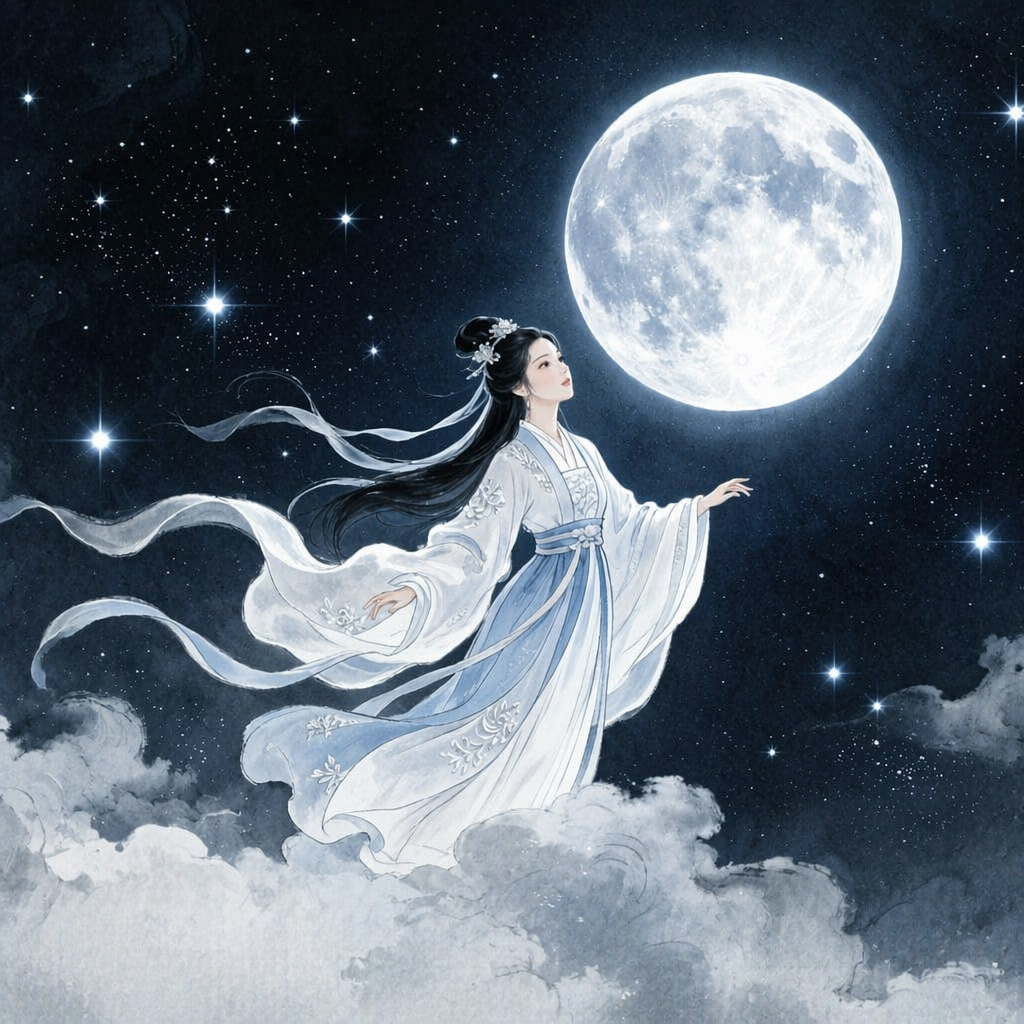
Chang'e Flies to the Moon
— China's Oldest Romance, and Where You Can Still See It Today
"Chang'e must regret stealing the elixir — a sea of jade, a sky of blue, a heart alone each night." — Li Shangyin, Tang Dynasty
Long ago, ten suns appeared in the sky at the same time.
This is not a metaphor. In Chinese mythology, the ten suns were the sons of the Heavenly Emperor. On the day they all rose together, rivers evaporated, crops scorched, and the cracked earth split open wide enough to swallow a fist. People hid in caves, the heat so intense that every breath felt like swallowing fire. The air stank of char — fields and villages were burning, and when the wind blew, ash hit the face, dry and scalding.
An archer named Hou Yi stepped forward. He climbed to the summit of Mount Kunlun, drew a crimson divine bow, and loosed nine arrows in succession. The twang of the bowstring echoed through the valleys like rolling thunder. Nine suns fell from the sky, crashing into the sea, sending up columns of water several stories high. Only one sun remained. The earth slowly cooled, rivers flowed again, and tender green shoots pushed through the scorched soil.
Hou Yi became a hero of the human world. But heroes rarely fare well in myths. The Heavenly Emperor, furious that nine of his sons had been killed, banished Hou Yi and his wife Chang'e to the mortal realm. Hou Yi could not bear to see his wife suffer, so he crossed mountains and valleys to find the Queen Mother of the West, and begged her for a pill of immortality. The Queen Mother said: if the two of you share it, you will both live forever; if one person takes it all, that person will return to the heavens.
Hou Yi gave the pill to Chang'e for safekeeping. He did not know that his apprentice, Peng Meng, had already been watching, coveting the elixir.
On the fifteenth day of the eighth lunar month, Hou Yi took his apprentices out hunting. Peng Meng feigned illness and stayed behind. Once Hou Yi was far away, Peng Meng burst into Chang'e's room and demanded she hand over the elixir. Chang'e, a slender woman, could not overpower this burly man. She snatched the pill and swallowed it whole.
Then her body began to lighten. Her feet left the ground, her skirts billowed upward like a leaf caught in an updraft. She floated out the window, rising higher and higher, wind pouring into her sleeves, cold as silk soaked in well water. She flew past clouds, past stars, and landed in an empty palace on the moon — the Guanghan Palace, the Palace of Vast Cold. There, only a white rabbit kept her company, and a cassia tree that could never be cut down. The moonlight was so white it looked blue, spilling across the jade floor of the palace, cold without a trace of warmth.
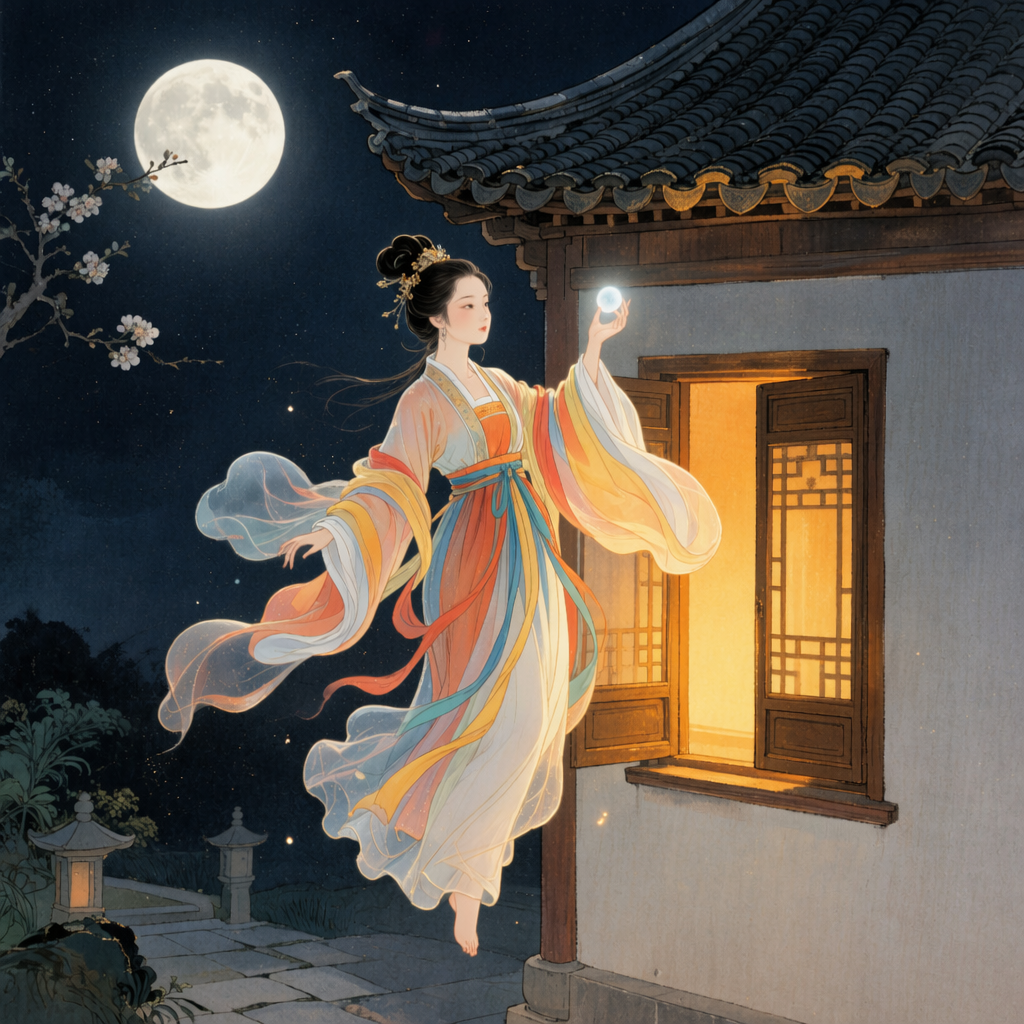
△ Chang'e swallows the elixir, her body lifting from the ground, soaring toward the Moon Palace — China's oldest legend of flight
When Hou Yi returned, his wife was gone. He rushed outside and looked up at the moon. It was full and bright, and a faint silhouette seemed to move across its surface. He recognized that shadow. That night, Hou Yi set up an incense table in the courtyard, placed Chang'e's favorite round cakes upon it, and bowed toward the moon from afar. Moonlight spilled across the table, candle flames flickered in the night breeze, and the courtyard was so quiet that only the chirping of insects could be heard.
This, it is said, is the origin of the Mid-Autumn Festival. And those round cakes were the very first mooncakes.
The story seems, at this point, to be simply a tale of parting and longing. But this story can still be seen with your own eyes today — not in a book, not on a screen, but in a mountain named after the moon, in Yichun, Jiangxi Province.
Why did Chang'e fly to the moon? The Chinese people have been asking this question for over a thousand years.
What is on the moon? A cold, empty palace, a rabbit pounding medicine, and a cassia tree that can never be felled. The Guanghan Palace — the name itself is chilled through: "Guang" means vast and empty, "Han" means freezing cold. The Tang Dynasty poet Li Shangyin sighed on her behalf: "Chang'e must regret stealing the elixir — a sea of jade, a sky of blue, a heart alone each night." The moonlight is cold, casting no warmth on the skin — not the cold of weather, but the cold of having no one beside you.
"Chang'e must regret stealing the elixir — a sea of jade, a sky of blue, a heart alone each night."
— Li Shangyin, "Chang'e." For over a thousand years, nearly every Chinese person has believed that Chang'e regretted her choice.
But things may not be so simple.
In older records, Chang'e was not the wife of a mortal man. The "Classic of Mountains and Seas" (Shanhaijing) mentions a goddess named Chang Xi from ancient times — she was the wife of the Heavenly Emperor and gave birth to twelve moons. Every night, she guided one moon to take its turn in the sky, just as her counterpart Xi He guided the sun by day. Scholars have noted that "Chang Xi" and "Chang'e" were nearly identical in pronunciation in Old Chinese. Chang'e was originally the Mother of Moons, one of the highest-ranking creator goddesses.
Over time, her identity was gradually rewritten. In the "Heavenly Questions" from the "Songs of Chu" (Warring States period), she became the wife of the archer Da Yi. In the "Lingxian" by the Eastern Han astronomer Zhang Heng, the story gained more detail: Da Yi obtained the elixir of immortality from the Queen Mother of the West, and Chang'e secretly consumed it all, flying to the moon. A diviner told her: "Great fortune. You shall return to the heavens. You will walk alone, but do not fear — your descendants will prosper."
From the supreme goddess who created the moons to a mortal woman who stole her husband's elixir and flew away alone — this transformation was no accident. Around five thousand years ago, Chinese society shifted from matriarchal to patriarchal, a process both long and dramatic. Goddesses saw their status decline step by step, from ruling heaven and earth to being subservient to husbands, from independent beings to those confined at home. Chang'e's story is a mirror reflecting this turning point: she was once the master of the heavens and the earth, then became a wife waiting for her husband to come home. Faced with two doses of elixir, she swallowed them all — not out of greed, but out of a desire to return to where she originally belonged.
The loneliness of the Guanghan Palace was not a punishment — it was a place she chose for herself. The palace was cold and empty, but no one there called her someone's wife. No one told her what she should or should not do. The moonlight fell on her face, quiet as water — a stillness she had traded everything to obtain.
Other female figures in Chinese mythology took the opposite path. The Weaver Girl gave up her immortality for the Cowherd. The Seventh Fairy severed ties with heaven for Dong Yong. The Holy Mother of Mount Hua was crushed beneath the mountain for loving Liu Yanchang. They were all goddesses, and they all chose mortal love — chose to be a husband's wife. Chang'e was different. She chose to leave her husband and return to the sky. Among all the women in Chinese mythology, she is the only one who actively chose to fly away alone. This choice came with a price — for a thousand years, poets wrote that she regretted it, storytellers said she was lonely, and people named mooncakes after her, implying her bitterness in every sweet bite. But perhaps she did not regret it. Perhaps the moonlight of the Guanghan Palace was more precious to her than all the warmth of the human world.
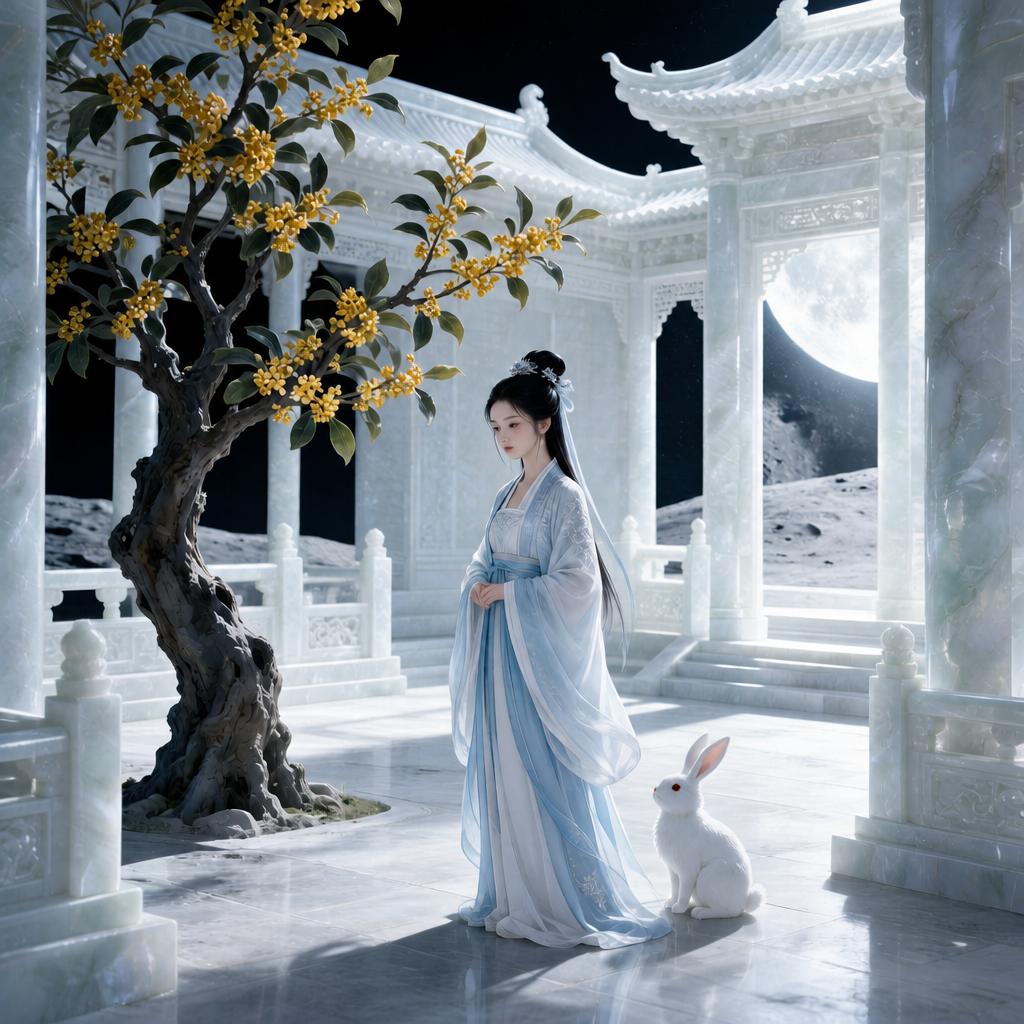
△ The Guanghan Palace — cold, vast, and empty, yet the place Chang'e chose for herself
Five thousand years have passed. In 2024, China's Chang'e-6 probe brought back soil samples from the far side of the moon — the first time in human history. China is also building a research station at the lunar south pole, and its name is "Guanghan Palace." From the mythological woman who flew to the moon to the real spacecraft that landed on it, the story has traveled five thousand years. But the moon remains the same moon — just as bright, just as silent, hanging in the sky.
Step out of Yichun's high-speed rail station, take a thirty-minute ride, and you will see the silhouette of a mountain — its ridge curves in a semicircle, like a crescent moon suspended between heaven and earth. This mountain is called Mingyue Mountain — Bright Moon Mountain.
Yichun is in western Jiangxi Province, known in ancient times as Yuanzhou. How deep is this city's connection to the moon? It is called the "Capital of the Moon." Over the centuries, literary figures have left behind more than three hundred poems about the moon here. The Mid-Autumn "Moon Worship Ceremony" has continued for over a thousand years. At the foot of the mountain lies a small town called Wentang, where an eight-hundred-year-old well still steams with hot spring water. The stone around the wellhead, polished by the mineral water, gleams and feels warm to the touch.
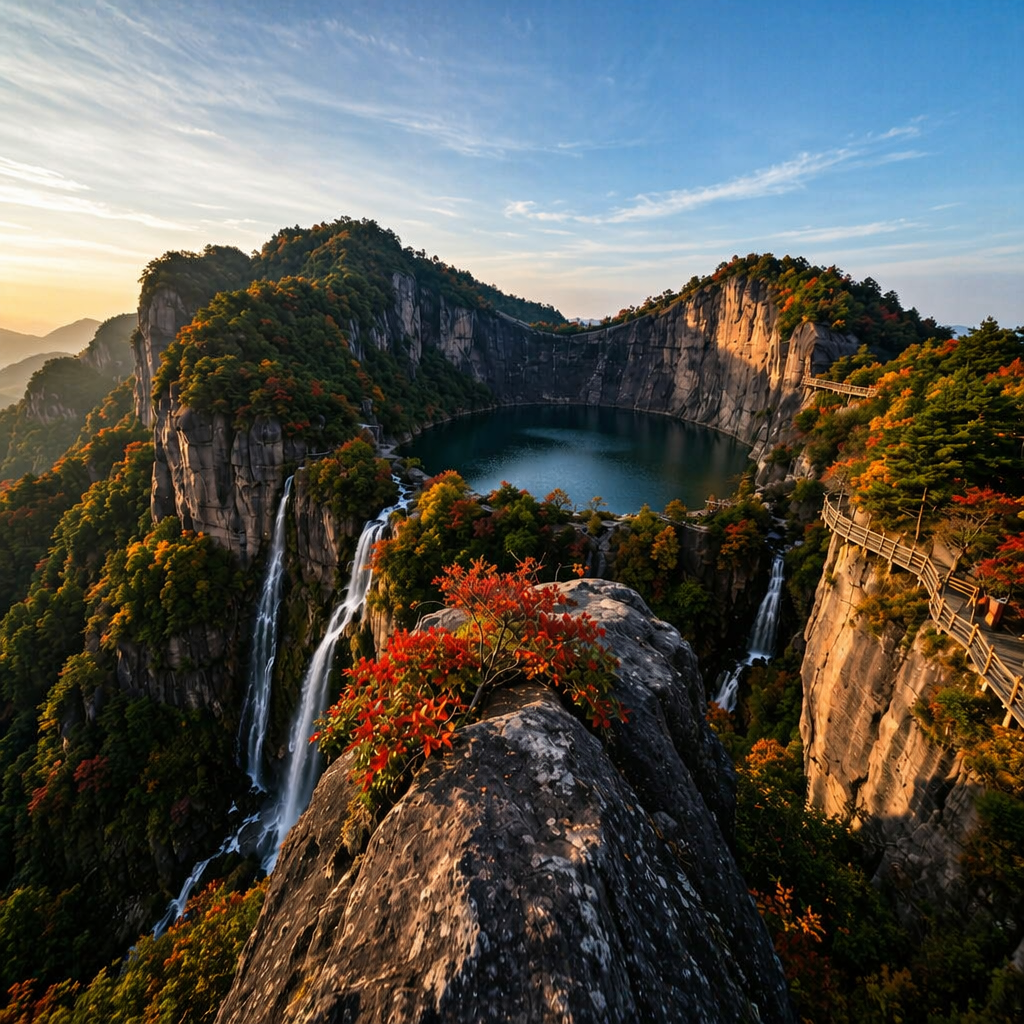
△ Mingyue Mountain — its ridge curves in a semicircle, like a crescent moon between heaven and earth
The summit of Mingyue Mountain sits at 1,530 meters above sea level. At the top, there is a small lake called Moon Lake, its surface mirroring the sky — on a clear day, it looks like a silver mirror. There is also a natural stone cave called the Star-Moon Cave, where cracks in the ceiling let sunlight and moonlight filter through like twinkling stars overhead. A walkway called the Azure Cloud Plank Road is built along the cliff face — walk along it, and on your left is a sheer rock wall, on your right a deep valley. Wind rushes up from below, carrying the fresh scent of vegetation and the mist of distant waterfalls, brushing the face with a cool, damp touch.
The mountain also features a "Flying-to-the-Moon Zipline" — starting near Moon Lake, it spans over a thousand meters to the opposite ridge, making it the zipline with the greatest elevation drop in Asia. Suspended from the cable, with a valley hundreds of meters deep beneath your feet, the wind hits you head-on, faster and faster, until all you hear is the rush of air and your own heartbeat. Further along, a sightseeing mini-train runs along the mountain ridge, its cars painted bright yellow, rolling slowly through pine forests and flower fields. The rumble of wheels on tracks echoes through the valley — clack, clack, clack — like a slow-tempo song.
But the most remarkable thing about Mingyue Mountain is not the scenery above — it is a performance below.
The show is called "The Romantic Show of Mingyue," staged at the Mingyue Romance Scenic Area in Wentang Town. It runs once every afternoon, lasting 60 minutes. The performance is divided into six acts: "Echoes of Antiquity," "Queen of the Bright Moon," "Chang'e Flies to the Moon," "Love in Jiangxi," "Sending Off the Red Army," and "Lovers Finally Unite." Over a hundred performers participate, with tens of thousands of stage mechanisms — many call it "a show you must see once in your lifetime." When the "Chang'e Flies to the Moon" act begins, a performer suspended by wires rises from the stage into the air, a giant moon prop glowing behind her. Stage lighting floods the entire theater with the cold light of the moon palace. The audience sits below, looking up at a person flying from the ground toward the moon — just like that night thousands of years ago in the legend. Wind machines on stage create air currents that ripple through the performer's skirts and hair, while moonlight projections spread across the theater ceiling, making you feel as though you, too, are floating in the night sky.
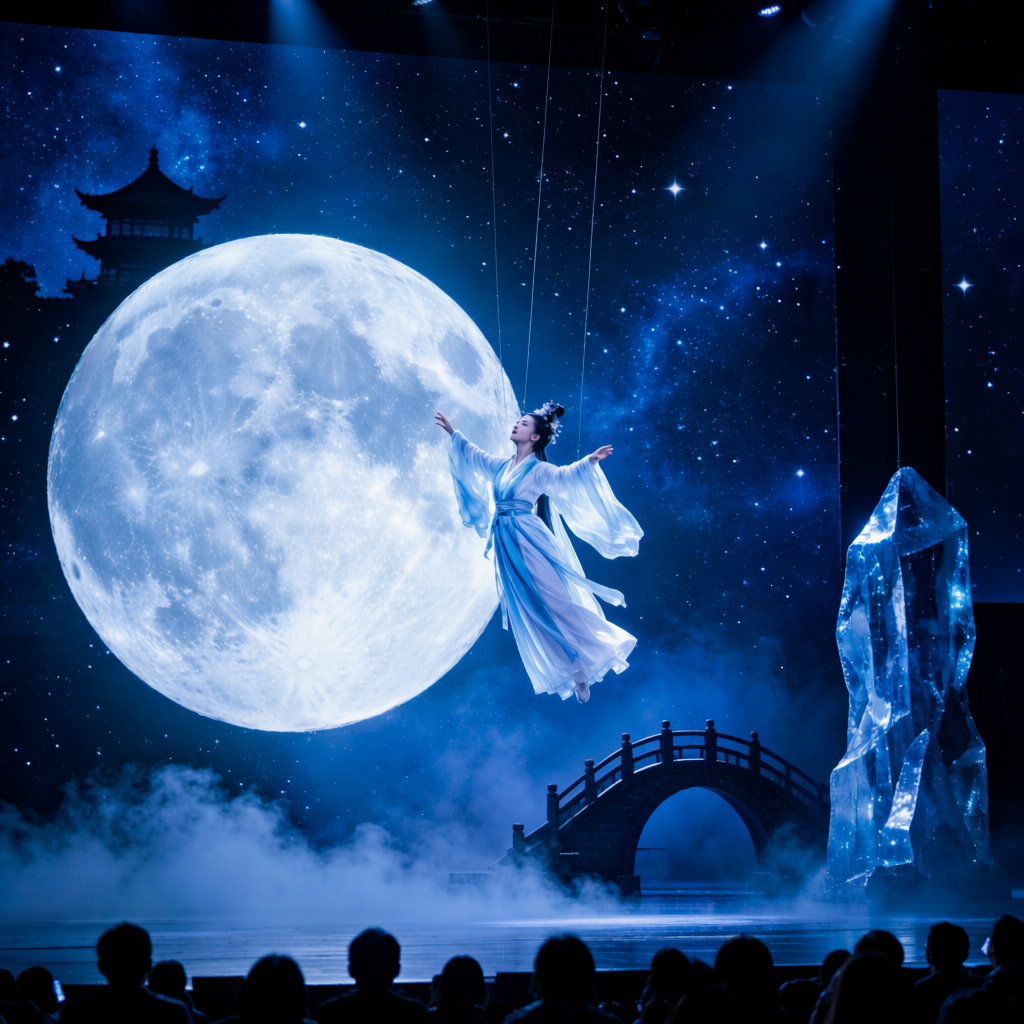
△ "The Romantic Show of Mingyue" — Chang'e Act: a performer soars through the air on wires, recreating the moment of flying to the Moon Palace
In 2025, the show was upgraded with AR interactive features: audience members scan the stage with their phones, and additional light effects appear on screen — Chang'e's trailing skirt extends into the phone display, and the shadow of the Jade Rabbit emerges on the moon. One audience member wrote on social media after watching: "I didn't know mythology could be this close."
The scenic area offers more than just this one show. At night, the ancient town of Wentang also hosts a "Chang'e Flies to the Moon — Fireworks Narrative Show": fireworks cascade from the South Gate Tower of Gujing Spring Street like a waterfall of light suspended above the rooftops, synchronized with a retelling of the Chang'e and Hou Yi myth. The boom of fireworks echoes one after another, shards of light falling onto the cobblestone streets, crackling and leaving behind a thin layer of paper debris. The air fills with the sulfur smell of gunpowder mingled with the sweet fragrance of osmanthus.
If you come to Mingyue Mountain during the Mid-Autumn Festival, you will see something that exists nowhere else — the Fire Dragon Chasing the Moon.
The "fire dragon" is not a real dragon. It is built from bamboo strips and colorful cloth, about a dozen meters long, its body covered with burning incense sticks and candles. After dark, dragon dancers use torches to light every incense stick on the dragon's body, turning the entire creature into a dragon of fire, glowing orange-red in the night. Drums begin to beat, the rhythm growing faster and denser, vibrating in your chest. The fire dragon starts to move — coiling, leaping, weaving through streets and alleys, followed by a crowd of villagers and tourists carrying lanterns. Firelight flickers across their faces, now bright, now dark. The air is thick with the pine-wood scent of burning incense and the gunpowder tang of firecrackers, blended together, making you want to cough but unwilling to step away. The fire dragon sets off from Yupan Plaza, passing the mineral hot springs, the Wentang archway, and Gujing Spring Street — the whole procession takes about twenty minutes.
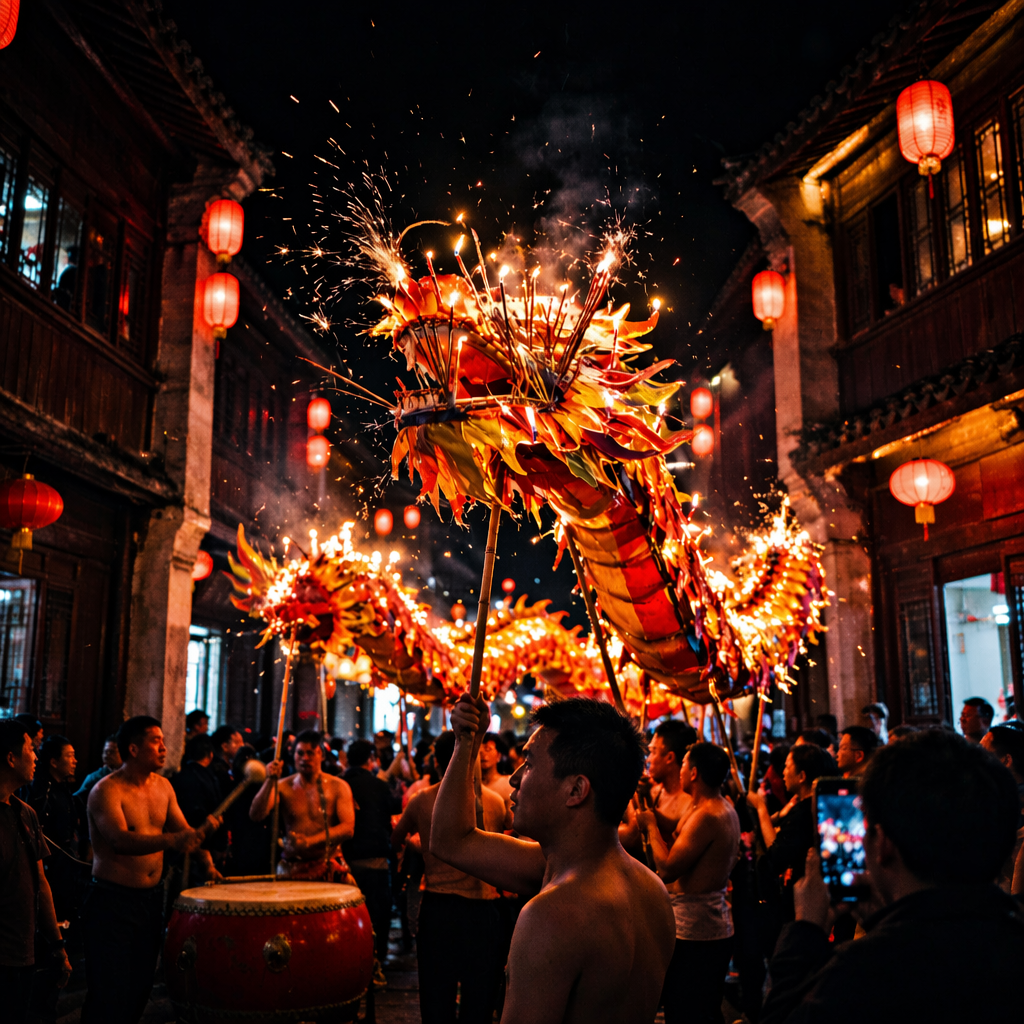
△ Fire Dragon Chasing the Moon — a dragon built of bamboo and cloth, covered in burning incense, becoming a creature of fire in the night
This was a real scene from the 2025 Mid-Autumn Festival. A tourist from Shaanxi named Zhang Lili said afterward: "I came to the right place for the Mid-Autumn holiday. Mingyue Mountain is full of 'moon-ness' — the atmosphere is incredible."
Before the fire dragon procession, there is also a "Mid-Autumn Moon Worship Ceremony." The main altar is set up in the center of Yupan Plaza — offerings are presented, candles lit, and blessings recited. After the ceremony, the chief officiant invites everyone present to face Mingyue Mountain and pray. Candle flames flicker in the night breeze, and incense smoke rises straight up from the censer, only dispersing when it meets the wind. This ceremony has continued in Yichun for over a thousand years, its procedures nearly identical to ancient times.
Beyond the fire dragon and moon worship, the Mid-Autumn season at Mingyue Mountain also features a "Bright Moon Concert." The venue is at the scenic area's campground — the stage is set on a lawn, with the mountain ridge and night sky as its backdrop. The band plays on stage, and the music is not all pop — there are also folk songs adapted from classical poetry. The sound drifts in the night breeze, mingling with the chirping of insects and the distant murmur of hot spring streams. The audience sits in camping chairs, holding a cup of selenium-rich mineral water from Wentang Town. The moon slowly rises from behind the mountain — first a sliver of white, then a half-circle, then a full disk, its light spreading across the grass, stretching everyone's shadow long. Some set down their cups, some raise their phones to take photos, and some do nothing at all, simply watching the moon climb, inch by inch.
Transport: Take Bus 118 from Yichun High-Speed Rail Station, approx. 30 min direct
Tickets: 95 RMB (adult); ticket + round-trip cable car 240 RMB
Elevation: Summit 1,530 m; summer temperature 22°C
Hot Springs: Year-round 68–72°C, daily output 10,000 tons, rich in selenium and 26 other trace elements
Best Time: Autumn (heat fades, moon is brightest); activities peak around Mid-Autumn
Suggested Itinerary: Two days — Day 1: hike the mountain & watch the show; Day 2: hot springs & explore the ancient town
Hike Mingyue Mountain by day, watch the fire dragon and moon ceremony by night, and squeeze in a hot spring soak in between. The hot spring water in Wentang Town stays at 68 to 72 degrees Celsius year-round, gushing out ten thousand tons a day, rich in selenium and twenty-seven other trace elements. In 2016, the World Federation of Hydrothermal Climatotherapy awarded it the title of "World-Class Multi-Purpose Premium Hot Spring" — the only one of its kind in the world. Locals have been soaking their feet in the spring water for eight hundred years. After hiking down the mountain, plunge your sore, tired legs into a 40-degree hot spring pool. Steam rises, carrying a faint mineral scent, and a fine layer of sweat breaks out on the skin. The warmth loosens everything from the soles of your feet to your shoulders — as if you've been washed through with warm water from the inside out.
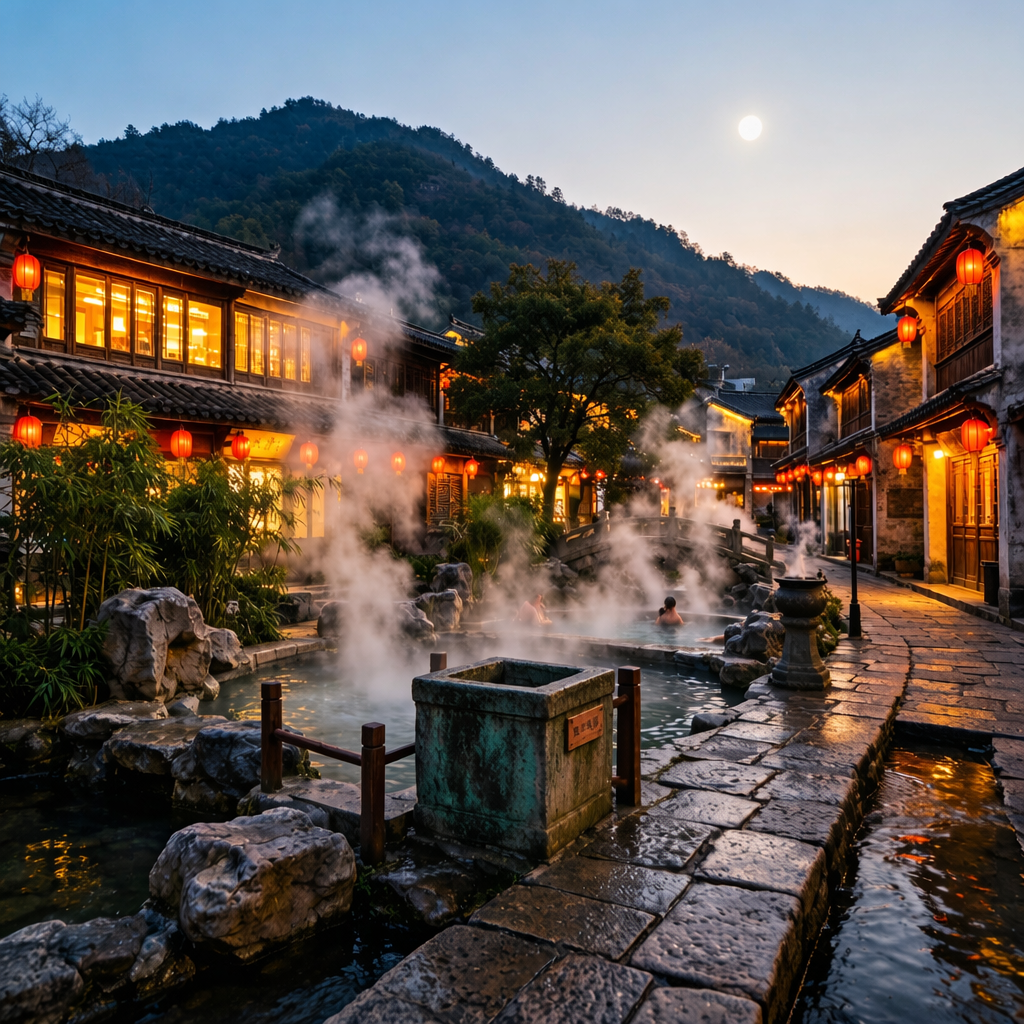
△ Wentang Town's selenium-rich hot springs — 68–72°C year-round, 10,000 tons daily output, the world's only "World-Class Multi-Purpose Premium Hot Spring"
The mountaintop offers a different kind of experience. Take the cable car to the summit, where two campgrounds sit at 1,420 meters. In summer, the temperature is only 22 degrees — ten degrees cooler than the base. Wind drifts through the pine forest, carrying the bitter-fresh scent of resin. By day, there are resident bands, Frisbee games, and hand-drum circles — laughter and music drifting along the ridge. At dusk, the sun drops, the evening breeze turns cool, and the camp lights up with warm yellow string lights. Look up, and the stars are so dense they look like scattered silver. The Milky Way stretches from east to west, and the moon hangs above the ridge line, impossibly large. At four or five in the morning, a sea of clouds surges up from the valley, a vast white expanse, and the sun pushes through from below the cloud layer, turning the whole mountain gold. A gust of morning wind hits the face, cool as if brushed with dew.
Someone wrote a line on social media that was shared by many who had visited Mingyue Mountain: "So this is what it feels like to celebrate a Mid-Autumn with roots and a soul."
Even the food is tied to the moon. Yichun "Zha Fen" (rice noodles) are made from rice batter that is steamed and cut into thin strips, then stir-fried — chewy, springy, savory with a hint of spice, full of wok hei. One bowl warms you from tongue to stomach. Wentang rice cake (Fa Gao) has been passed down since the Song Dynasty — soft, sticky, and sweet, a staple at local weddings and banquets. There is also a large steamed bun made with selenium-rich hot spring water, one per steamer basket, round as a full moon — locals call it the "Chang'e Flying-to-the-Moon Bun." Break it open, and steam escapes through the cracks in the dough. The meat filling inside glistens with oil. One bite — the bun is soft and fluffy, the filling piping hot. The tongue tastes salt and umami first, then a faint sweetness.
If time allows, you can also visit Yangshan Temple, hidden in a stream valley deep within Mingyue Mountain. Founded in the Tang Dynasty, the temple is approached by first hearing the sound of flowing water, then catching the scent of sandalwood, and finally seeing the temple's flying eaves emerge from behind the treetops. Inside, there is a thousand-year-old ginkgo tree. In autumn, when its leaves turn yellow, the wind scatters golden leaves across the stone steps, rustling underfoot. A thousand years ago, a monk chanted sutras here beneath the moon. Today, a visitor stands under the same tree, looking at the same moon.
On the night Hou Yi set up the incense table in his courtyard, the moon was round and bright. He saw a shadow moving on its surface and recognized it as Chang'e. From then on, every year on the fifteenth of the eighth month, he would make her favorite round cakes, arrange them before the moon, and sit until dawn. Night dew soaked his clothes, insects chirped in waves, a dog barked somewhere in the distance, and moonlight fell on the round cakes like a thin layer of frost.
That is the ending in the legend — one person waiting, one person flying, with 380,000 kilometers between them.
But at Mingyue Mountain, the ending is different. A fire dragon glides through the night, hot springs steam at your feet, string lights glow at the mountaintop campground, and moonlight spills down from above the ridge, turning the cobblestone path pale white. Over a thousand years ago, someone wrote poetry on this mountain, gazing at the moon. Today, someone sits on the same mountain, watching the same moon, feeling the same wind pass through the pines. Pine needles, loosened by the breeze, drift down onto shoulders, carrying the bitter scent of resin.
Chang'e's story has not ended at Mingyue Mountain. It has become the candlelight on the fire dragon's back, the figure soaring toward the moon above the stage, the moonlight trembling on the surface of the hot springs, and the bun in the steamer, round as a full moon. Every Mid-Autumn, the residents of Wentang Town light the fire dragon at Yupan Plaza, the drums begin, and firelight illuminates every upturned face. In that moment, the legend from thousands of years ago and tonight's night breeze are one and the same.
Autumn is the best time to visit Mingyue Mountain. The heat has faded, the mountain is cool, and the moon is at its brightest. Take Bus 118 from Yichun High-Speed Rail Station — thirty minutes and you are there. Tickets are 95 RMB; the cable car is extra. Two days are recommended — Day 1: hike the mountain and watch the show; Day 2: soak in the hot springs and stroll through Gujing Spring Street. If you time it for Mid-Autumn, you will also see the Fire Dragon Chasing the Moon and the Moon Worship Ceremony.
The moon is the same moon from five thousand years ago. But the person watching it — that could be you.
"Chang'e must regret stealing the elixir — a sea of jade, a sky of blue, a heart alone each night."
— Chang'e is on the moon. Mingyue Mountain is in Jiangxi. Both are waiting for you. —