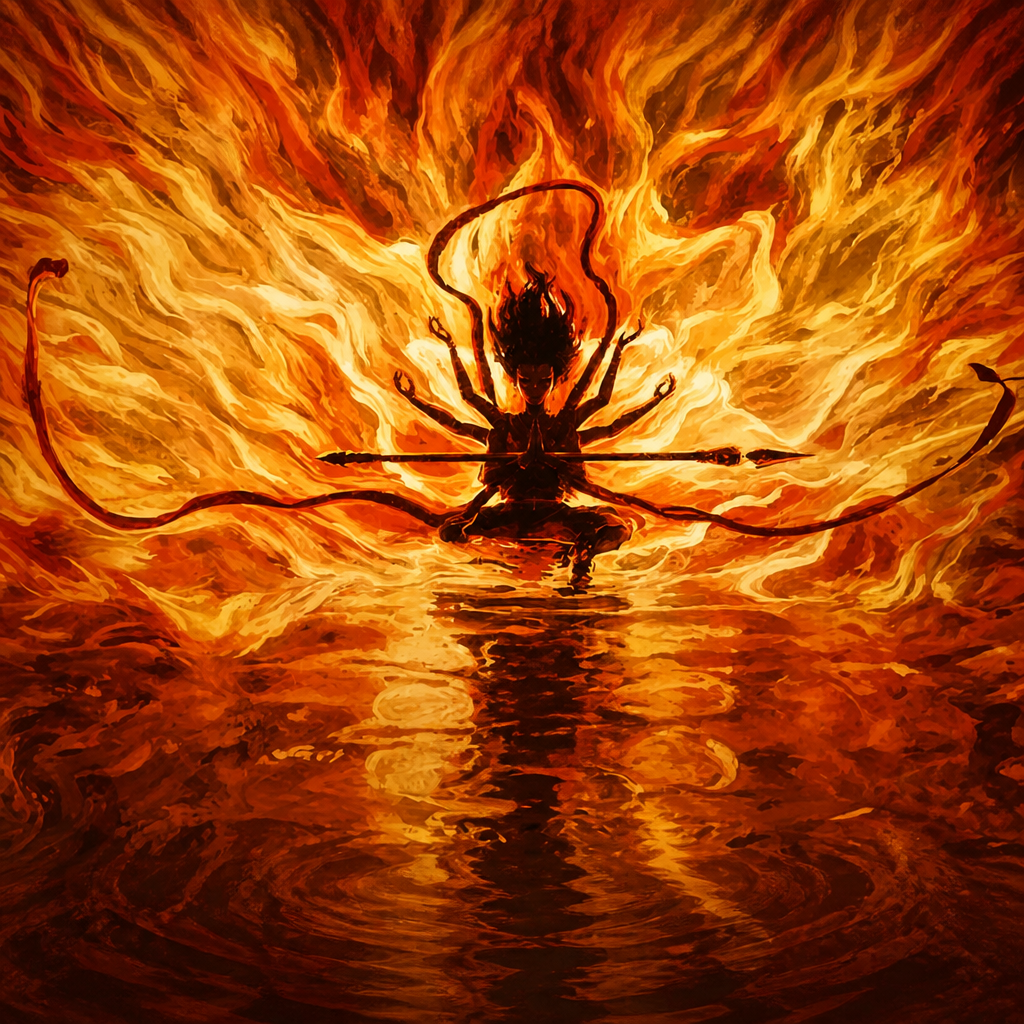
Ne Zha: How a "Monster" Rewrote Destiny
— and the Town That Lets You Step Inside the Movie
"My fate is mine, not heaven's." — A child labeled a "monster" says this to destiny.
January 29, 2025 — the first day of the Chinese Lunar New Year. In a movie theater in Chengdu, hundreds of audience members sat in the dark, waiting for the film to begin. The screen lit up. A small boy walked out of the flames — with dark circles painted around his eyes, bared teeth, a long spear gripped in his hand, and two burning wheels beneath his feet. He was short in stature, but his eyes held a defiant fire that refused to lose.
Drums sounded, and the entire theater fell silent. The child on screen is called Ne Zha — a mythological figure in China whose story has been told for over five hundred years. Nearly every Chinese person has grown up hearing his legend. But this time, the animated film starring him would far exceed everyone's expectations.
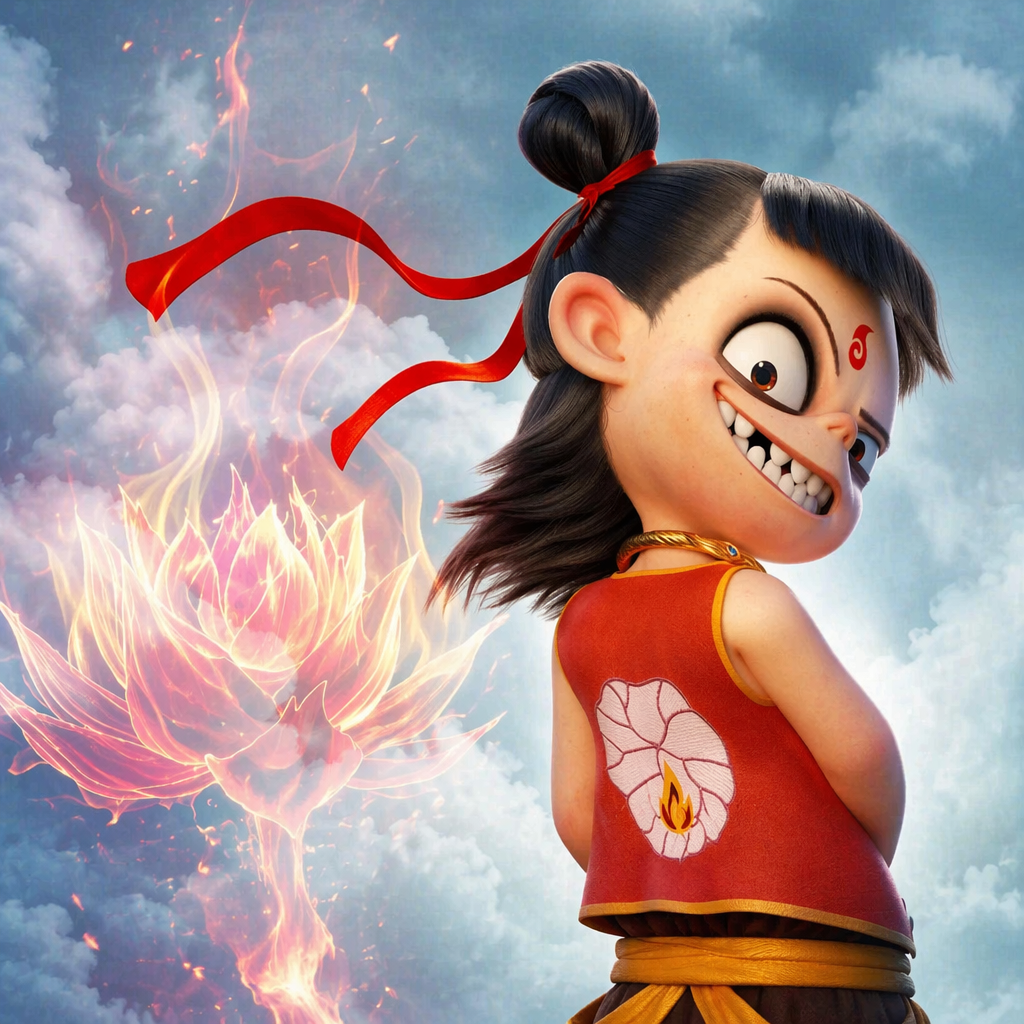
△ Ne Zha the demon child — dark circles, jagged teeth, yet the protagonist of China's highest-grossing film ever
The film is called "Ne Zha 2: Demon Child Conquers the Sea Dragon." It played in Chinese theaters for 153 days. 324 million people bought tickets — more than the entire population of the United States. Domestic box office reached 15.445 billion RMB. The film then opened in North America, Southeast Asia, and Europe. By April 2026, its global cumulative box office reached $2.267 billion, surpassing "Titanic" to become the fourth highest-grossing film in global cinema history. Among the top five films at the worldwide box office, it is the only non-Hollywood film — and the only animated film.
A "monster child" from Chinese mythology out-earned "Titanic" and "The Avengers." Someone no one believed in, standing at the very top — that is exactly Ne Zha's own story.
To understand why Ne Zha moved so many people, you first need to know his story. In the Ming Dynasty novel "Investiture of the Gods," Ne Zha is the son of a military general, born with divine strength, who runs amok in the Eastern Sea and tears out the Dragon King's third son's tendons. In the traditional version, he is a born hero — righteous, brave, enforcing justice on behalf of heaven. But the 2019 film "Ne Zha: Birth of the Demon Child" and its 2025 sequel flipped this story completely upside down.
In this version, Ne Zha is labeled a "Demon Pill" from the moment he is born. In the Heavenly Court's system, he is destined to be a monster, destined to be destroyed by heavenly lightning. He did nothing wrong — a pair of mystical pearls was simply swapped at birth. The Spirit Pearl, meant to create a hero, and the Demon Pill, destined for evil, were switched. So Ne Zha grows up carrying the identity of a "demon." Villagers run when they see him. Children throw stones at him. He can't even find someone to play shuttlecock with.
"Prejudice in people's hearts is a great mountain — no matter how hard you try, you cannot move it."
— Shen Gongbao, a line from the "Ne Zha" film series. This quote has been shared over a billion times on social media.
The character who speaks this line is Shen Gongbao — a leopard spirit who cultivated himself into human form. He worked harder than anyone, pushed himself more than anyone, but because he was born a "demon," the Heavenly Court never gave him a fair chance. His master saved the best resources for another disciple — Taiyi Zhenren, a man of mediocre talent but "legitimate" birth. Shen Gongbao did decades of dirty, thankless work, and in the end got nothing. Does this story sound familiar? In workplaces in every country, someone has lived through something similar.
The sequel, "Demon Child Conquers the Sea Dragon," pushes this injustice even deeper. In the Heavenly Court there is a character called the Wuliang Immortal — benevolent in appearance, gentle in speech, commanding a vast "Demon-Hunting Army." On the surface, they are upholding justice, eliminating monsters that threaten the human world. But in reality? The captured demons receive no trial, no education — they are thrown directly into a massive bronze cauldron and refined into immortality pills: supplements that celestial beings consume to boost their powers. Immortals who preach virtue behind closed doors sustain their privileges by devouring the lives of the weak. The cauldron's surface is carved with grotesque faces, like silent screams.
There is a scene in the film: Ne Zha's mother is trapped by a Heart-Piercing Curse, her body covered in thorns, blood beads seeping through her skin. The Wuliang Immortal uses the parents' lives to force Ne Zha to kill himself. Lady Yin — Ne Zha's mother — breaks free in the final moment, rushes forward, and tightly embraces her son, who is covered in thorns. The thorns pierce her arms, blood soaks through her sleeves, but she refuses to let go.
"I never cared whether you were a demon or an immortal. I only know that you are my child."
— Lady Yin, "Ne Zha 2: Demon Child Conquers the Sea Dragon." When this scene played in theaters, the sound of sniffling filled every screening.
This line needs no translation. In any language, a mother saying to her child, "No matter what you are, you are mine," means the same thing. This is why the film transcends culture — its core is not Chinese mythology, but something everyone has experienced: being labeled, being misunderstood, being crushed by prejudice, and then, in a single moment, deciding that you will no longer accept the script others have written for you.
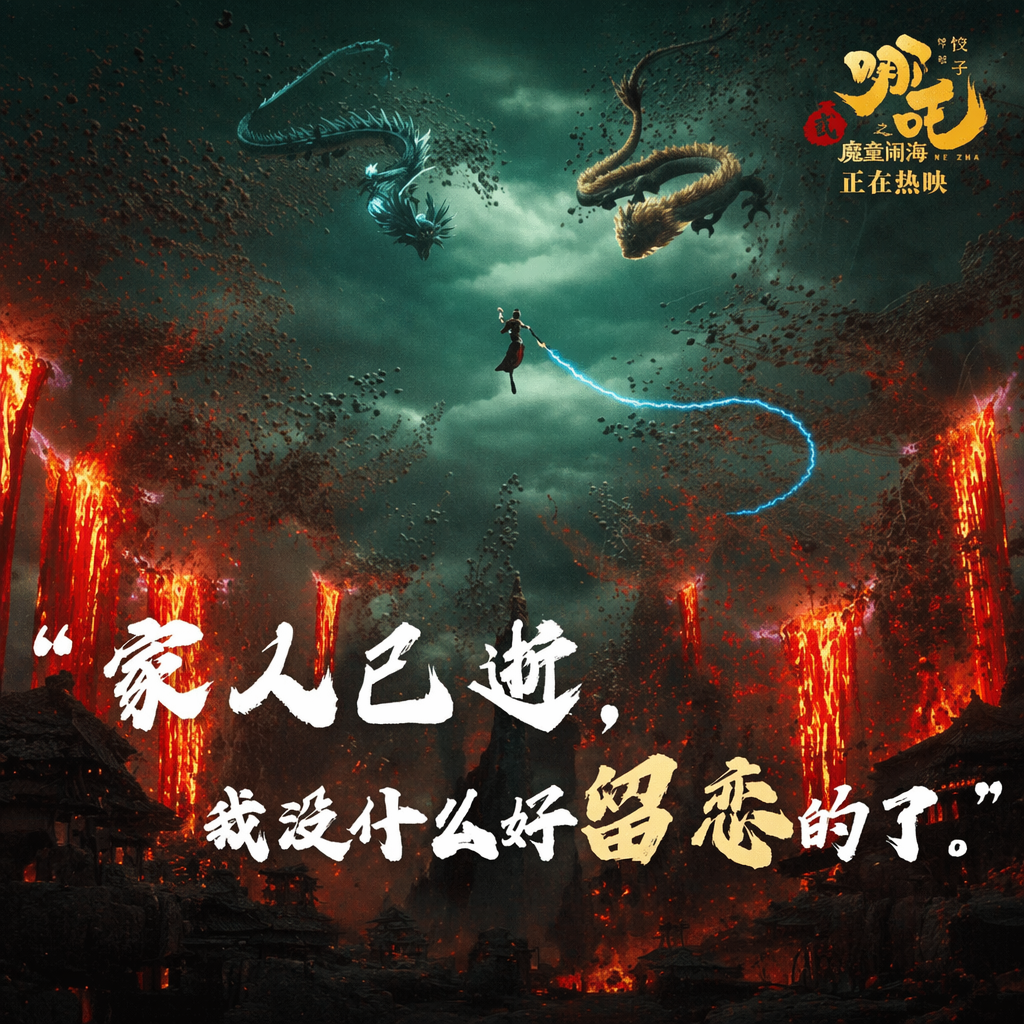
△ "I want to try." — three words, light as a feather falling to the ground, yet the entire theater heard them
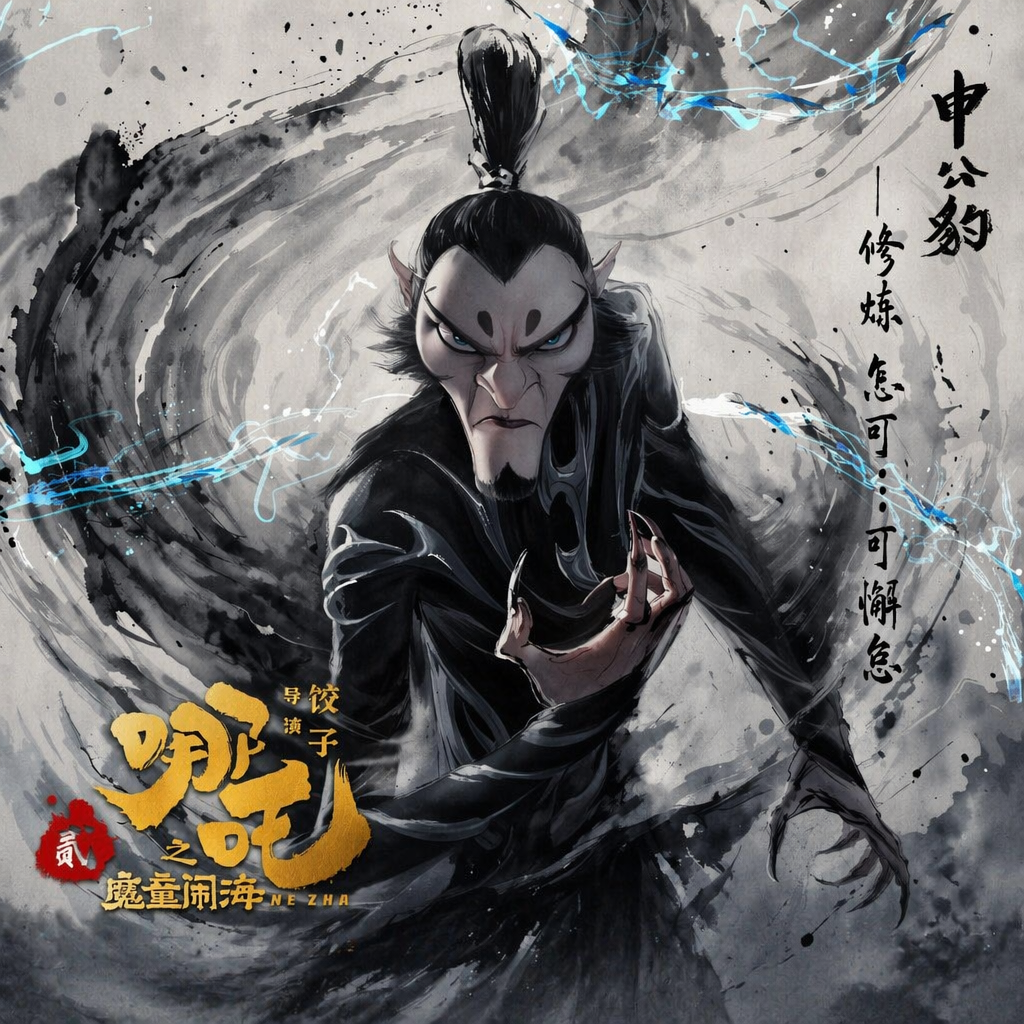
△ Shen Gongbao — one line about prejudice made this character the mirror of the entire film
The director goes by the name Jiaozi (literally "dumpling") — his real name is Yang Yu, from Luzhou, Sichuan. He spent four years in pharmacy school, but instead of putting on a white coat and walking into a hospital, he shut himself in a small room and taught himself animation. In 2008, he made a 16-minute animated short that scored 8.8 on Douban (China's IMDb). Then came a long ten years — borrowing money, being rejected, revising, revising again. When the first "Ne Zha" film premiered in 2019, he was nearly forty. The sequel took another five years. The end credits rolled for a full seven minutes, densely packed with the names of 138 animation studios. Jiaozi once said he originally planned to outsource part of the production to foreign companies, but they did not put in their best effort, and the results were disappointing. So he made a decision: everything would be done by Chinese teams. The team behind "Deep Sea" came. The team behind "White Snake" came. Even the makers of "Boonie Bears," a competing franchise, pitched in. Everyone took on work at a loss — like the Dragon Clan in the film, pulling off their hardest scales one by one to forge a suit of armor made of ten thousand dragons' scales.
Surpassed: "Titanic" ($2.264 billion)
China Mainland: 15.445 billion RMB, 324 million admissions
Run: 153 days, breaking 113 box office records
Unique Distinction: The only non-Hollywood film and the only animated film among the global top 5
Production Scale: 4,000-person team, 5-year production cycle, 138 animation studios involved
324 million admissions — this means one in every four Chinese people saw this film. In Chengdu, the city where Ne Zha was born, the ticket lines at cinema entrances snaked from the lobby all the way out to the street. The night air carried the sweet aroma of roasted chestnuts, people rubbed their hands together and stomped their feet, their white breath rising under the streetlights. No one complained about the wait. They came to see a child who refused to give up, and a mother who refused to let go.
If a film is a window, then Hengdian is the world behind that window. In central Zhejiang Province, within Dongyang City under the administration of Jinhua, there is a small town called Hengdian. Twenty-some years ago, it was nothing but barren hills. Today it covers 121 square kilometers and has been dubbed "China's Hollywood" by The Hollywood Reporter. Over ten thousand film and television productions have been born here — from Zhang Yimou's martial arts epics to palace intrigue dramas, from historical series to xianxia (immortal fantasy) spectacles. Walking through Hengdian's streets, the air carries the scent of sandalwood incense and roasted chestnuts. The stone-paved paths beneath your feet have been polished to a shine — every stone may have borne the footprint of some celebrity.
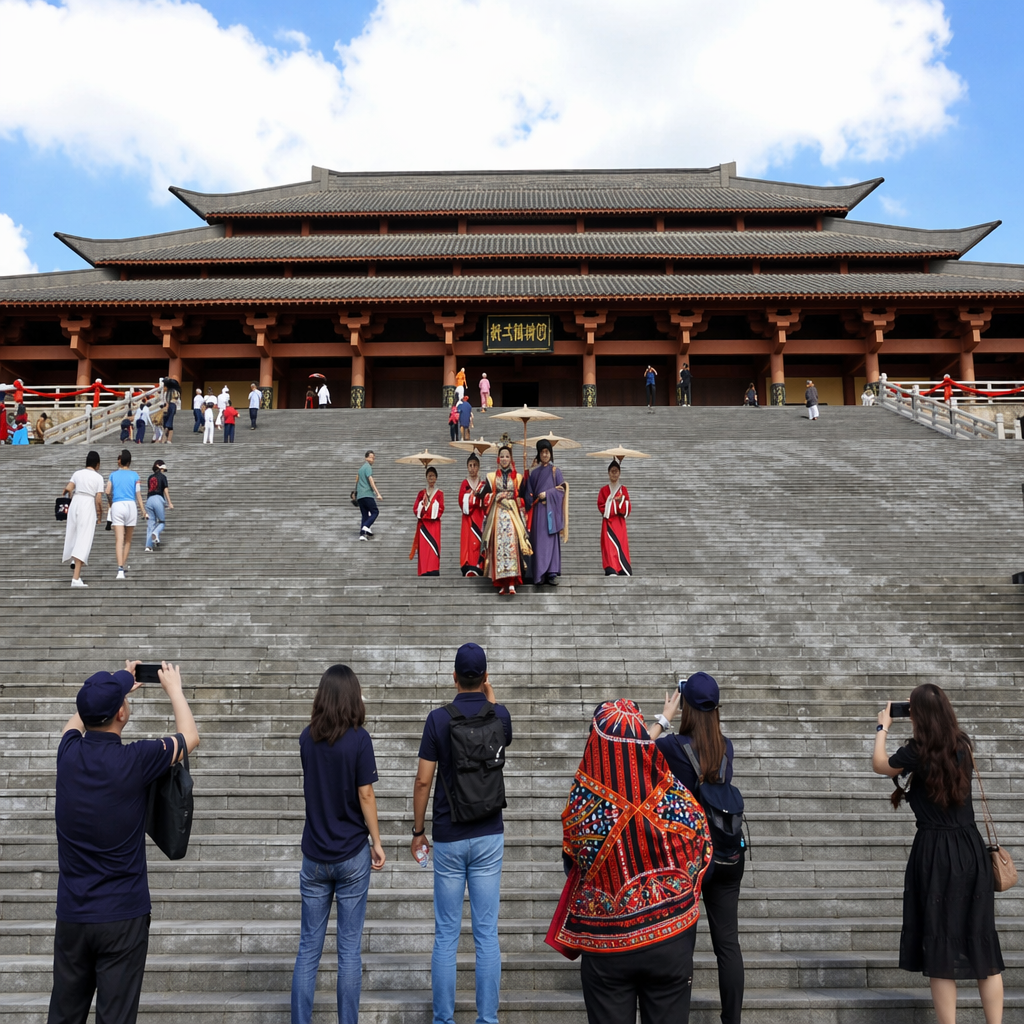
△ Hengdian's Qin Royal Palace — not a set, but a place where actors can truly don costumes and film (China News Service)
Hengdian has five main scenic areas, like a three-dimensional picture book of Chinese history. The Qin Royal Palace recreates the palace of Qin Shi Huang from over two thousand years ago — its hall's pillars are so thick that two people joining arms could barely encircle one. Standing at the entrance and looking up, the flying eaves spread like eagle wings, sunlight striking the glazed tiles and reflecting a blinding golden glare. The air holds the scent of wood and earth — a dry, weighty fragrance that belongs to the architecture itself. The Ming and Qing Palace is a 1:1 replica of Beijing's Forbidden City — the same red walls and yellow tiles, the same Golden Water Bridge, even the patterns on the floor bricks are identical. A tourist who once got lost in the real Forbidden City might experience a disorienting sense of déjà vu here.
The Qingming Riverside Scene recreates the street life depicted in the famous Northern Song painting by Zhang Zeduan. Wooden shop signs creak in the wind. An old man selling candied hawthorn sticks holds his skewers high, the sugar coating glinting amber in the sunlight. Take a bite — the sugar shell snaps crisp, and the sweet-sour hawthorn juice bursts on your tongue. The Guangzhou Street · Hong Kong Street area turns the clock to the modern era — neon tubes light up at dusk, the air mixing the bitter fragrance of herbal tea with the sweet richness of char siu roast pork, as if you've stepped into a Wong Kar-wai film.
"When the 'bully' and his entourage appeared, I was almost startled — I was completely pulled into the scene. The director and crew were all very professional. The filming experience was fantastic."
— Brodie, an Australian tourist, during Hengdian's "I Was an Extra at Hengdian" experience program. He played a passerby being bullied by the "bully."
"I Was an Extra at Hengdian" is one of Hengdian's most popular experience programs. Put on a costume, get your makeup done, walk onto the set, and hear the director shout "Action!" — your sweaty palms grip the props, your heart pounds against your ribs. The clapperboard snaps with a "crack," the lights blaze on all at once, and the temperature instantly rises several degrees. In that moment, you are not watching a movie — you are inside the movie. Hugo, a Spanish architect, stood before the great hall of the Qin Royal Palace, looked up for a long time, and said: "Hengdian let me feel the 'rhythm' and 'cadence' that belong uniquely to classical Chinese architecture. Chinese architecture is grand and magnificent — different from European and American architecture, in a class of its own." António, a Portuguese artist, after watching the "Imperial Splendor" 6D dome flight show, said: "The performance overlays virtual content onto real physical space, digitally recreating historical scenes and vanished landmarks — at once ancient and modern. Absolutely stunning."
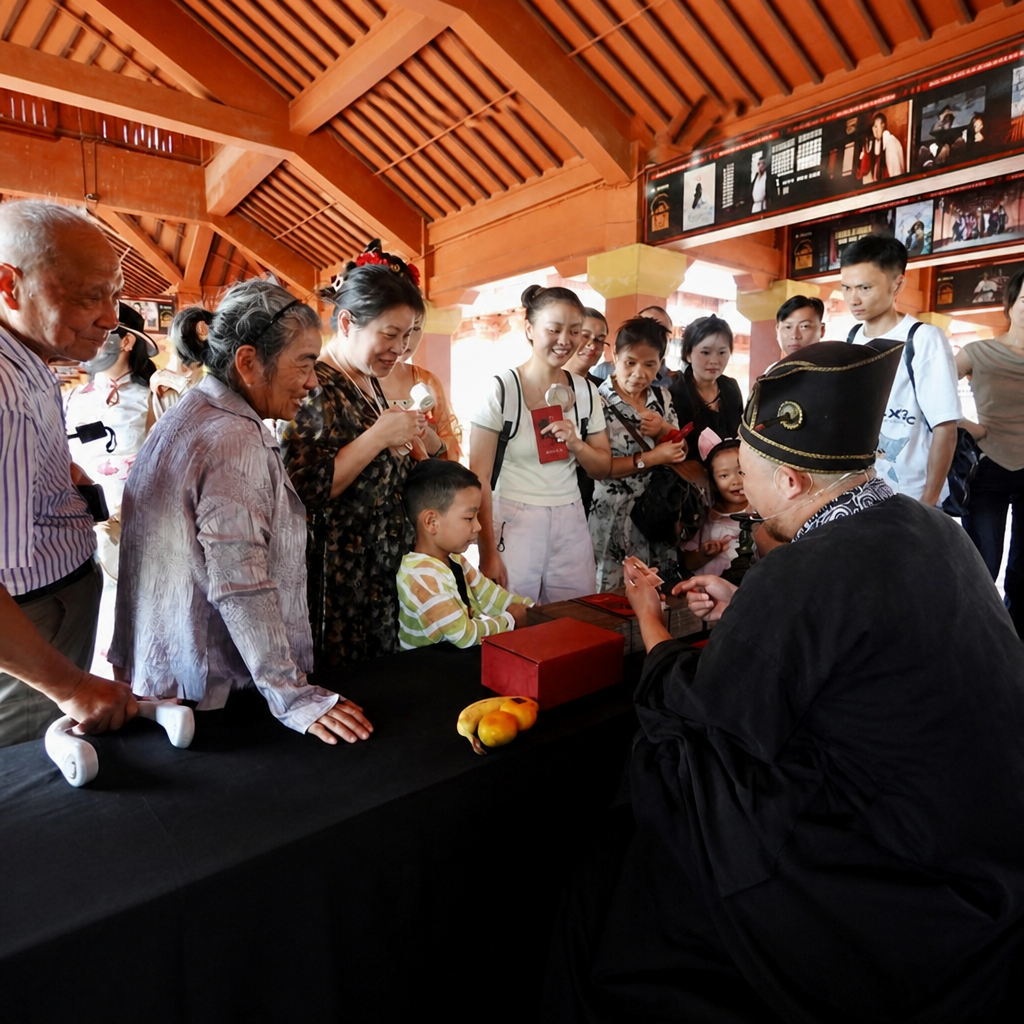
△ Hengdian NPC interaction — visitors can act alongside costumed performers, take photos, and even "solve cases" together (China News Service)
Over 20 themed performance shows run daily at Hengdian, with more than 100 street performances scattered throughout the scenic areas. The Flood Disaster Show unleashes 500 tons of water pouring from the sky — the mist hits your face with a cool dampness and the earthy smell of soil. The Danuo Performance uses masks and drumming to recreate ancient sacrificial rituals — drumsticks striking hide drums produce a sound so deep it seems to surge up from underground, making your chest cavity resonate. Walking down the street, you might stumble into a street performance at any moment — a "general" in full costume rides past on horseback, hooves clopping on stone paving in a crisp, rhythmic beat, fine dust swirling up into the air, sunlight turning the dust into golden shafts of light.
And then there is something at Hengdian that absolutely must be mentioned: the food. At the Imperial Banquet, dishes fill a long table — porcelain bowls clinking against porcelain bowls, every dish with a name, a story, a history. The Heroes' Feast is all about the spirit of the martial world — drinking from large bowls, eating big chunks of meat, the grease glistening on wooden tables under candlelight, fingers glistening after gnawing on bones. The Long Table Feast is about ceremony — dozens of people sitting face-to-face in two rows, the arcs of chopsticks reaching for food like a kind of choreography. After the meal, you step out of the restaurant, night wind pouring down your collar, carrying the scent of fireworks from a distant film set. The stars overhead are far more numerous than in the city — because Hengdian's sky is dark enough to see the Milky Way.
Tickets: Two-day pass (5 parks) ~369 RMB, including Qin Royal Palace, Ming-Qing Palace, Qingming Riverside Scene, Guangzhou-Hong Kong Street, and Dream Bund
Recommended Experiences: "I Was an Extra at Hengdian" micro-film shooting (advance reservation required), free hanfu costume rental, 6D dome flight show, night tour of Dream Valley
Best Time: Spring and autumn (Apr-May, Sep-Oct) for the most comfortable weather. Chinese New Year period has the densest programming.
Hidden Tip: Go to the Ming-Qing Palace at 6 AM to watch the sunrise — golden light spills across the glazed tiles with almost no other visitors. You can have the entire "Forbidden City" to yourself.
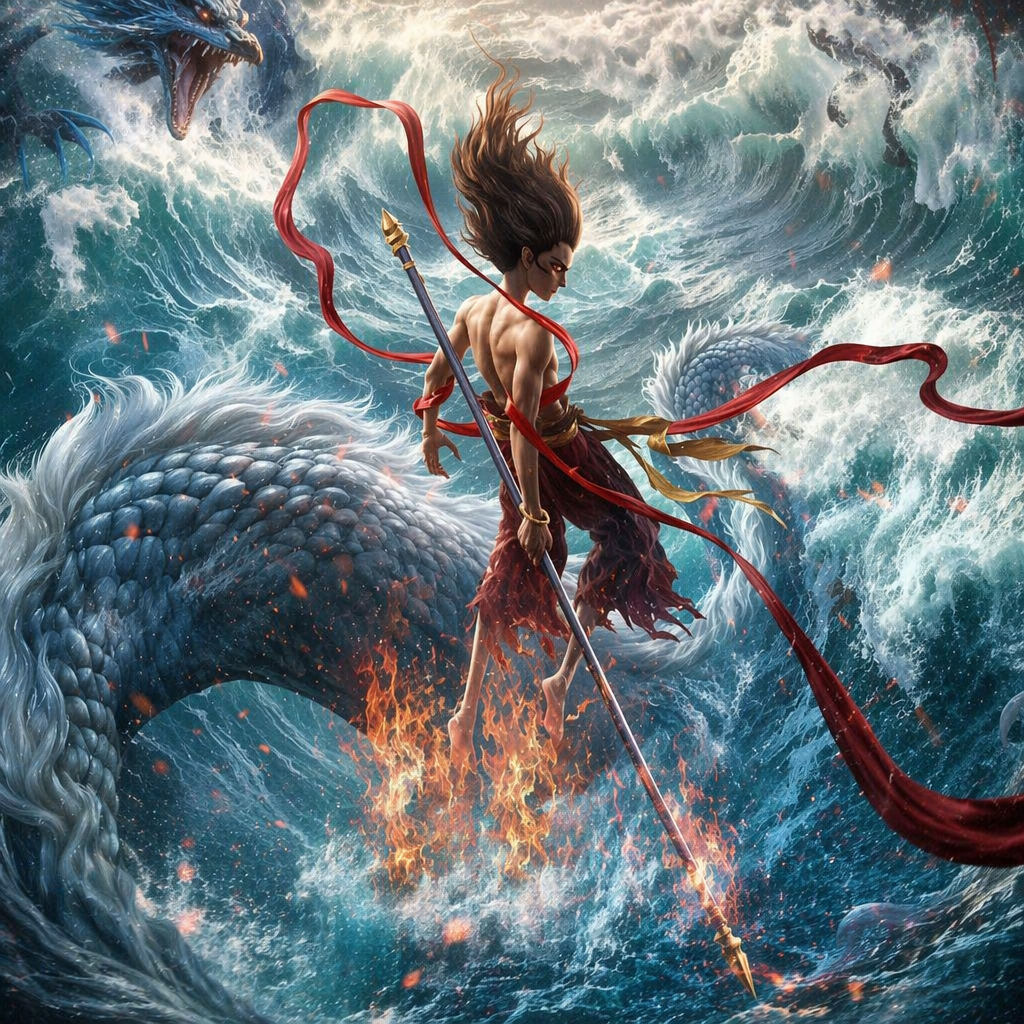
△ From the palace steps of Hengdian to the Dragon King battle on screen — the mythical scenes in the film have a real-world starting point here
A foreign audience member may have never heard of "Investiture of the Gods," may not know what a "Chaos Pearl" is, may not be able to tell the difference between the Chan Sect and the Jie Sect. But when they sit in a theater and see Ne Zha being shunned by the entire village, they will understand that feeling. Being labeled knows no borders — the child mocked at school for an accent, the young professional looked down upon in the workplace for a degree, the teenager attacked on social media for their appearance. Labels are the cheapest weapon in the world: they cost nothing, requiring only a glance or a single sentence.
Ne Zha's story crosses cultures because it is not about Chinese mythology — it is about a truth everyone understands: your identity is not determined by your birth. Ne Zha is the reincarnation of the "Demon Pill." By the Heavenly Court's rules, he is destined to be a monster. But he refuses to accept it. He shouts at destiny —
"My fate is mine, not heaven's."
— Ne Zha. This line has been printed on T-shirts, tattooed on arms, and written in college entrance exam essays. In Chinese: "我命由我不由天。"
In Western popular culture, similar themes are not hard to find. Harry Potter was considered for Slytherin by the Sorting Hat, but he chose Gryffindor. In Disney's "Frozen," Elsa fled the role of the "good princess." But Ne Zha's difference is that he is not fighting a specific villain — he is fighting an entire system. The Heavenly Court defines who is an immortal and who is a demon, who deserves to live and who should be refined into a pill. This is not one person's battle; it is a question posed by an underclass against the rules of the game.
There is a character in the film that is easy to overlook: Shen Xiaobao, Shen Gongbao's younger brother. A sunny little leopard spirit who worships his brother and wants to work at the Heavenly Court too. He trains diligently, finally manages to take human form, and runs joyfully to find his brother. What he doesn't know is that his brother does all the dirty work at the Court, that those demons who "cultivate to become immortals" end up thrown into the elixir furnace. Shen Gongbao looks at his brother's sparkling eyes and says nothing — just fobs him off with a lame excuse about "I'm about to be promoted." That image is more heartbreaking than any battle scene — a person who has seen through the truth, not knowing whether to tell his hopeful younger brother that the place he's desperate to enter is, in fact, a slaughterhouse.
Near the end of the film, the Dragon King of the Eastern Sea asks Ne Zha: "Do you really think you can change this world?" Ne Zha falls silent for a moment, then says: "I want to try." Three words. Light — like a feather drifting to the ground. But everyone in the theater heard it.
"The road ahead is yours to forge. From now on, be true to your own heart's choice."
— Ao Guang, the Dragon King of the Eastern Sea, speaking to his son Ao Bing. A father who has lived for thousands of years finally admits that his own experience may not be entirely right.
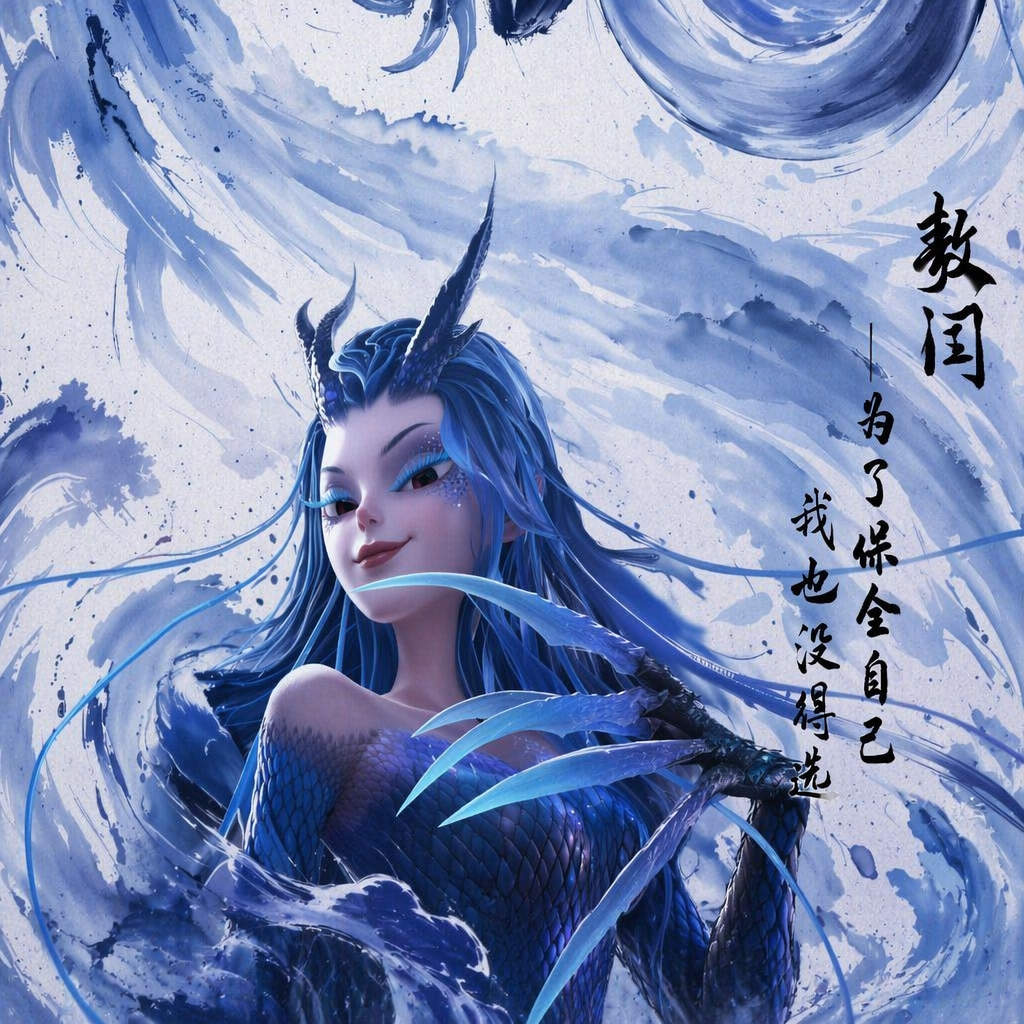
△ Ao Guang, Dragon King of the Eastern Sea — a father thousands of years old who ultimately learned to let go
This sentiment holds true in any culture. Japanese youth call it "jibun-rashiku" (be yourself). Americans call it "be true to yourself." The French say "sois toi-même." Different languages, the same meaning. The reason Ne Zha's story was seen by 324 million people and drew audiences in over twenty countries to buy tickets is not because it is so "Chinese" — but because it is real enough. Real things need no translation.
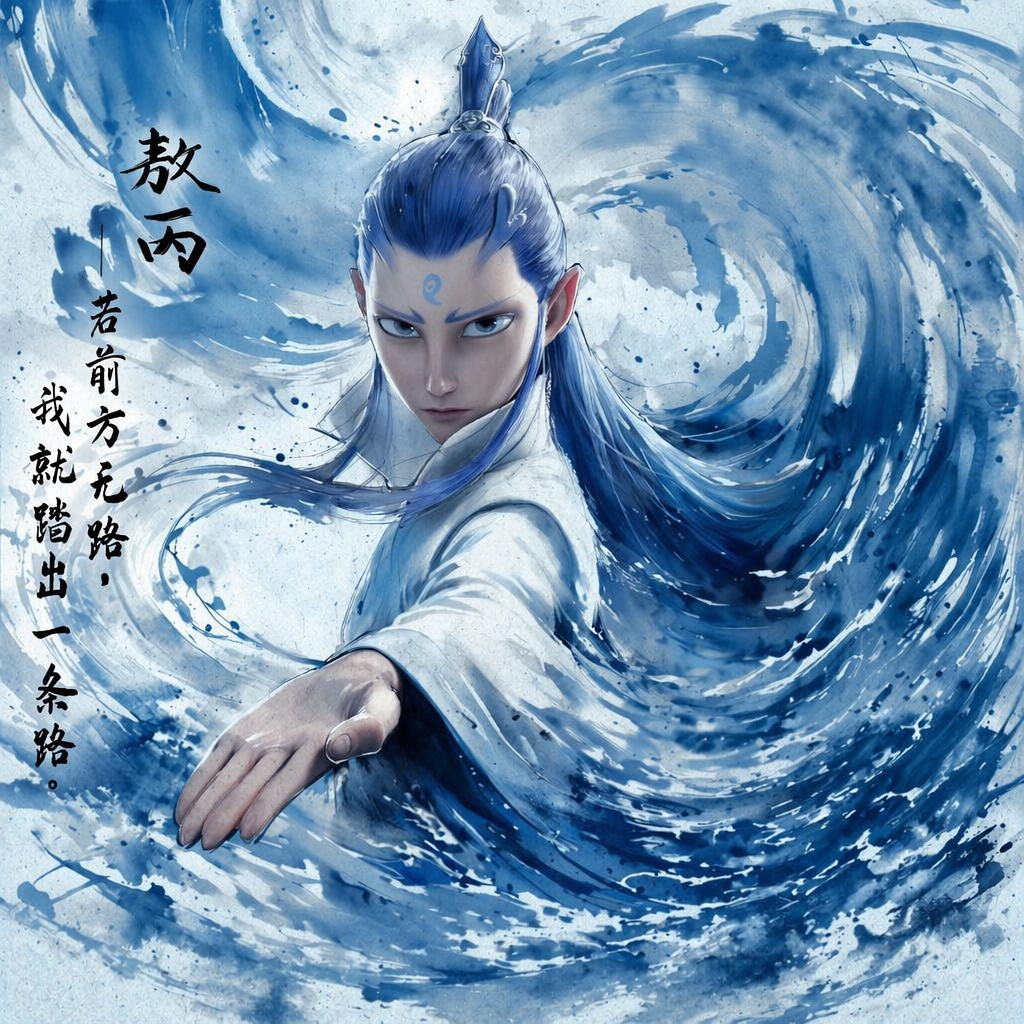
△ Ao Bing — the Dragon Prince reincarnated from the Spirit Pearl, mirror image of the Demon Pill Ne Zha, his destined twin and only true friend
There is one more layer in the film that perhaps even the director himself did not fully intend. Ne Zha has always been unhappy with his appearance — dark circles, buck teeth, short stature. When Ao Bing possesses his body, he becomes handsome and refined, and Taiyi Zhenren quips, "Now this looks like the genuine article." In the real world, countless people live inside filters, held hostage by society's definition of "beauty." In the end, Ne Zha accepts himself as he is — not handsome, not tall, dark circles, buck teeth. But he is Ne Zha. Being yourself is enough. This is said to Ne Zha, and also to every person sitting before the screen.
Back to that Chengdu theater at the beginning. The lights came on, the credits finished rolling, and the audience filed out little by little. Someone was rubbing their eyes. Someone was still sitting in their seat, not moving.
This film is available on Bilibili, Netflix, and other platforms, all with English subtitles. But some things cannot be felt through a screen.
Hengdian is in central Zhejiang Province — China's largest film and television production base. The majority of China's costume dramas and historical films are shot here. The steps of the Qin Royal Palace are much higher than you'd imagine. The red walls of the Ming-Qing Palace grow hot in the sunlight. The neon lights of Guangzhou Street don't come on until dusk. Put on a hanfu and walk the stone-paved roads — the wind blows in from a distant film set, carrying the sound of drums and galloping hooves.
Five hundred years of mythology, ten years of animation, two hours in the dark — in the end, it all lands on this piece of land. Come and see.
"My fate is mine, not heaven's."
"Being yourself is enough."
— Ne Zha is on the screen. Hengdian is in Zhejiang. Both are waiting for you. —