Farewell My Concubine
A Tragedy of Love, Opera, and History
That Night at Cannes in 1993
In May 1993, at the Cannes Film Festival awards ceremony, when the presenter announced that "Farewell My Concubine" had won the Palme d'Or, the entire venue exploded in applause. This was the first time a Chinese film had ever received this award — and it remains the only time to this day. The film won the highest honor at the 46th Cannes International Film Festival, shocking the entire Western film world.
France's Le Figaro wrote: "This is the first time China has won the top prize in Cannes history, and it remains the only Chinese film to receive this honor." Besides the Palme d'Or, the film also won the FIPRESCI Prize and earned a nomination for the Golden Globe Best Foreign Language Film. In 2003, Time magazine named it one of "The 100 Greatest Films of All Time."
The film also made box office history in America — it opened in 79 American art theaters and earned $5.22 million in early 1994, which is still the highest box office record for a Chinese art film in the US. In mainland China, it earned 40 million RMB.
Why could a film about Peking opera make people all over the world cry and applaud? The answer might lie in the man who played Cheng Dieyi — Leslie Cheung.
How a Hong Kong Man Became Cheng Dieyi
Before becoming Cheng Dieyi, Leslie Cheung was a superstar in Hong Kong — singing pop songs, acting in movies, an idol to millions. But in 1991, he met director Chen Kaige, and everything changed.
Chen Kaige later recalled their first meeting: "When I saw him, I thought he was Cheng Dieyi." Leslie Cheung just smiled and said nothing.
The biggest problem was: Leslie Cheung was from Hong Kong and had never learned Peking opera. The production team initially found two body doubles for him. But Leslie Cheung made a decision that surprised everyone — he went to Beijing half a year early to study Peking opera and Mandarin.
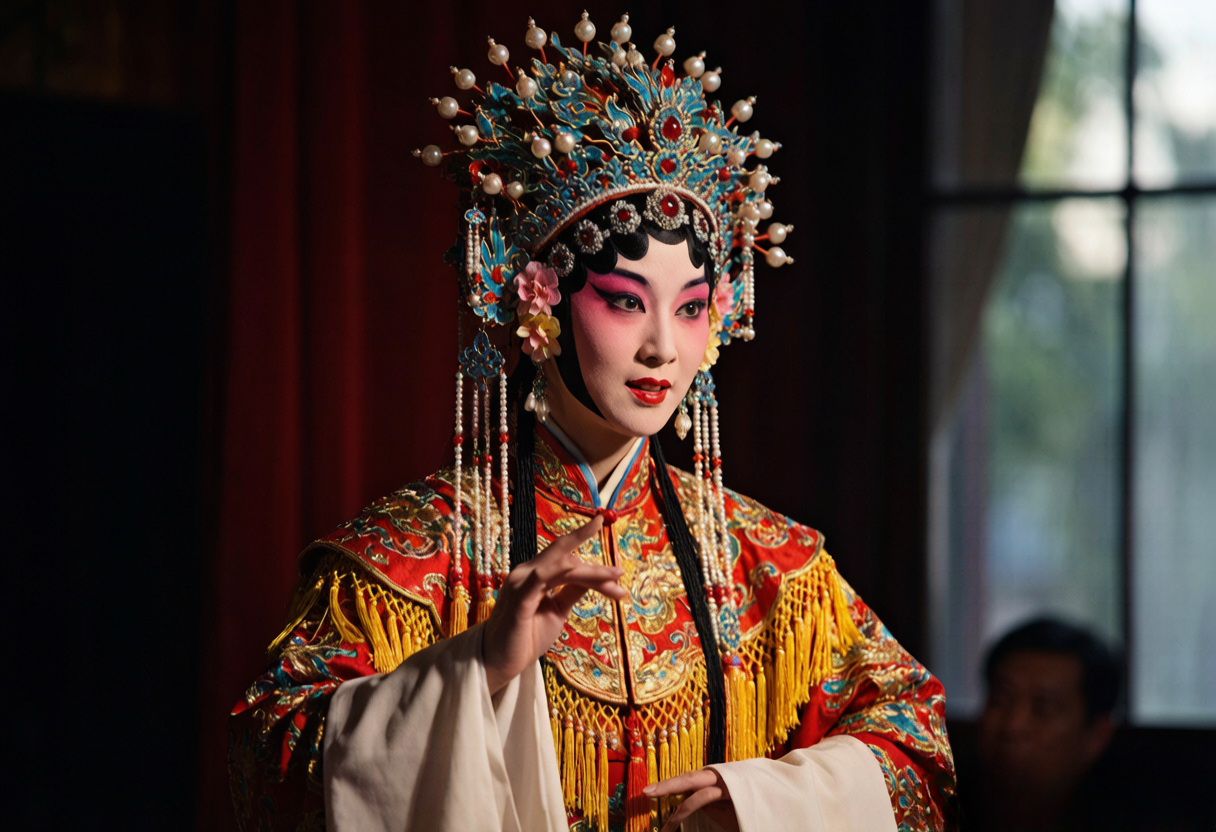
He studied with Peking opera master Zhang Manling for six months, starting from the most basic movements — how to swing "cloud hands," how to curl "orchid finger" gestures, every eye movement and body posture practiced over and over. Zhang Manling later said Leslie Cheung was extremely hardworking, practicing for long hours every day without complaint. The body doubles the team prepared were never used because Leslie Cheung learned so well.
Chen Kaige still remembers that moment — when Leslie Cheung put on the costume and makeup, stood before him and said: "Thank you for telling me this story. I am Cheng Dieyi." Chen Kaige later said: "That was a moment that made my hair stand on end."
Chen Kaige评价张国荣说:"If Leslie Cheung hadn't encountered Cheng Dieyi, his talent wouldn't have been fully revealed. In my view, Cheng Dieyi was actually a body he borrowed. When a person breathes and lives with the character he plays, he gives himself to that character."
Shortly after Leslie Cheung passed away, Chen Kaige had a dream. In the dream, Leslie Cheung was wearing his opera costume and a long gown, smiling slightly and saying "Farewell from now on." Chen Kaige suddenly woke up with tears in his eyes.
"If Leslie Cheung hadn't encountered Cheng Dieyi, his talent wouldn't have been fully revealed. Cheng Dieyi was actually a body he borrowed. When a person breathes and lives with the character he plays, he gives himself to that character."
— Chen Kaige on Leslie Cheung
From the Late Qing to the Cultural Revolution
The story of "Farewell My Concubine" spans from the late Qing Dynasty all the way to the Cultural Revolution — a period of over fifty years. The lives of two people are like two rivers, intersecting in the currents of history, then separating, never able to return to where they started.
But what the film is really about is not politics — it is Peking opera. The Peking opera "Farewell My Concubine" is one of Mei Lanfang's most classic works, the brightest pearl of 20th-century Peking opera art. From street stages in the late Qing, to refugee opera troupes during the war, to being criticized as "feudal dross" during the Cultural Revolution — the fate of Peking opera is the fate of Chinese culture.
Cheng Dieyi has a famous line: "We promised to be together for a lifetime — if it's short by a year, a month, a day, even an hour, it's not a whole lifetime!" On the surface, this is about love, but actually it is about opera. Cheng Dieyi internalized the role of Yu Ji into his own life — he could not tell stage from reality, could not distinguish opera from life. "Not being obsessed is not being successful" — this is the pinnacle of art, and also a form of resistance against reality.
Many foreigners think "Farewell My Concubine" is simply "a film about homosexuality." Actually its meaning is much deeper — the film uses the Peking opera stage as a mirror, reflecting human nature's relationship with era and history. On the surface it tells the love story of an opera singer, but essentially it describes the tremendous changes in Chinese society from the late Qing through the Cultural Revolution, and the fate of traditional Chinese opera art throughout this process.
Finding the Film's Traces in Beijing
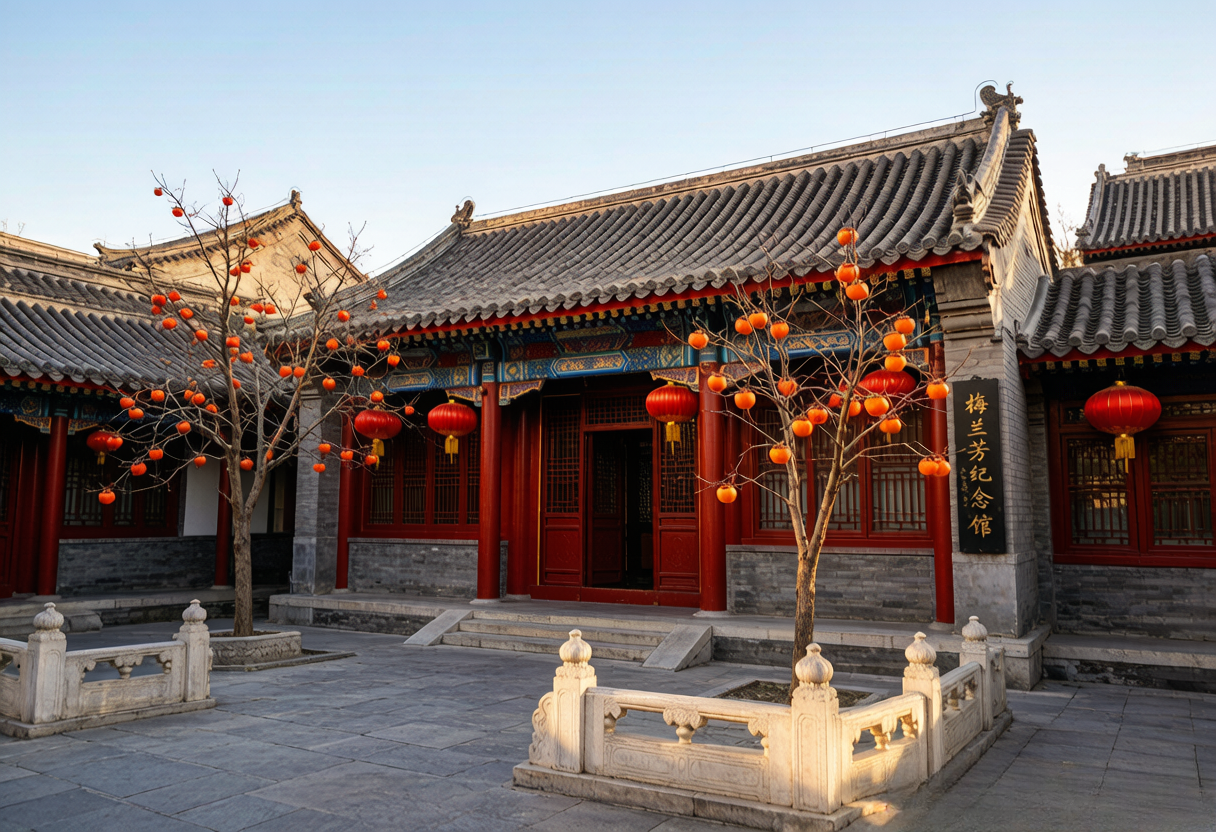
Most of "Farewell My Concubine" was filmed in Beijing. The scenes of Cheng Dieyi's home and the courtyard where he punishes Xiao Si were filmed at the Mei Lanfang Memorial Hall. Located at No. 9 Huguo Street in Xicheng District, Beijing, it is a typical old Beijing courtyard house. It was originally the stable of a prince's mansion, later renovated into a residence where Peking opera master Mei Lanfang lived from 1951 to 1961.
Walking into this courtyard, you will see two persimmon trees and two crabapple trees — symbolizing "everything safe and sound." In front of the screen wall made of blue bricks and grey tiles stands a white marble statue of Mei Lanfang. In spring, crabapple blossoms cover the trees; in autumn, persimmons hang red from the branches. When sunlight falls on the blue brick ground, you will understand why Chen Kaige chose this location — that stillness, that weight, is uniquely Beijing.
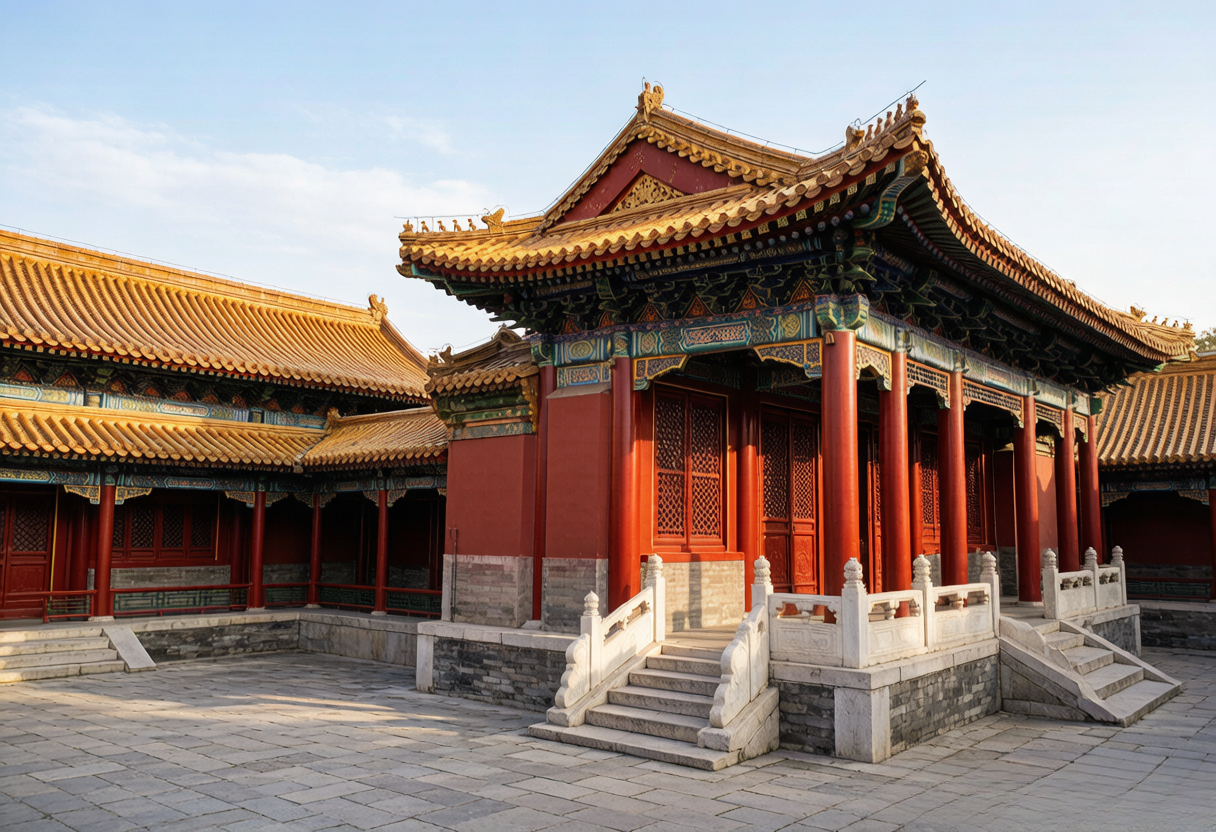
Prince Gong's Mansion is the largest princely mansion from the Qing Dynasty and an important filming location for the film. The long corridor scene where Little Douzi is taken away by the eunuch was filmed here. The corridor is特别长,一眼望不到头。 Walking on it, you will recall the heartbreaking scene from the film.
The Temple of Heaven (now Zhongshan Park) — the most shocking scene in the entire film, the struggle session, was filmed in front of the main hall. Cheng Dieyi and Duan Xiaolou are tied to the stage being criticized, their dignity trampled under people's feet.
"Farewell My Concubine" has eleven filming locations in Beijing. Besides three outside the city, the rest can be combined into several citywalk routes: from Prince Gong's Mansion to the former Fu Ren University to Mei Lanfang's former residence; from Ditan Park to the Confucius Temple; from the Forbidden City Gate to the corner tower. Walking these routes slowly, you will see half of modern Chinese history.
"'Farewell My Concubine' uses the Peking opera stage as a mirror, reflecting human nature's struggle within era and gender. Cheng Dieyi's obsessive pursuit of 'not being obsessed is not being successful' is both the pinnacle of art and a form of reality resistance."
Things You Can Do in Beijing Today
Mei Lanfang Memorial Hall tickets cost only 10 RMB (5 RMB for students, free for under 18 and over 60). Open Tuesday to Sunday 9:00 AM to 4:30 PM, closed Monday. Take the metro to Ping'anli Station Exit B and walk about 10 minutes. The area is not large, but you can spend a peaceful hour there. Standing under those persimmon trees and thinking about Cheng Dieyi's story, you will feel the money was well spent.
After watching the film, you can experience Peking opera in person at Liyuan Theater. This is run by the Beijing Peking Opera Company and Qianmen Hotel, established in 1990. You can watch opera while drinking tea, and the performance has English subtitles so foreigners can understand it too. "Watching Peking opera at Liyuan Theater is like visiting the Forbidden City and eating Peking duck — it's a must-do when you come to Beijing."
There is also Dian Jiangchun Peking Opera Space, which opened recently and is especially popular with foreign tourists. Since 2025, foreign visitors have more than doubled. During National Day, there are special performances where actors come down from the stage to interact with the audience, and you can learn a few moves yourself.
If you have more time, go to Tianle Yuan Grand Theater, located in Xianyukou near Qianmen. Subtitles are provided on both sides in both Chinese and English. During the intermission, there is an interactive session where you can try on costumes and learn about face painting.
In 2023, the Ministry of Culture and Tourism held the "Centennial Photography Exhibition of Peking Opera 'Farewell My Concubine'." The opera has been performed from Mei Lanfang's era to today. A visitor wrote: "Now that the film has been out for over 30 years, we are glad to see that Peking opera has not died like the film predicted."
Mei Lanfang Memorial Hall: 10 RMB, open Tue-Sun 9:00-16:30
Prince Gong's Mansion: 40 RMB
Liyuan Theater: Inside Qianmen Hotel, English subtitles
Tianle Yuan: Xianyukou, Chinese-English subtitles
The Opera Keeps Playing
"Farewell My Concubine" has been out for over 30 years, and Leslie Cheung has left us. But Peking opera still plays, the persimmon trees at Mei Lanfang Memorial Hall still grow, the corridors at Prince Gong's Mansion still stand, the great hall at the Temple of Heaven still exists. Every evening, different operas are still being performed in theaters across Beijing.
Cheng Dieyi said: "We promised to be together for a lifetime — if it's short by a year, a month, a day, even an hour, it's not a whole lifetime!" This sentence is not just about love — it is also about art. We promised a lifetime, short by a year, a month, a day, an hour — it is not a whole lifetime.
Next time you come to Beijing, stand at Mei Lanfang Memorial Hall, walk through Prince Gong's Mansion, watch an opera at Liyuan Theater. You will understand — the dream about opera, about people, about era, has always been there.
"We promised to be together for a lifetime — if it's short by a year, a month, a day, even an hour, it's not a whole lifetime!"
"Not being obsessed is not being successful"
— Mei Lanfang Memorial Hall · Prince Gong's Mansion · Liyuan Theater —