Wuxia · Oscar Winner
Crouching Tiger, Hidden Dragon
The Film That Brought Wuxia to the World
In 2000, a Chinese-language film quietly hit theaters. The director was Ang Lee, who was not particularly famous at the time. The stars were Chow Yun-fat, Michelle Yeoh, Zhang Ziyi, and Chang Chen. No one dared predict it would create any miracles, because before this, Chinese-language films had never really shone on the Oscar stage.
The story is not complicated: there is a legendary sword called the Green Destiny in the jianghu (the martial arts world), which triggers a series of conflicts. Li Mubai is a retired hero, and Yu Jiaolong is a young woman from a wealthy family who yearns for freedom. The two fly through the bamboo forest, speaking with swords and communicating with their eyes. There is a classic line in the film: "The jianghu hides crouching tigers and hidden dragons — is the human heart not the same?" — a line that people still quote to this day.
At the 2001 Academy Awards, Crouching Tiger received 10 nominations — the highest number of nominations ever for a foreign-language film. It ultimately won four awards: Best Foreign Language Film, Best Cinematography, Best Art Direction, and Best Original Score. It was not only the first foreign-language film ever nominated for Best Picture, but also the first foreign-language film to gross over $100 million in American box office history — $128 million in North America, $205 million worldwide, with a production budget of just $17 million. Time magazine later ranked it fourth among the top 10 classic films since 2000.
But Crouching Tiger brought far more than these numbers. Before this, when foreigners thought of Chinese martial arts, they imagined violent fight scenes. But Ang Lee showed the world: Chinese wuxia is not "kung fu fighting" — it is a philosophy of "lightness" — overcoming the hard with the soft, moving a thousand pounds with four ounces. Film critics noticed the color palette in the movie: "Blue and green tones run through the entire film — the gray-white of Beijing symbolizes the chains of Confucian ritual, the golden desert suggests primal desire, and the emerald bamboo forest becomes a visualization of Taoist spirit."
The word "wuxia" may not be familiar to foreign tourists. Simply put, "wu" means martial arts, "xia" means chivalry — a group of people with extraordinary skills who, for the sake of justice and belief, travel through the jianghu, drawing their swords when they see injustice. But in Crouching Tiger, Ang Lee showed a deeper wuxia spirit: it is not fighting for fighting's sake, but "letting go."
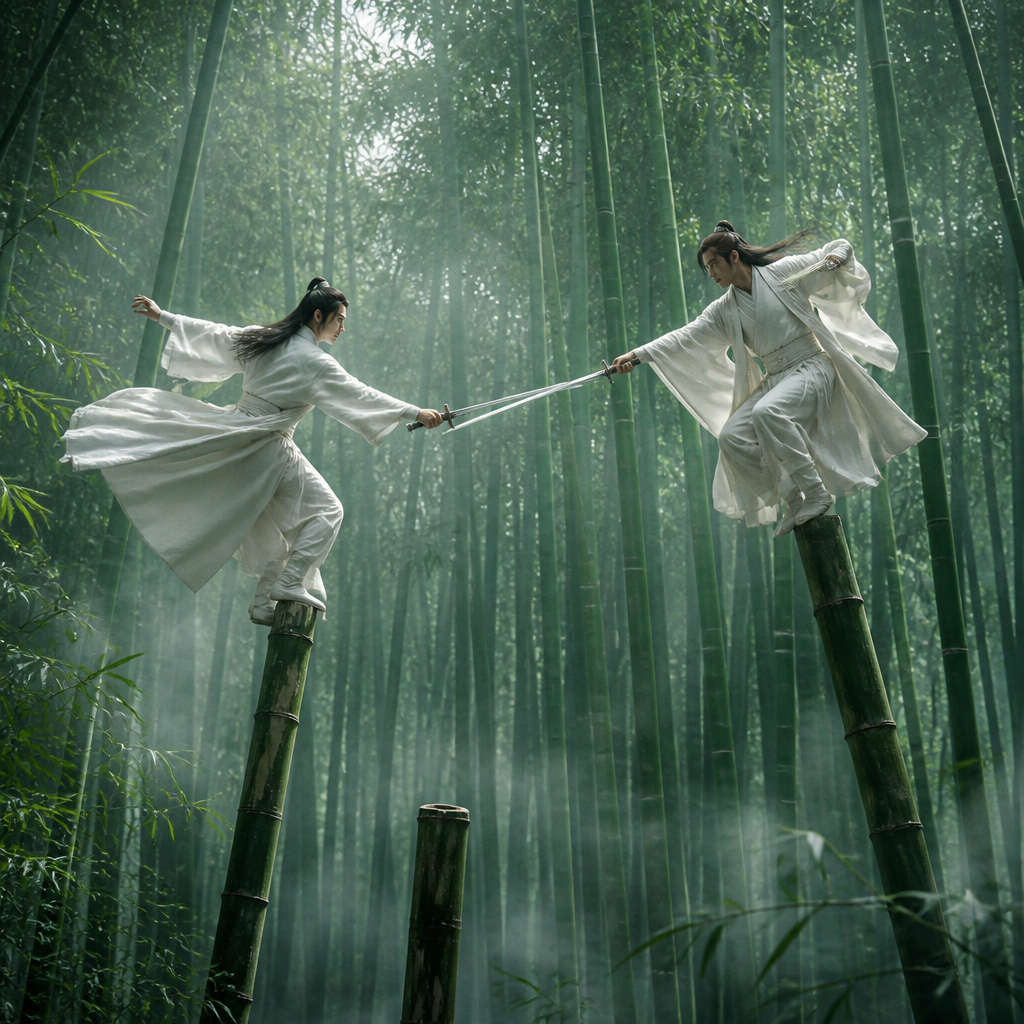
The most iconic bamboo forest duel scene — Chow Yun-fat and Zhang Ziyi standing on bamboo tips, the bamboo rising and falling, the two figures floating with the wind, swords flashing. Ang Lee later said that scene took two full weeks to film, each shot waiting for the wind, the light, the bamboo's curve to be just right. "This duel is not fighting — it is dancing."
Bamboo has never been just a plant in Chinese culture. "High character, upright integrity" — bamboo is hollow yet strong, symbolizing the virtue of a gentleman; bamboo stays green all year round, symbolizing resilience and perseverance; bamboo bends but never breaks, symbolizing flexibility and tolerance. So when Ang Lee chose the bamboo forest as the visualization of wuxia spirit, he was choosing a symbol that carries two thousand years of Chinese cultural memory.
This is why global audiences feel an inexplicable beauty when they see that bamboo forest — because that combination of "lightness" and "resilience" is the most familiar aesthetic to Chinese people. When you walk through a bamboo forest, you feel the soft fallen leaves beneath your feet, the dense bamboo leaves above your head, sunlight filtering through the gaps, and a faint sweet fragrance in the air — that is bamboo's unique scent, slightly cool, slightly sweet. You will understand why martial arts films use bamboo as their backdrop — because bamboo itself is a symbol of "xia" — seemingly fragile, but actually resilient.
"The jianghu hides crouching tigers and hidden dragons — is the human heart not the same?"
— Classic line from "Crouching Tiger, Hidden Dragon"
The cast of Crouching Tiger was not particularly star-studded at the time. Ang Lee's choice of Chow Yun-fat to play Li Mubai was a bold decision — at that time, "Brother Mc" was his most iconic image, playing a stylish modern gangster. Playing a refined ancient hero was quite a contrast. But that very contrast gave Li Mubai depth — he is not simply a "hero," but a man struggling between the jianghu and retirement.
Michelle Yeoh played Yu Xiu Lian, the character closest to "xia" in the film — traveling through the jianghu, valuing friendship and righteousness, with the free-spirited elegance of a江湖人. Her fight scenes flowed like water, no dragging whatsoever. There is a scene where she confronts Yu Jiaolong at an inn — two women staring each other down, and their eyes alone could kill. That scene had no special effects; it relied entirely on the actors' skills.
Most surprising was Zhang Ziyi, who was still a newcomer at the time. She played Yu Jiaolong with a wildness — refusing to be constrained, yearning for freedom, like a caged bird. Her fight scenes looked less like "kung fu" and more like dance, with a primal impulse and beauty. There is a scene of her chasing Yu Xiu Lian in the desert — the horses' hooves kicked up clouds of dust, and Zhang Ziyi was actually riding the horse, not suspended on wires.
And there was Chang Chen playing Luo Xiaohu — a bandit chief in Xinjiang who fell in love with Yu Jiaolong. The Xinjiang scenes, set against the backdrop of a setting sun over the Gobi Desert, with the two dancing by a campfire — that dance was completely improvised. Ang Lee let them play their own music and dance however they came. It was precisely this "naturalness" that gave that scene its vitality.
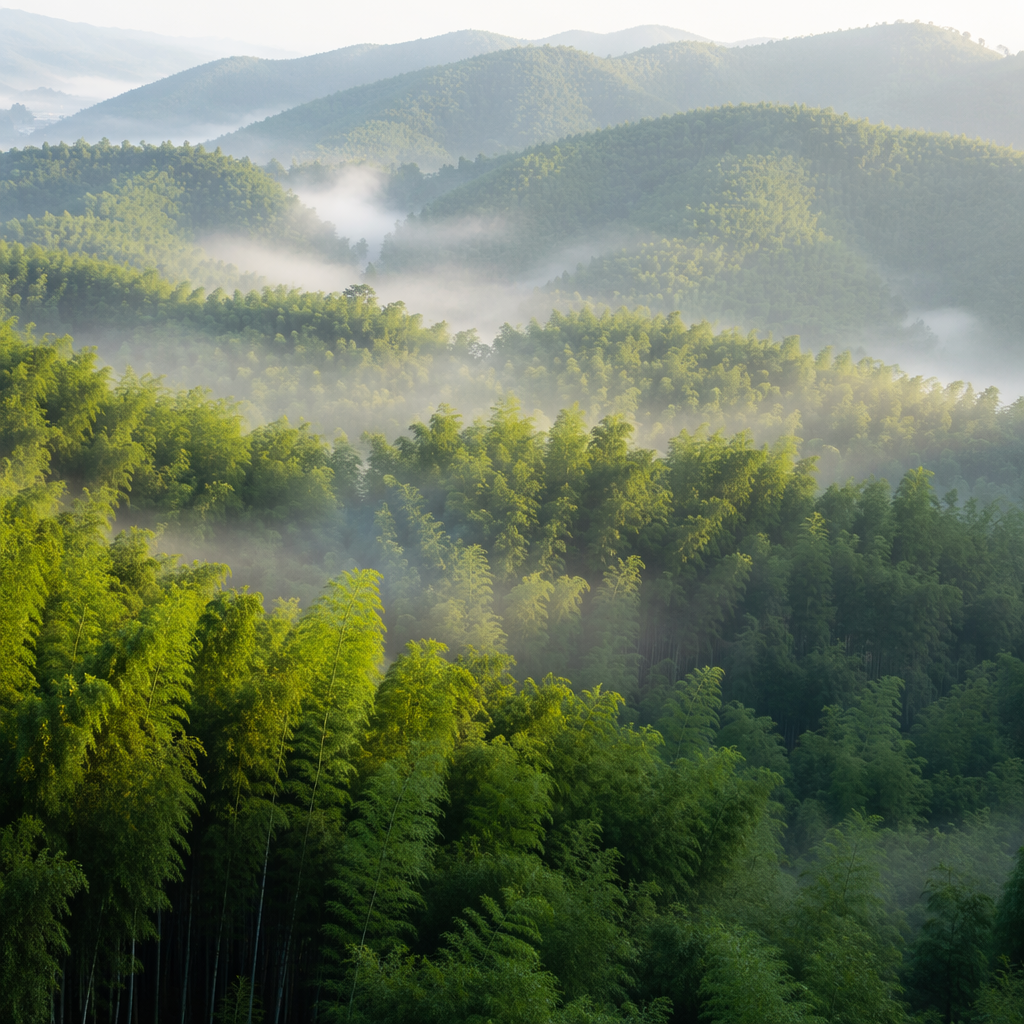
The bamboo forest scenes in Crouching Tiger were filmed in Anji, Zhejiang. Anji is located in the northwest of Zhejiang, at the northern foot of the Tianmu Mountains, covered with endless bamboo groves. It is China's famous "Bamboo Town." The bamboo there grows very tall, each stalk reaching for the sky, and when the wind blows, the bamboo leaves rustle like a symphony of nature.
When Ang Lee revisited Anji, he said: "It was Anji's beautiful landscape that brought 'Crouching Tiger, Hidden Dragon' to the Oscar stage!" Interestingly, several other bamboo scenic areas in China have claimed to be the filming location, but the only one thanked in the film's end credits is China Anji Bamboo Sea Scenic Area. Official certification, only this one.
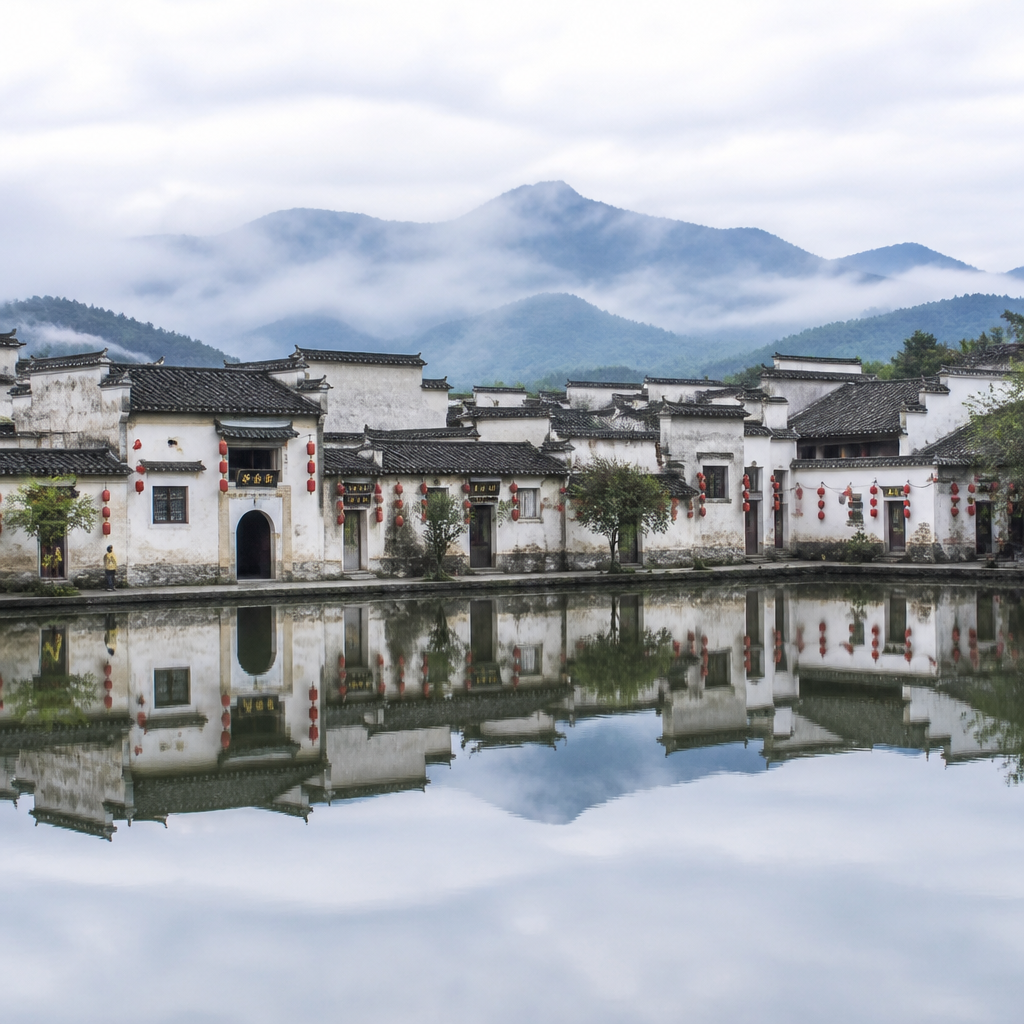
And the ancient bridge where Li Mubai led his horse in the film was filmed in Hongcun, Anhui. Hongcun was built during the Southern Song dynasty, over 800 years ago. In 2000, together with Xidi, it was listed as a UNESCO World Heritage Site. The village's most exquisite feature is its water system — the entire village is designed in the shape of a "cow": the Moon Pond is the "cow's stomach," South Lake is the "cow's belly," and the water channels are the "cow's intestines." This water system has been running for 800 years, serving as both landscape and fire prevention and water supply system.
When you walk into Hongcun, you will realize the water system was not dug at random — water is diverted from mountain streams, flows through the channels into the village, passes through the ponds in front of every house, and finally empties into South Lake. Trees and flowers grow along both sides of the channels, and in spring, peach and plum blossoms reflect on the water's surface — it is unbelievably beautiful. That scene, just a few seconds in the film — Li Mubai leading his horse across the painted bridge — made global audiences remember this "village in a Chinese painting."
Besides Anji and Hongcun, Crouching Tiger also filmed in other locations: the cliff in Cangyan Mountain, Hebei — where Yu Jiaolong made her final jump; the Gobi Desert and Tian Shan glaciers in Xinjiang — where Luo Xiaohu and Yu Jiaolong met. Each location is different, but each is undeniably China.
"It was Anji's beautiful landscape that brought 'Crouching Tiger, Hidden Dragon' to the Oscar stage!"
— Ang Lee on revisiting Anji
Anji Bamboo Sea ticket costs 58 RMB, plus 90 RMB for the glass walkway. It is about 1 hour's drive from Hangzhou and about 3 hours from Shanghai. Self-driving is recommended. The scenic area is huge — 6.67 million square meters, equivalent to nearly 1,000 football fields. Standing on Guan Zhu Tower, you can overlook the endless bamboo sea. Close your eyes and you can hear the rustle of bamboo leaves in the wind — that is natural white noise. Listen for a while and you will feel drowsy, especially suitable for city tourists seeking a "sound SPA."
There is also a "Crouching Tiger, Hidden Dragon" monument in the area, and taking photos in hanfu (traditional Chinese clothing) is very popular. The "hero photos" you see online were almost certainly taken in front of that stone. The scenic area also has a bamboo slide — sitting in a sled-like vehicle and sliding through the bamboo forest, the speed is not too fast, but on both sides are green bamboo trees, and that feeling is like flying through the bamboo.
Hongcun ticket costs about 94 RMB, about 1 hour's drive from Huangshan city center. It is best to go in early morning or evening when the light is best. The Moon Pond reflecting white walls and dark tiles looks like an ink painting. There are many places to explore: South Lake Bridge — the bridge Li Mubai led his horse across in the film; Moon Pond — the most classic view; Chengzhi Hall — known as the "Folk Forbidden City," with wood carvings so detailed they will give you goosebumps; and the water channels — part of villagers' lives for 800 years, walking alongside you can hear the flowing water.
Next to Hongcun is a village called Tachuan, which is most beautiful in autumn — maple leaves cover the hills, paired with the white walls and dark tiles of Huizhou architecture, that is a natural oil painting. But that requires a separate ticket, not part of the Hongcun scenic area.
A reasonable route: Day 1 arrive in Huangshan, tour Hongcun, stay in Hongcun or downtown Huangshan; Day 2 drive about 3 hours to Anji, stay overnight; Day 3 tour the bamboo sea and return. About 3 days, 2 nights, a relaxed pace.
"Walking deep into the bamboo sea, the green is so thick like unmixed paint, even my breath is wrapped in bamboo fragrance. When the wind blows, the bamboo leaves rustle, and all my worries seem to be crushed by this freshness."
— Xiaohongshu visitor
The score for Crouching Tiger was composed by Tan Dun. He is a famous Chinese composer who also did the music for "Hero" and "The Samurai." His music has a kind of "ethereal" quality — mostly using traditional Chinese instruments: erhu, pipa, guzheng, and horsehead fiddle, occasionally interspersed with cello and orchestra, but the main body is Chinese-style remoteness.
The most classic "bamboo forest" melody uses the horsehead fiddle — that melodious sound, like running across the vast grassland, like floating in the clouds. Matched with the scene of Chow Yun-fat and Zhang Ziyi flying on bamboo tips, it really makes viewers feel an urge "to fly." That melody has since been used by countless people as ringtone and background music — showing just how widespread it is.
Tan Dun later won the Oscar for Best Original Score for Crouching Tiger. This was the first time a Chinese composer received this award. When accepting the award, he said: "I hope that through my music, the world can hear China's voice."
Anji Bamboo Sea: 58 RMB, glass walkway 90 RMB, 1 hour from Hangzhou
Hongcun: 94 RMB, about 1 hour from Huangshan
Recommended: Hongcun + Anji, 3 days 2 nights
Crouching Tiger was released over 20 years ago, but that bamboo forest is still growing, that ancient village is still flowing with water. The movie is fake, but the scenery is real — when you go there, stand in the same spots, feel the same wind, hear the same rustle of bamboo leaves, you will understand why Ang Lee said that bamboo forest "becomes a visualization of Taoist spirit."
Some stories feel one way when you watch the movie; standing on the land where the story took place feels completely different. Ang Lee used a sword, a bamboo forest, and an ancient village to show the world the possibilities of Chinese cinema, and to make the world remember China's scenery.
Next time you visit China, take a walk through Anji's bamboo forest, sit by Hongcun's water. You will find that the dream about swords, bamboo, and "overcoming the hard with the soft" is still there waiting for you.
"Blue and green tones run through the entire film — the gray-white of Beijing symbolizes the chains of Confucian ritual, the golden desert suggests primal desire, and the emerald bamboo forest becomes a visualization of Taoist spirit."
— Film critic color analysis
"Overcoming the hard with the soft"
— Anji Bamboo Sea · Hongcun —