Buddhist Art · UNESCO
Yungang Grottoes
45 Caves, 59,000 Buddha Statues
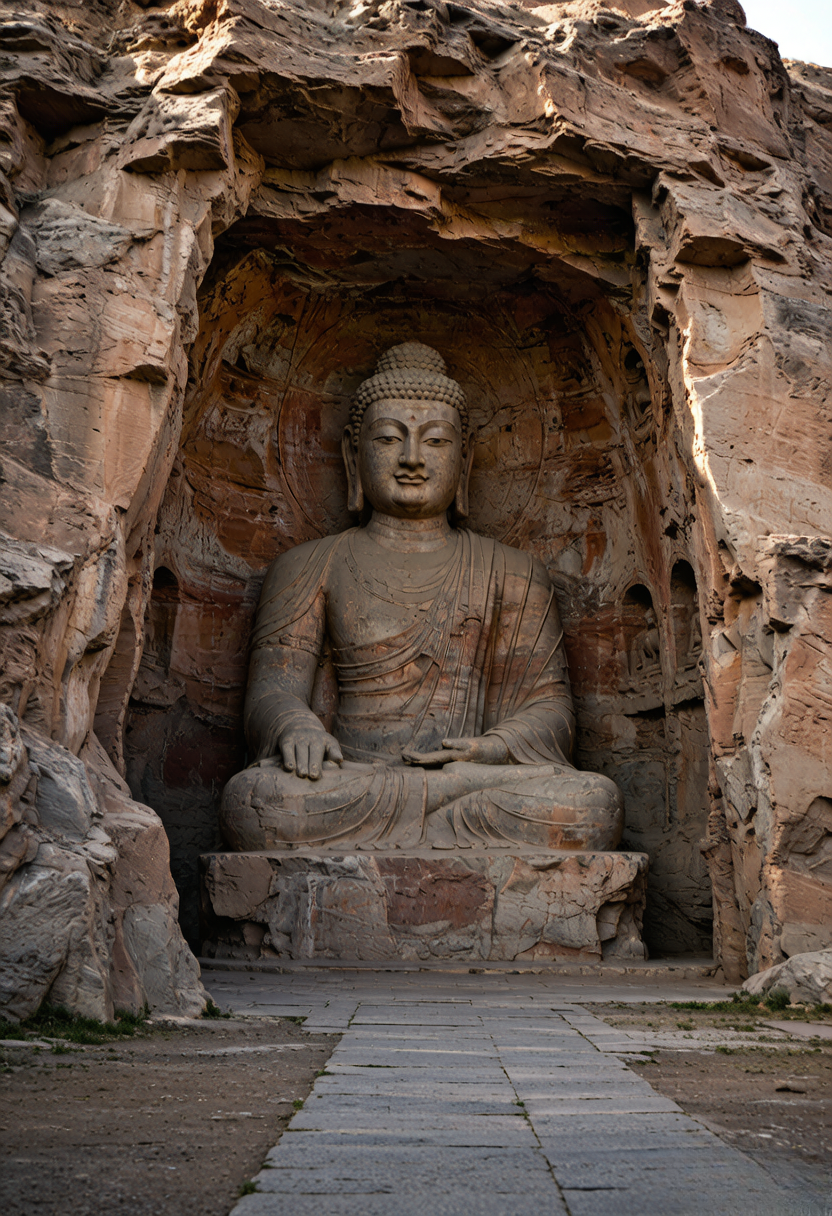
You stand in front of Cave 20 and look up. The 13.7-meter open-air Buddha sits before you, his eyes lowered, eyelids gently closed as if in deep contemplation, yet simultaneously seeming to gaze upon all living beings with boundless compassion. His lips curve slightly upward, carrying a mysterious yet warm smile — a smile that seems to have seen through everything, to encompass everything, to understand the countless joys and sorrows of human existence.
The wind from Wuzhou Mountain sweeps down from the north, carrying the distinctive dry and rough air of the Loess Plateau, brushing against your cheeks and stirring something profound in your heart. Sunlight pours down from above at an angle, falling upon the Buddha's face, and the stone — weathered by 1,500 years of elements — transforms in the light to reveal a warm ochre hue, its layered textures seeming to tell stories of countless years passing by. You cannot help but reach out your hand, wanting to feel this stone that has carried millennia of faith — it is cool to the touch, its surface rough and uneven, marked by the traces of wind and rain, yet these very imperfections make it feel more real, more awe-inspiring.
1,500 years ago, there was no electricity, no modern machinery, no precision measuring instruments. A group of artisans brought only simple hammers and chisels, carving the stone piece by piece, inch by inch, dedicating decades or even centuries of their lives to transform this silent mountain rock into solemn Buddhist statues. 1,500 years later, you stand here, and the Buddha still has that same expression — compassionate, serene, accepting — as if time has frozen upon him, as if he has been waiting for your arrival all along.
This is the Yungang Grottoes — China's first royal-sponsored cave temple complex, a legendary story about faith, power, and art intertwined throughout Chinese history. 1,500 years later, you can still stand before these giant Buddhas and feel the dreams, ambitions, and most sincere faith of that dynasty.
"The mountains were carved and rocks opened, structures were built upon the cliffs. The true visages are immense and majestic, rare in the world. Mountain halls and water pavilions, temples shrouded in morning mist, forests and deep pools like brocade mirrors — new sights to behold."
— Li Daoyuan, "Commentary on the Water Classic"
In 460 AD, Emperor Wencheng of Northern Wei made a decision that would change the history of Chinese Buddhist art: he commanded a Western Regions monk named Tan Yao to supervise the carving of five massive cave temples. These are now known as Caves 16 through 20, later called the "Five Tan Yao Caves" by posterity. This was an unprecedented move — before this, although caves existed in China, there had never been a precedent of an emperor personally ordering and mobilizing state power to construct such a project.
Who was Tan Yao? Legend says he was a learned monk from the Western Regions, profound in Buddhist wisdom and doctrine. One day, the Northern Wei emperor went out with a magnificent procession, horses magnificent and grand. Tan Yao stood by the road watching. Someone asked him: "Master, what are you looking at?" Tan Yao replied: "I see these horses recognizing the good person." This meant that the emperor was a person of virtue, worthy of respect. This is the origin of the famous Chinese historical anecdote "horses recognize the good person."
Emperor Wencheng was deeply moved by this, so he decided to let Tan Yao supervise this great project. He had caves carved into the cliffs of Wuzhou Mountain, blending the compassion of Buddhism with the majesty of imperial power.
The five principal Buddhas in the Five Tan Yao Caves each carry their own symbolic meaning — they represent the five emperors of Northern Wei: Emperor Daowu, Emperor Mingyuan, Emperor Taiwu, Emperor Jingmu, and Emperor Wencheng. This concept of "worshiping the emperor is worshiping Buddha" perfectly merged secular power with religious faith. An emperor had the faces of himself and his ancestors carved into Buddhas — this was the ultimate expression of power and the most sincere declaration of faith.
Yungang Grottoes is the first large-scale cave temple complex in China sponsored by royalty since Buddhism was introduced to China. It is not merely a religious site, but also a political symbol, a cultural declaration. From Yungang onward, China's cave temple art entered a completely new era, laying the foundation for later masterpieces like the Longmen Grottoes and the Mogao Caves at Dunhuang.
You might think Yungang Grottoes are just "Chinese Buddhist statues" — but that would be a major misunderstanding. The most breathtaking aspect: the statues here integrate artistic elements from India, Central Asia, Greece, Rome, and Persia, making it essentially an open-air museum of world art.
Look at those pillars and decorations — you'll find the graceful curves of Greek Ionic capitals, the typical contours of Indian stupas, Persian金银花纹 patterns. Various cultural elements converge and fuse here, forming a unique Yungang style. In a Chinese cave, you see artistic symbols from around the world — this is not coincidental, but a true reflection of "globalization" 1,500 years ago. The Silk Road brought not only silk and spices, but also the exchange and collision of art, faith, and ideas.
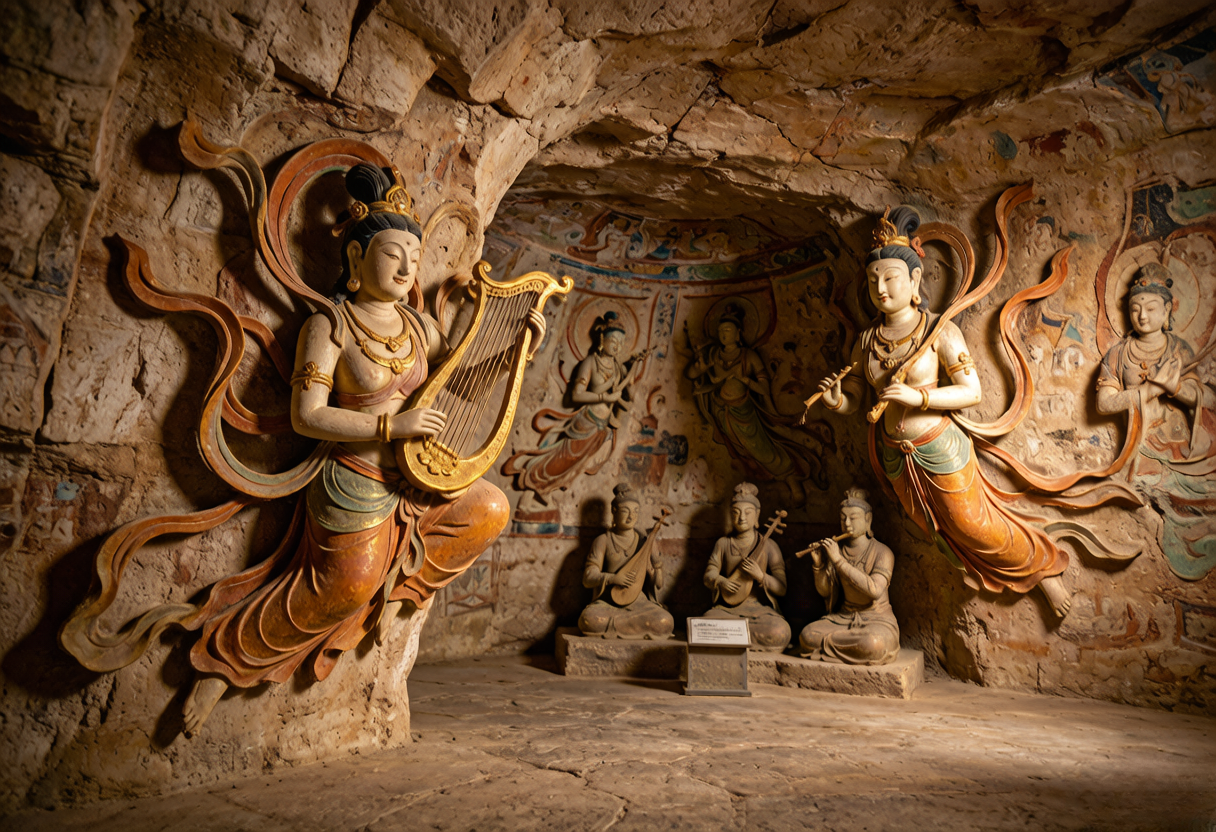
Cave 12 is called the "Music Cave" or "Buddha's Sound Cave" — flying apsaras (fairies) covering the walls hold various musical instruments: transverse flutes, harps, lutes, five-string instruments, waist drums... These reliefs are so detailed that you can even see every string of each instrument. This is a Northern Wei concert on stone — Central Asian and Chinese instruments playing together in one cave, the musical traditions of the Central Plains and Western Regions blending here. 1,500 years ago, Chinese artisans were already absorbing and integrating foreign cultures, transforming them into their own artistic language.
"1,500 years ago, this was already a product of 'globalization.'" This statement is no exaggeration. The existence of Yungang Grottoes is the most vivid testimony to the cultural exchange along the Silk Road.
Did you know? The open-air Buddha in Cave 20 that captivates countless visitors was originally not open-air at all. 1,500 years ago, it was a complete cave, the front wall intact, the Buddha seated within the cave, sheltered from the elements.
However, in the first year of Yanchang (512 AD), a magnitude 7.5 earthquake struck Wuzhou Mountain. The mountain collapsed and rocks tumbled; the front wall of Cave 20 collapsed on a large scale in this disaster. That collapse lasted 1,500 years. When the dust settled, people discovered with amazement that the principal Buddha, originally hidden deep within the cave, had actually "broken through the wall" and was exposed to the heavens and earth.
This accidental natural disaster instead created the most iconic image of Yungang Grottoes — the mysterious and warm smile of the open-air Buddha, called the "Oriental Smile" by countless art enthusiasts. That smile transcends the boundaries of language and culture, striking directly into the depths of every soul. Countless travelers come from far away, just to see this Buddha with their own eyes.
Today, "high-fiving with the Buddha" offset photos have become a viral sensation on social media — tourists extend their hands in a high-five pose, using angles and perspective to create fun interactive photos with the Buddha's palm. This modern trend showcases the wonderful collision between ancient art and youthful culture.
Sometimes, the greatest artistic masterpieces are born from coincidence. A natural disaster accidentally created the most moving image of Yungang Grottoes — perhaps this was destined in some mysterious way.
"The Yungang Grottoes are a world cultural heritage site. Protecting them well is not only of significance to China, but also to the world."
— President Xi Jinping (2020)
Yungang Grottoes are located on the southern slope of Wuzhou Mountain, 16 kilometers west of Datong City, Shanxi Province. Transportation from downtown Datong is very convenient. Whether you choose the most cost-effective bus or a comfortable taxi, you can easily reach this thousand-year treasure house of art.
🚌 Bus (Best Value) — Take bus 3 or 603 tourist line from downtown Datong, direct to the East Gate of the scenic area. Fare is only 2-3 RMB, journey takes about 40 minutes. Along the way, you can also enjoy the city scenery of Datong.
🚄 High-speed Rail — Datong South Station has direct shuttle buses to the scenic area, 10 RMB per person, about 40 minutes to the cave entrance. Convenient and efficient.
🚕 Taxi — Round trip from Datong Ancient City costs about 35-50 RMB, only 25 minutes. Suitable for travelers with tight schedules or more luggage.
Tickets: Peak season (April 1 - October 31) 120 RMB, off-season (November 1 - March 31) 100 RMB. Students with valid ID enjoy half-price discount, seniors 60+ and children under 1.2m enter free.
⚠️ Extremely Important: You MUST book 1-15 days in advance on the "Yungang Research Institute" official WeChat mini-program with real-name registration! The scenic area does not sell on-site tickets for individual visitors. Those without advance booking cannot enter — remember to plan ahead! Tickets include all caves, Lingyan Temple, and Yungang Museum, with re-entry allowed within 3 days.
Opening Hours: Peak season 8:30-17:30 (last entry 16:30), off-season 8:30-16:30 (last entry 16:00). Summer hours (July-August) adjusted to 7:30-18:00. Open every day including Mondays throughout the year.
• Cave 20 — Open-air Buddha — Symbol of Yungang, 13.7 meters tall, known as the "Oriental Smile." Best photo lighting 9-11 AM with front light.
• Caves 16-20 (Five Tan Yao Caves) — Earliest royal caves at Yungang, five Buddhas correspond to five Northern Wei emperors. Western Regions rough carving style, magnificent and powerful.
• Cave 5 — Largest Buddha at Yungang, up to 17 meters tall. Standing at the Buddha's feet, visitors are not even as tall as the Buddha's toes.
• Cave 6 — "Yungang's Greatest Cave," central pillar 14.4 meters high, walls covered with reliefs telling the life story of Buddha.
• Cave 12 (Music Cave) — Flying apsaras holding ancient musical instruments, known as the "Northern Wei Concert on Stone."
New Experience: The "Explore Yungang" XR immersive exhibition launched in July 2025 uses digital modeling, sensor interaction, and LBE large-space technology. Visitors wearing VR glasses can "travel back" to Northern Wei times, personally experiencing the carving scene of the thousand-year-old grottoes. The Yungang digital exhibition hall has already attracted over 12 million online visitors.
Best Visiting Time: 8:30-9:00 AM is the optimal time — sunlight at this angle shines into the caves, allowing you to see many details clearly. After 3 PM, the interplay of light and shadow is strongest, perfect for photography. The secret to avoiding crowds: reverse your route — go from Cave 20 toward Cave 1, allowing more从容 enjoyment compared to the regular route.
Italian tourist Claudia stood in front of Cave 20 and exclaimed: "So amazing! This has been a journey I've been looking forward to for a long time." A New Zealand tourist said: "Before this, I only saw pagodas and temples in movies. Coming to Yungang Grottoes was shocking — all the stone carvings here are awe-inspiring."
🎫 Tickets: Peak 120 RMB, off-season 100 RMB, students half price, seniors/children free
🚌 Transport: Bus 3/603 from Datong, 2-3 RMB
⏰ Open: Peak 8:30-17:30, off-season 8:30-16:30
📱 Booking: Must book on "Yungang Research Institute" mini-program in advance
🕐 Suggest: 2.5-3 hours, morning or after 3pm best light
1,500 years ago, the first artisan's chisel first hit the stone of Wuzhou Mountain, producing a crisp sound. That sound traveled through the long tunnel of time, through the changes of dynasties and the passage of ages, reaching all the way to today. You stand in the same place, listening to this echo spanning a thousand years.
"Protecting Yungang Grottoes well is not only of significance to China, but also to the world." President Xi Jinping's words still echo in our ears. This is not merely the protection of a cultural heritage site, but the safeguarding of humanity's shared memory.
Next time you visit China, don't just go to Beijing to see the Great Wall, don't just go to Xi'an to see the Terracotta Warriors. Go to Datong, go to Yungang Grottoes — some history is not written in books, it is carved in stone. Standing before these Buddhas, you don't need to understand Chinese, you don't need any background knowledge to feel that temperature and power bridging 1,500 years. The stone will tell you in its own language: what is faith, what is art, what is civilization shared by all humanity.
"From Northern Wei emperors to today's tourists, from Western craftsmen to Greek columns — Yungang Grottoes is world history carved in stone." The road to the glorious Tang Dynasty still extends beneath your feet.
"The Yungang Grottoes are a Northern Wei history book carved in stone, a road leading to the glorious Tang Dynasty."
"The Northern Wei Epic Carved in Stone"
— Datong, Shanxi · Yungang Grottoes —